P
Loading blog...
Loading blog...
Higher research budgets are not going to more researchers. They are going to fewer, more verified ones.
Samir Haddad
Mar 29, 2026•3 min read
Something has shifted in how research clients hire. Budgets are up in many sectors, demand for insights is higher than it has been in years, and yet many researchers are finding it harder, not easier, to win projects. The market is growing but the pool of trusted researchers clients are willing to hire is shrinking.
That sounds like a contradiction. It is not.
Qualtrics' 2025 Market Research Trends Report found that 67% of cutting-edge research teams reported an increase in research budget, and 71% said their organizations were leaning on their insights more heavily for strategic decisions. When research feeds directly into million-dollar business or policy decisions, clients stop treating researcher selection casually.
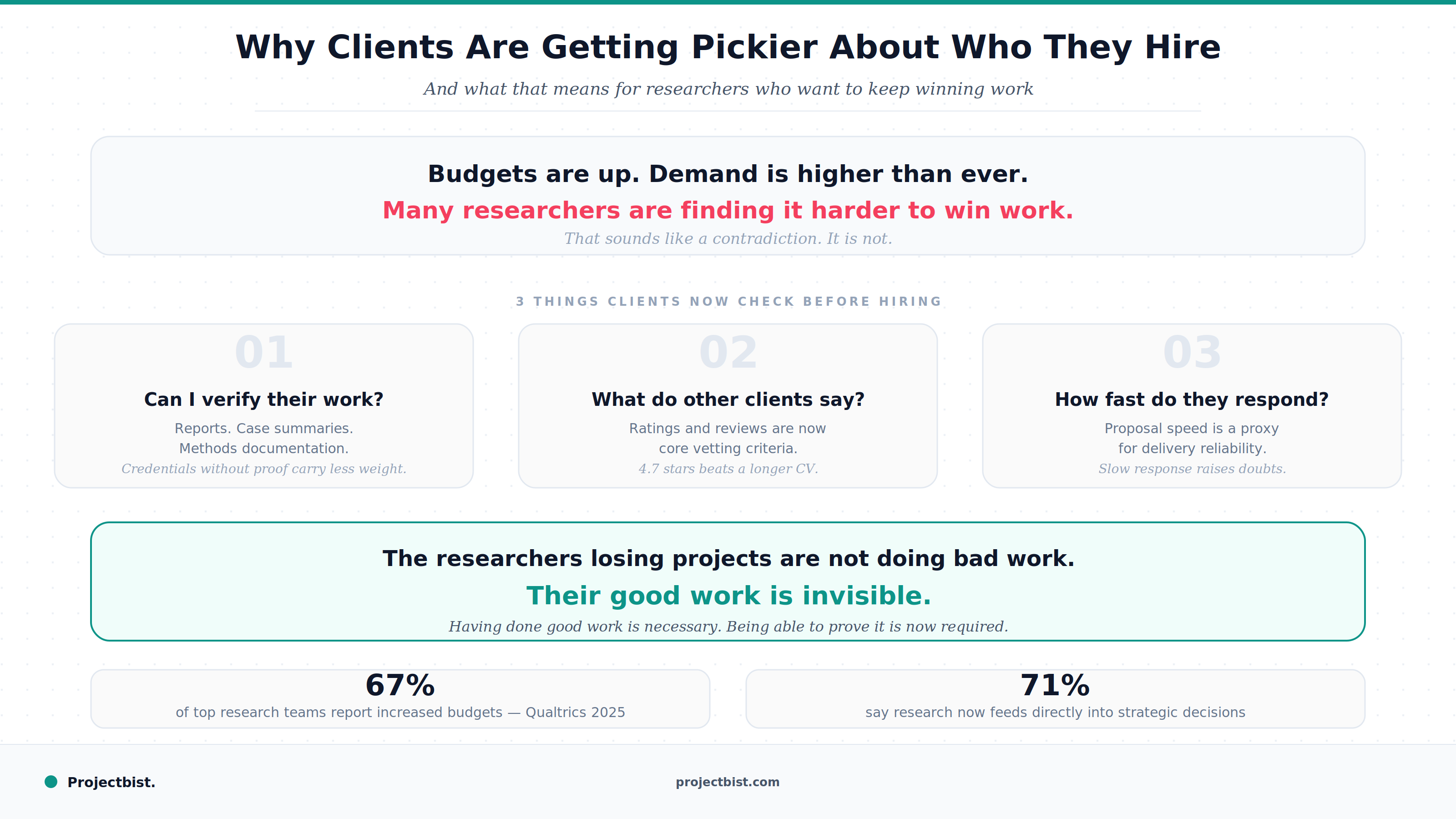
Across different sectors, research buyers are converging on the same vetting criteria. They want to know three things before they commit.
Not just a list of past clients, but evidence: reports, case summaries, methods documentation, or client testimonials that demonstrate how a researcher works, not just that they have worked. Credentials without proof carry much less weight than they used to.
Ratings and reviews are now a core part of how clients evaluate research professionals, particularly for clients who are hiring someone for the first time. A researcher with 12 completed projects and an average 4.7 rating is easier to trust than one with a longer CV and no client feedback trail.
This one catches many researchers off guard. Responsiveness during the proposal stage has become a proxy for how reliable a researcher will be during project delivery. A slow proposal response raises doubts about field team coordination, timeline management, and communication under pressure.
For clients, higher selectivity means better outcomes. They are spending the same or more money on research but getting better-matched researchers with documented track records.
For researchers, it means the bar has moved. Having done good work is necessary but no longer sufficient. You need to be able to demonstrate that work clearly and quickly to someone who has never met you.
The researchers losing projects are not the ones doing bad work. They are the ones whose good work is invisible.
The good news is that what clients are looking for is buildable. It requires intention, not luck.
The research market is rewarding credibility. The researchers and firms who have systematically built a verifiable track record, collected reviews, and made themselves findable are the ones winning more work, not just more of the same clients.
Join ProjectBist and start showing your work where it counts.
Get Started Freearrow_forwardNewsletter
Personalize your updates! Subscribe to ProjectBist's Newsletter and choose from the following categories.
How to Price Your Research Consulting Services: The Honest Guide for Independent Researchers Globally
Inference vs Description: The Distinction That Quietly Determines Whether Your Research Findings Mean What You Think They Mean

Time Use Surveys: The Research Method That Makes Invisible Work Visible