P
Loading blog...
Loading blog...
User experience research started in product development but its methods and mindset are spreading into every sector that wants to understand how people use things.
Priya Nair
May 05, 2026•4 min read
Most people who hear 'UX research' assume it means testing apps and websites. That assumption was roughly accurate ten years ago. It is increasingly outdated.
The discipline of user experience research has spread steadily into healthcare (how patients navigate treatment pathways), financial services (how customers use mobile banking), government (how citizens interact with public services), and education (how learners engage with instructional materials). Anywhere a person has to use something designed by someone else, there is a UX research problem worth solving.
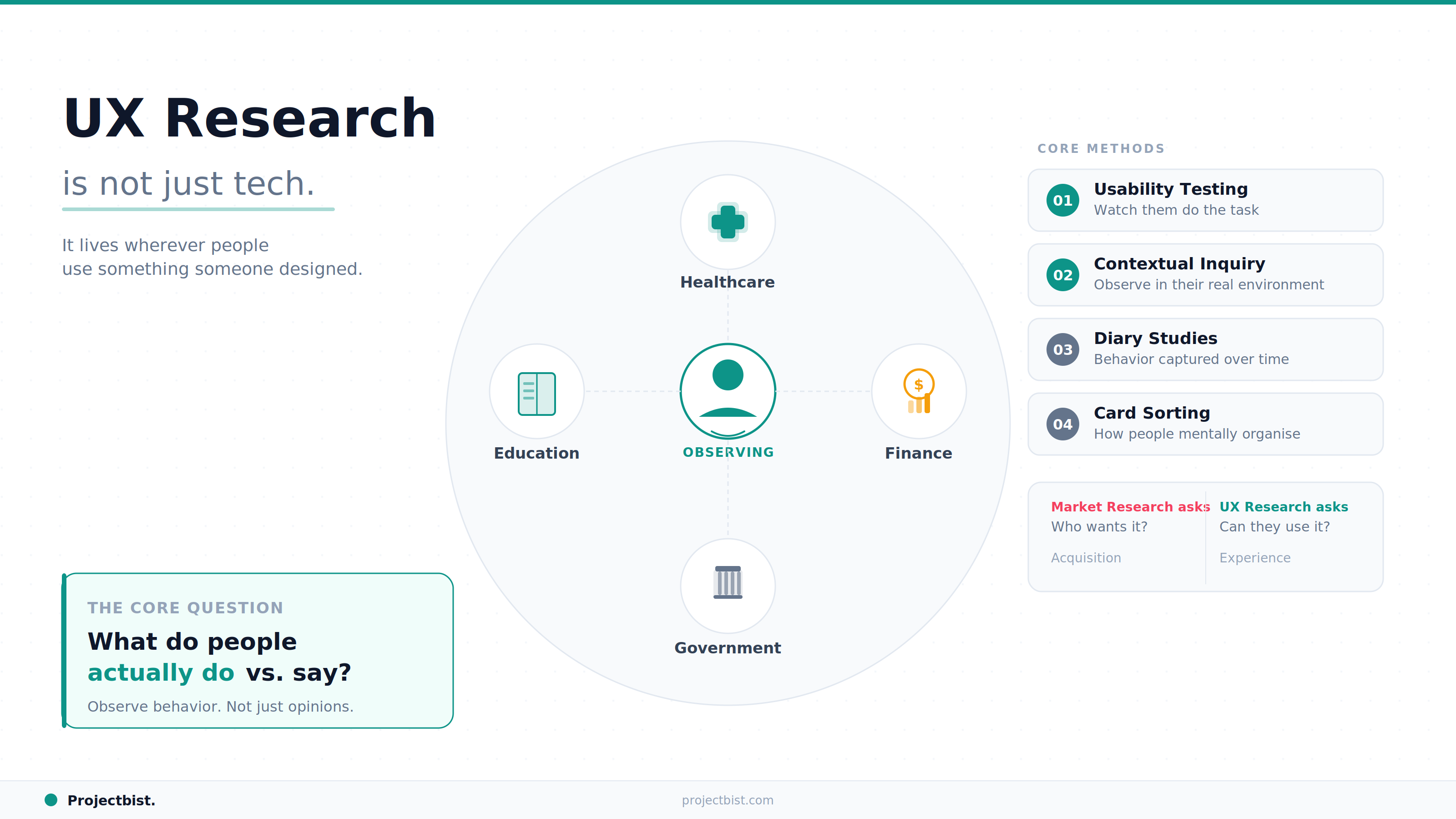
UX research studies the relationship between people and the products, services, systems, or environments they use. It asks: how do people currently accomplish this task, what works and what does not, what does the person expect to happen versus what actually happens, where does confusion or frustration occur, and what would a better experience look like?
These are fundamentally qualitative questions about human behavior, cognition, and expectation. That makes UX research a close methodological cousin of social and behavioral research, using many of the same core methods: in-depth interviews, observation, diary studies, and usability testing (which is essentially structured observation of task performance).
Participants are given specific tasks to complete using a product or prototype while the researcher observes and records where they succeed, struggle, or fail. This is the most foundational UX research method and produces direct behavioral evidence of usability problems rather than self-reported opinions about them.
Observing users in their natural environment while they use a product or perform a task, asking questions in the moment about what they are doing and why. This method surfaces behavior that laboratory usability testing misses because real environments have distractions, interruptions, and workarounds that controlled environments do not.
Participants document their experiences over a defined period, typically using a structured log or a mobile app. Diary studies capture behavior over time in a way that single-session observation cannot. They are particularly valuable for products used habitually or for studying experiences that unfold over days or weeks.
Methods for understanding how people mentally categorize information and navigate information architectures. Card sorting asks participants to organize topics or features into groups that make sense to them. Tree testing evaluates whether a proposed navigation structure matches users' mental models by asking them to find specific items within it.
The most useful thing UX research has contributed to the broader research field is the discipline of observing what people actually do rather than relying on what they say they do. Those two things are often very different.
Market research asks: who are the customers, what do they want, how large is the market, how should we position the product? UX research asks: once someone has the product, can they actually use it, where does the experience break down, what changes would make it work better?
Market research is primarily about acquisition and demand. UX research is primarily about usability and retention. The two disciplines have different primary questions but overlapping methods, and the most sophisticated organizations use both.
The expansion of digital services into traditionally offline sectors is driving demand for UX research skills beyond technology companies. Healthcare systems redesigning patient portals, financial regulators assessing the accessibility of disclosures, agricultural input companies building farmer-facing mobile apps in low-literacy contexts: all of these require researchers who can study human interaction with designed artifacts.
For research professionals looking to expand their methodology portfolio, UX research skills, particularly usability testing, contextual inquiry, and information architecture evaluation, open a genuinely different set of project opportunities. These can be showcased specifically on verified research profiles at ProjectBist to signal this distinct capability to clients who are searching for it.
Newsletter
Personalize your updates! Subscribe to ProjectBist's Newsletter and choose from the following categories.
How to Price Your Research Consulting Services: The Honest Guide for Independent Researchers Globally
Inference vs Description: The Distinction That Quietly Determines Whether Your Research Findings Mean What You Think They Mean

Time Use Surveys: The Research Method That Makes Invisible Work Visible