P
Loading blog...
Loading blog...
People tell social media things they would never tell a researcher. That makes social listening one of the most honest sources of consumer insight available.
Samir Haddad
Apr 19, 2026•4 min read
When you run a survey, respondents know they are being asked questions. They know there is an organization behind the survey and some purpose for the data. Even with the best questionnaire design, that awareness shapes what they say. People present the version of themselves they think is appropriate given the context.
Social media conversations do not have that filter. When someone tweets about why they stopped using a brand, complains about a bank's customer service in a Facebook group, or asks for recommendations in a WhatsApp community, they are not performing for a researcher. They are expressing something real.
That is why social listening, done properly, is one of the most unfiltered research methods available. It just requires understanding what it is and is not designed to tell you.
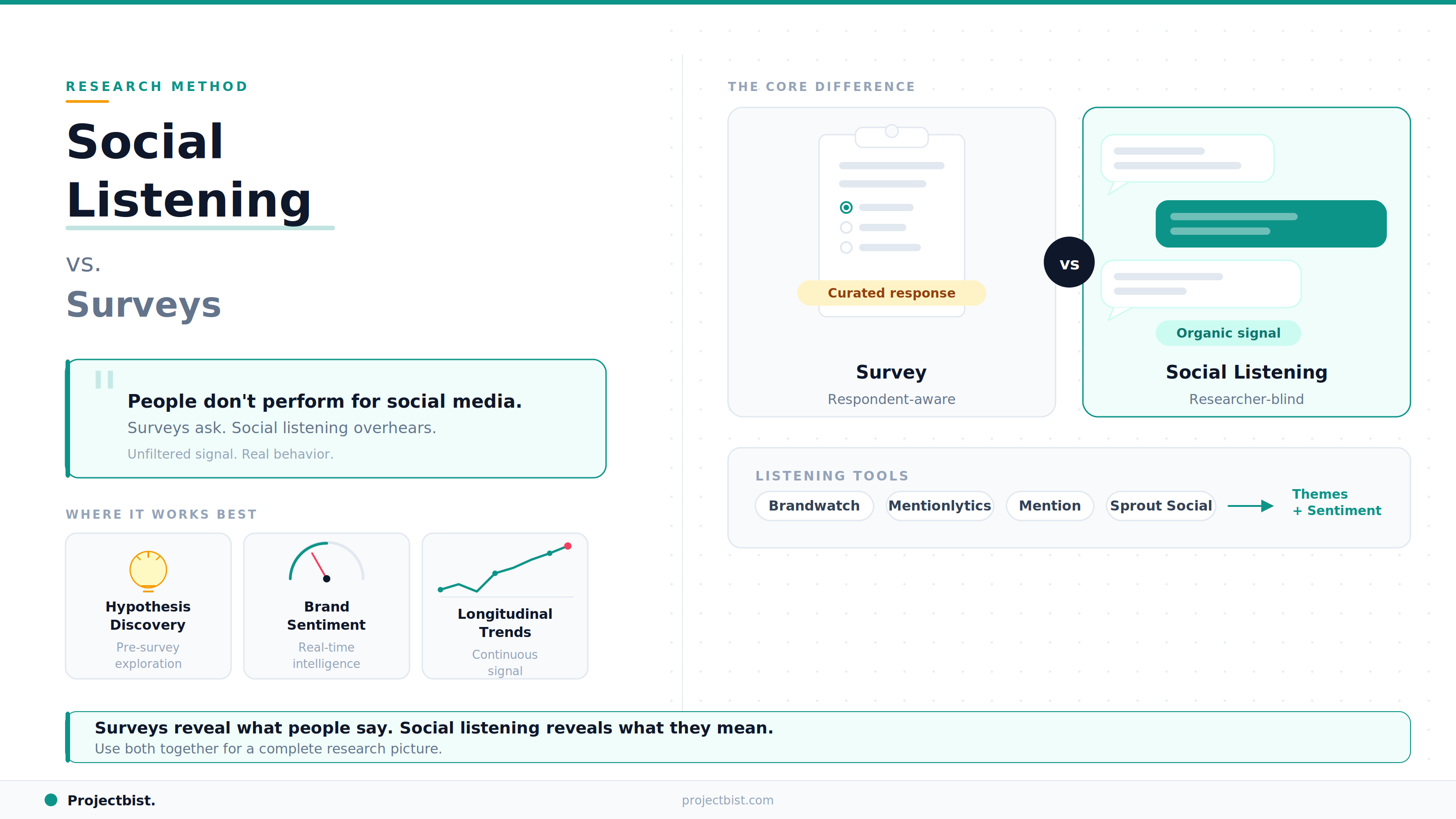
Social listening is the systematic monitoring and analysis of publicly available conversations on social media platforms, forums, review sites, and online communities to extract insights about a brand, product, topic, or population. It is different from social media monitoring (which just tracks mentions) because it involves analytical synthesis: identifying patterns, themes, sentiment shifts, and behavioral signals from the aggregated data.
Tools like Brandwatch, Mention, Sprout Social, and Mentionlytics all support social listening at different scales and price points. The output is not raw data: it is analyzed conversation, coded into themes, quantified by volume, and rated by sentiment.
This is equally important. Social listening draws from whoever is actively posting online, which is not a random or representative sample of any population. Young, urban, digitally active people are dramatically overrepresented in social media data. Older adults, rural populations, and people with limited smartphone access are dramatically underrepresented.
Social listening cannot produce statistically reliable estimates about the proportion of a population that holds a view. It can tell you that a concern exists and that it is gaining volume. It cannot tell you whether 10 percent or 60 percent of your actual customer base shares that concern. For that, you need a survey.
Social listening tells you what is being said. Surveys tell you by how many people. Both are better together than either is alone.
Social listening is an excellent source of hypotheses. Before designing a customer satisfaction survey, listening to organic conversation about a brand or product category reveals the language consumers use, the issues that matter most to them, and the questions worth asking. This makes the subsequent survey more precise and more likely to capture what actually matters to the population.
Social listening is particularly powerful for brands that operate at scale, where it would be impossible to survey everyone but where online conversation volumes are sufficient to analyze sentiment patterns. Tracking brand sentiment through social listening before, during, and after a campaign, product launch, or crisis provides real-time intelligence that surveys cannot match for speed.
Unlike a point-in-time survey, social listening data is continuous. A well-configured listening dashboard captures conversation over weeks, months, and years, providing a longitudinal view of how consumer sentiment and concern topics are shifting without the cost of repeated survey waves.
Social listening draws on publicly available data, but this does not mean it is ethically uncomplicated. Researchers have a responsibility to handle social data in ways that do not de-anonymize individuals, that aggregate appropriately, and that distinguish between public figures and private individuals. The fact that a post is technically public does not mean the person who posted it consented to their words being used in a research report. Good practice anonymizes individual mentions and reports at the pattern level rather than reproducing personal posts verbatim.
ProjectBist profiles show methodology specialization including social research and digital methods.
Find Digital Research Specialistsarrow_forwardNewsletter
Personalize your updates! Subscribe to ProjectBist's Newsletter and choose from the following categories.
How to Price Your Research Consulting Services: The Honest Guide for Independent Researchers Globally
Inference vs Description: The Distinction That Quietly Determines Whether Your Research Findings Mean What You Think They Mean

Time Use Surveys: The Research Method That Makes Invisible Work Visible