P
Loading blog...
Loading blog...
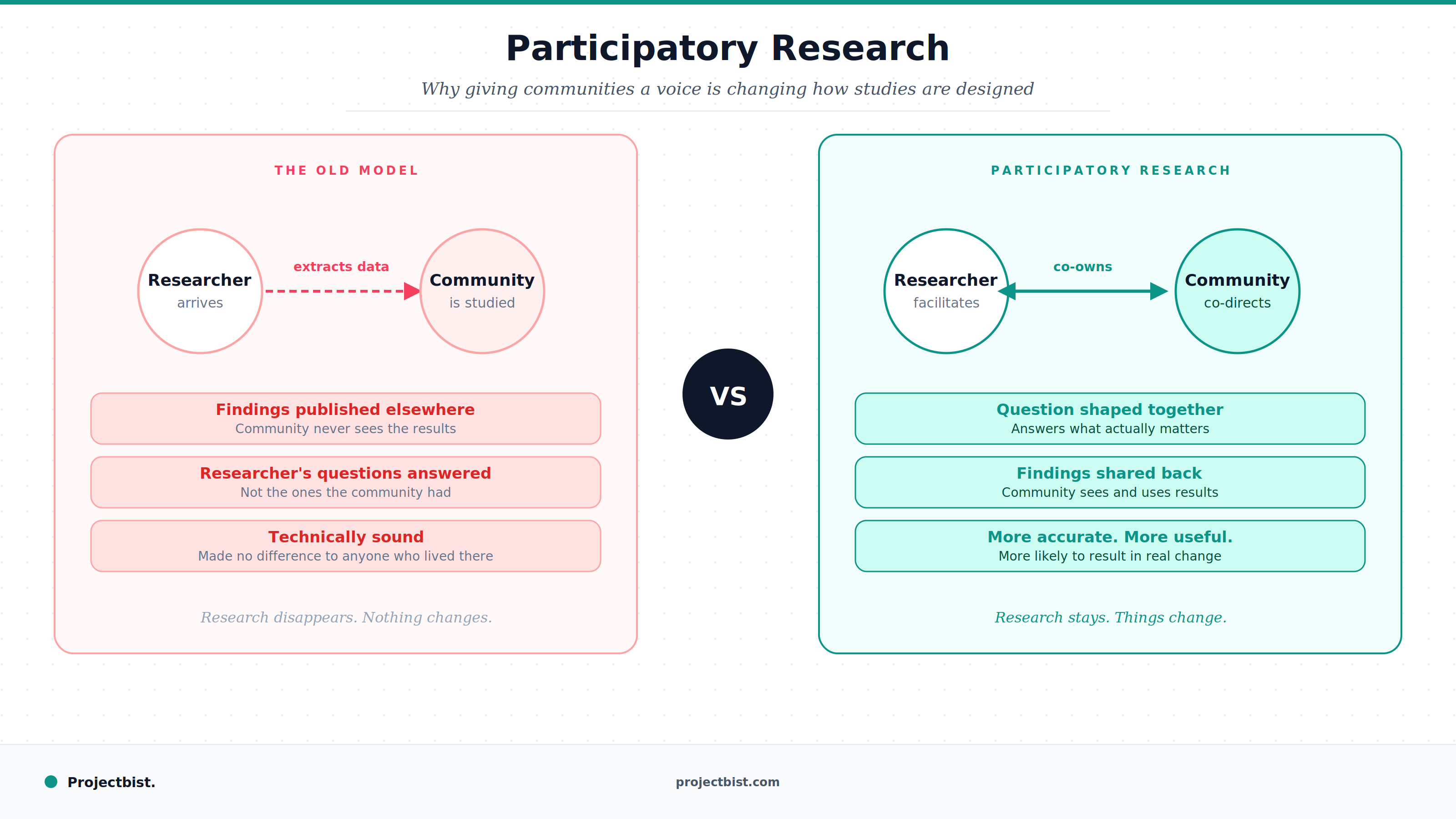
Traditional research treats communities as sources of data. Participatory research treats them as co-investigators. The quality difference is significant.
Priya Nair
May 26, 2026•4 min read
There is a long history in development research of researchers arriving in communities, collecting data, disappearing, and publishing findings that the community never sees and that rarely address the questions the community actually had. The research was technically sound. The community was accurately described. And the research made no difference to anyone who lived there.
Participatory research emerged as a direct response to this dynamic. It is built on a simple but consequential premise: the people who are affected by a research question are also the people most capable of contributing to answering it. When their knowledge, experience, and perspective shape both the question and the method, the research tends to be more accurate, more useful, and more likely to result in action.
Participatory research is a family of approaches, not a single methodology. The most widely used frameworks include:
The quality advantage of participatory research is counterintuitive to researchers trained in controlled, externally designed studies. But it is real and has a straightforward explanation.
Community members who helped design a data collection tool understand what the questions are actually asking and why. They can translate accurately across languages and contexts in ways that externally trained enumerators often cannot. They can identify when a question is being misunderstood and correct it in real time. They know which topics are sensitive enough that a community elder needs to be present for the conversation to happen at all.
This local knowledge does not just improve data quality. It improves the relevance of the research question itself. Communities that participate in designing a study often redirect it toward aspects of their reality that an external researcher would not have thought to ask about.
Participatory research challenges a deeply embedded assumption in professional research: that the researcher knows the right questions to ask. Often they do not. And the people who do are sitting in the communities being studied.
Participatory approaches require a significantly different posture from the researcher. You are not the expert arriving to study a community. You are a technical resource facilitating a process that the community co-directs. That shift is intellectually and personally demanding for researchers trained in more conventional designs.
The strongest growth in participatory approaches is in global health research, climate adaptation and resilience planning, humanitarian response monitoring, and social protection program design. International funders including the World Bank, USAID, and major foundations are increasingly requiring evidence that affected communities were meaningfully involved in research design, not just sampled.
For researchers with development sector backgrounds, building documented competence in participatory methods is a genuine differentiator in an increasingly competitive field.
Newsletter
Personalize your updates! Subscribe to ProjectBist's Newsletter and choose from the following categories.
How to Price Your Research Consulting Services: The Honest Guide for Independent Researchers Globally
Inference vs Description: The Distinction That Quietly Determines Whether Your Research Findings Mean What You Think They Mean

Time Use Surveys: The Research Method That Makes Invisible Work Visible