P
Loading blog...
Loading blog...
Most independent researchers price themselves too low, for too long, using the wrong model. Here is a more honest framework for what research expertise is actually worth and how to charge for it.
Amina Idris
Jun 13, 2026•5 min read
The most consistent finding from conversations with independent research consultants globally is not about methodology gaps or technical skills. It is about pricing. Most independent researchers charge less than they should. They know it. Their clients know it. And they keep doing it anyway, usually because they are uncertain about what 'correct' pricing looks like for their market and their type of work.
This post is an honest attempt to address that gap: what structures exist, what the actual rate data shows globally, and how to move toward a pricing approach that reflects what your expertise genuinely creates for clients.
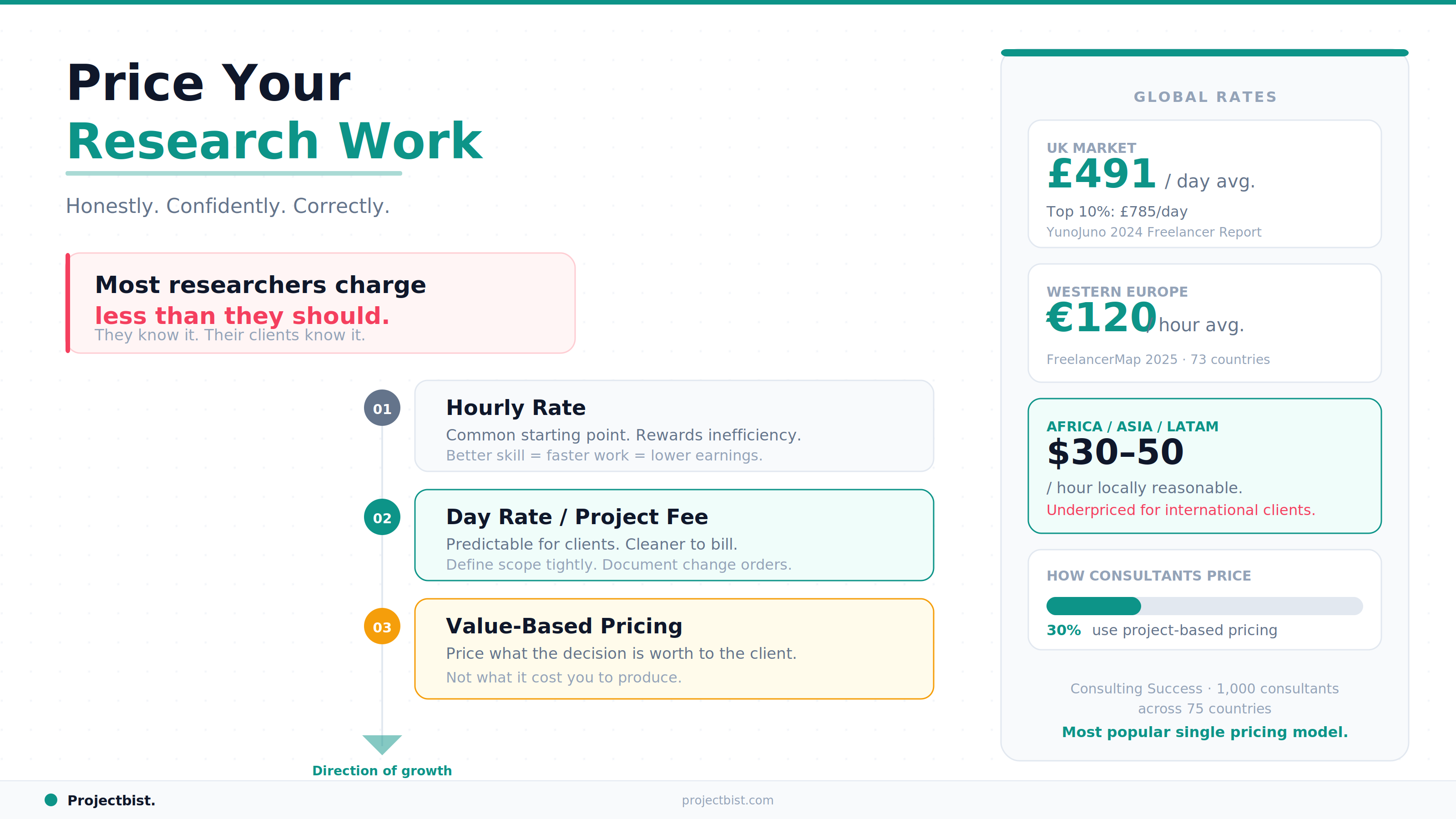
The most common starting point for new research consultants. According to YunoJuno's 2024 UK Freelancer Report, market research professionals in the UK averaged GBP 491 per day (roughly GBP 61 per hour), with the top 10 percent averaging GBP 785 per day. Market research saw 64 percent year-on-year growth in bookings, the highest of any discipline in their dataset.
Global variation is significant. The FreelancerMap 2025 study of 3,571 independent professionals across 73 countries found average hourly rates in 'Consulting and Management' of EUR 120 per hour for Western European markets. Across Africa, Asia, and Latin America, rates are considerably lower in absolute terms but often competitive in purchasing power parity terms. A Nairobi-based researcher charging USD 30 to 50 per hour is not underpriced relative to their local market; they may be substantially underpriced relative to international clients commissioning work for their markets.
The structural problem with hourly rates is that they reward inefficiency: the more experienced you are, the faster you work, and the less you earn per unit of output. They also leave clients uncertain about total cost, which generates unnecessary friction in negotiations.
Day rates are the dominant model for experienced freelance researchers. They provide predictability for clients and simplify billing for researchers. Project-based rates, where you quote a fixed fee for a defined scope of work, are even more client-friendly: Consulting Success research involving nearly 1,000 consultants across 75 countries found that 30 percent use project-based pricing, the most popular single structure, precisely because it aligns incentives with outcomes rather than hours.
The risk with project-based pricing is scope creep: a project that seemed bounded at proposal stage expanding in ways that consume more researcher time than the fee reflects. Rigorous scope definition, a clear change-order process, and explicit documentation of what is and is not included are the practical tools that make project-based pricing work without eroding margins.
The most sophisticated pricing approach, and the one that produces the best outcomes for both researchers and clients, is value-based pricing: setting fees based on what the research is worth to the client rather than what it costs you to produce.
A price optimization study that tells a client their product is priced 15 percent above what their target segment will pay, and enables a repositioning that prevents a failed launch worth millions: how much is that research worth? Not the same as the number of days it took to produce.
Value-based pricing requires a clear understanding of the decision the research will inform, an estimate of what a better decision is worth to the client, and the confidence to price accordingly. It is the direction most pricing advice for consultants points toward, and the direction most independent researchers are furthest from.
The strongest argument for raising your rates is not that you need the money. It is that underpricing signals something to clients. Clients who pay low rates wonder, reasonably, whether they are getting what they paid for.
Research consulting rates vary enormously by specialization. Based on current market data across freelance platforms and professional networks:
Researchers based in Africa, South Asia, and Southeast Asia face a specific challenge: their local rate context is significantly lower than the international market for their skills, yet they are increasingly bidding for international projects alongside researchers from higher-rate markets.
The practical strategy is differentiation: clearly documenting local expertise and contextual knowledge that international researchers cannot replicate, combining that with technical credentials that are internationally recognized, and pricing for international engagements at international rates rather than local ones. Your cost of living is your business. The value of your expertise to a client commissioning research in your region is a different calculation entirely.
A verified, complete profile on ProjectBist that demonstrates your methodology specializations, past client ratings, and documented credentials supports this differentiation. It lets the profile make the quality argument that your rates require.
Newsletter
Personalize your updates! Subscribe to ProjectBist's Newsletter and choose from the following categories.
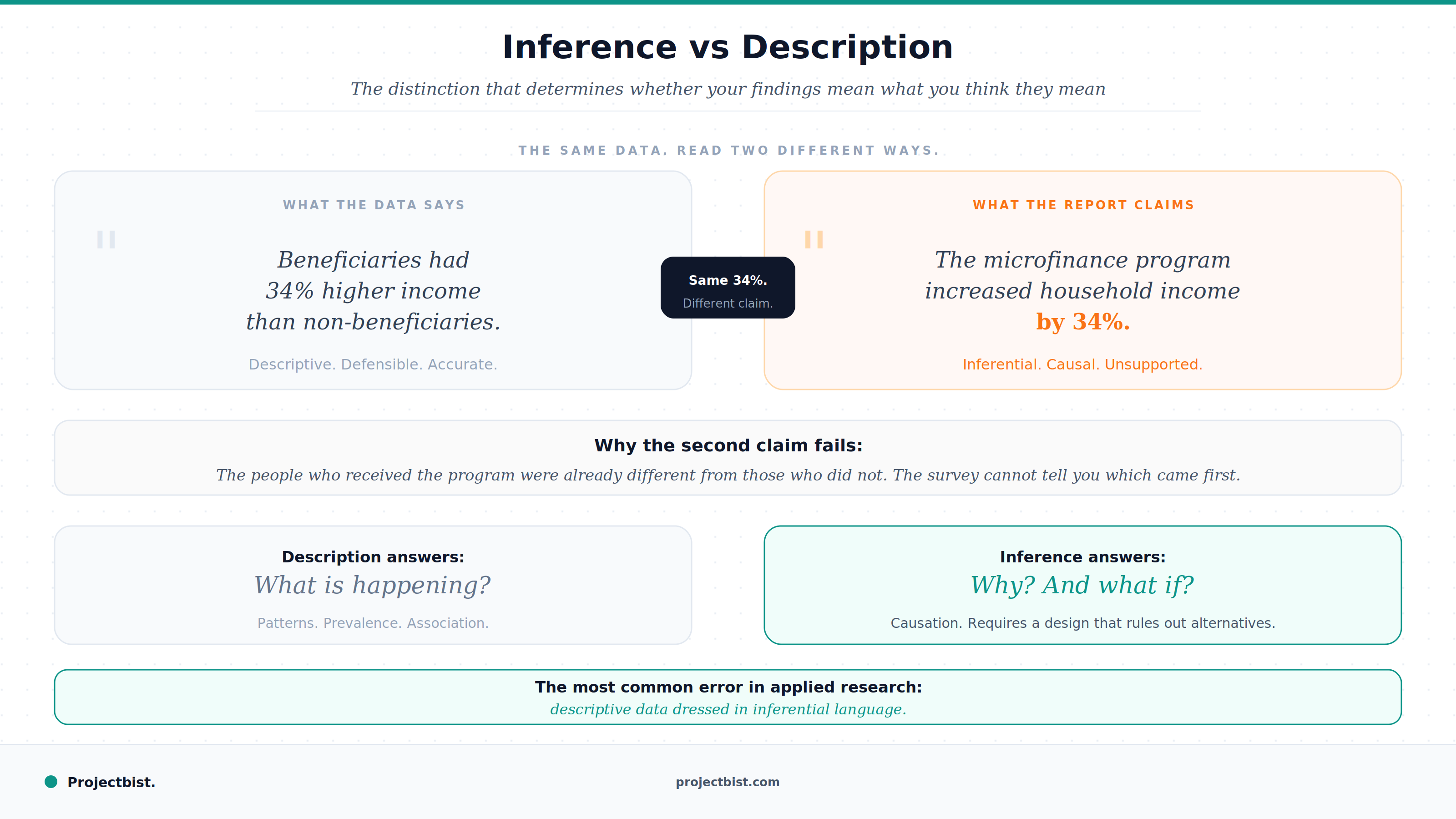
Inference vs Description: The Distinction That Quietly Determines Whether Your Research Findings Mean What You Think They Mean

Time Use Surveys: The Research Method That Makes Invisible Work Visible

Research in Humanitarian and Conflict Settings: Why Standard Methods Often Fail and What Works Instead