P
Loading blog...
Loading blog...
Humanitarian crises do not pause for research timelines. And the populations most urgently in need of good evidence are often the hardest to reach with standard methods.
Kwame Mensah
Jun 07, 2026•4 min read
You arrive in a camp for internally displaced persons with a research plan that took two weeks to design. Your sampling frame is a population registration list that was last updated three months ago. A quarter of the registered households have moved on. New arrivals are not on any list. Your survey instrument was translated into the national language, but the majority of respondents speak a regional dialect the translator does not. The security situation makes afternoon field visits unsafe.
This is not an unusual scenario for humanitarian research. It is Tuesday.
Research in humanitarian and conflict-affected settings is its own discipline, not simply standard research conducted under difficult conditions. The methods that work in stable urban environments break down in ways that are predictable once you understand them, and anticipating those failure modes is what separates useful humanitarian research from research that is technically completed but analytically worthless.
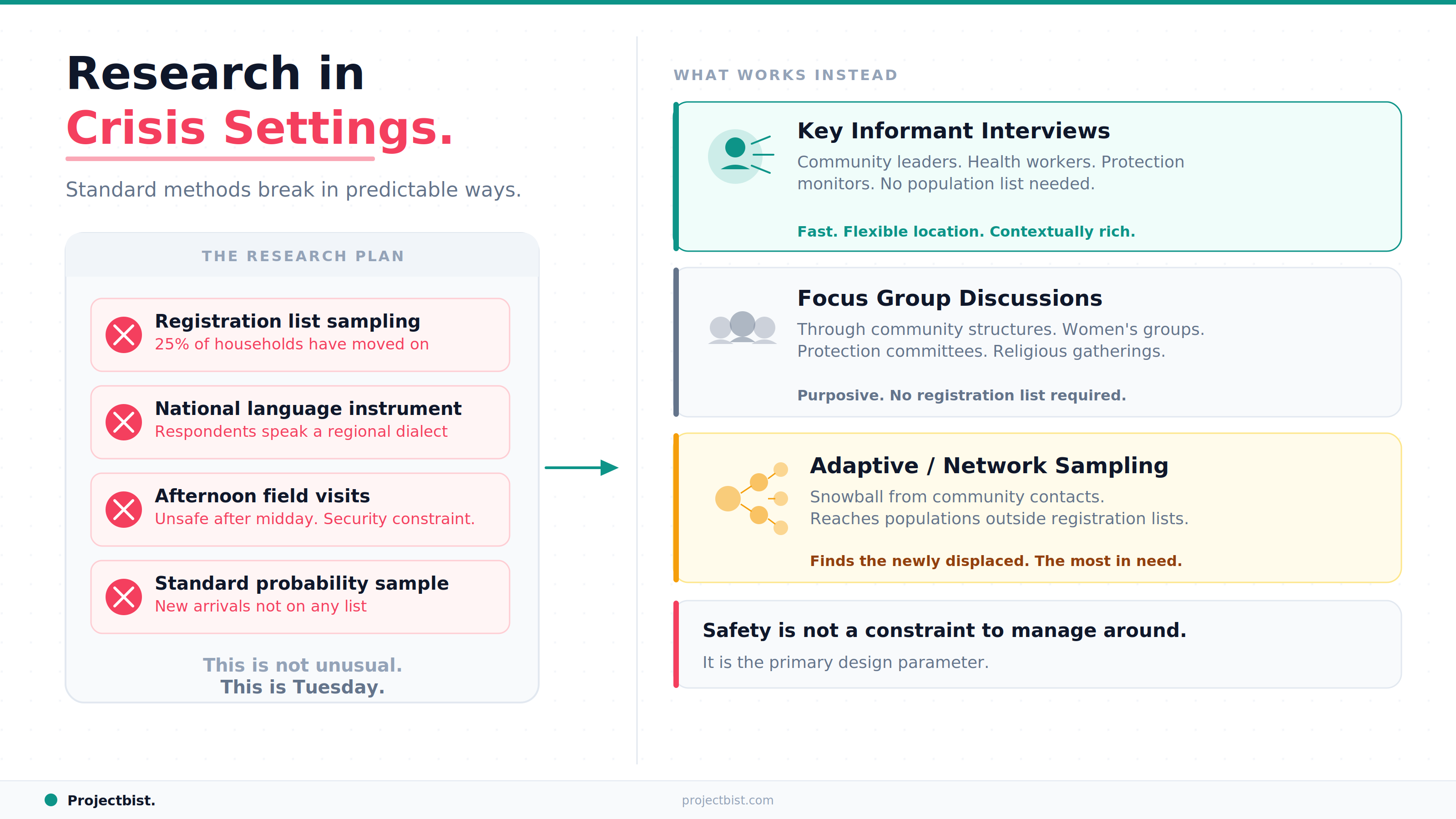
In displacement settings, refugee camps, conflict-affected communities, and post-disaster environments, the population being studied is moving. Sampling frames built at one point in time are outdated by the time fieldwork begins. Random selection from a registration list that does not include new arrivals systematically excludes the most recently displaced, who often have the most acute needs.
Adaptive sampling approaches, including snowball sampling from known community contacts, network sampling through community mobilizers, and satellite settlement mapping for populations who have dispersed beyond formal camp structures, address this challenge better than probability sampling from outdated lists.
Security conditions affect where, when, and by whom research can be conducted. Some areas are inaccessible to certain researchers. Women enumerators may access communities that male enumerators cannot, and vice versa. Research conducted during curfew periods, in areas where armed actors are present, or with populations who have reason to fear any external documentation requires fundamentally different protocols than standard household surveys.
Researcher and respondent safety is not a constraint to manage around. It is the primary design parameter. A finding produced at the cost of a researcher's or respondent's safety is not worth producing.
Crisis-affected populations are frequently subject to assessment after assessment from multiple humanitarian organizations. By the time a new research team arrives, some communities have answered similar questions dozens of times and seen few tangible outcomes. This creates both non-response problems and motivated misreporting: respondents may overstate needs to attract assistance or understate them out of fatigue or distrust.
Every humanitarian assessment should begin with a coordination check: who else has been researching this population recently, what did they find, and can their data serve some of the same purpose? Starting from scratch when useful data already exists is wasteful and contributes to respondent fatigue.
KIIs with community leaders, local health workers, protection monitors, and humanitarian staff who have existing community access are often the fastest and most reliable source of initial intelligence in crisis settings. They do not require population lists, can be conducted in flexible locations, and produce contextually rich data quickly.
FGDs organized through community structures (women's groups, community protection committees, religious gatherings) avoid the need for population lists while providing breadth of perspective. The key adaptation is ensuring that the groups accessed through community structures are not systematically different from those who are not connected to any formal community organization.
Specifically designed for compressed timelines and limited access, RAP combines multiple short data-collection methods with triangulation rather than relying on any single method for definitive findings. For initial needs assessment purposes, this approach produces directionally reliable findings faster than more rigorous designs.
The standard ethical requirements of research, informed consent, confidentiality, right to withdraw, do-no-harm, apply to all research contexts. In humanitarian and conflict settings, several of these acquire additional urgency.
Newsletter
Personalize your updates! Subscribe to ProjectBist's Newsletter and choose from the following categories.
How to Price Your Research Consulting Services: The Honest Guide for Independent Researchers Globally
Inference vs Description: The Distinction That Quietly Determines Whether Your Research Findings Mean What You Think They Mean

Time Use Surveys: The Research Method That Makes Invisible Work Visible