P
Loading blog...
Loading blog...
Trillions of dollars of investment decisions and regulatory reporting requirements now depend on research. The researchers who understand this space are exceptionally well positioned.
Jordan Blake
May 22, 2026•4 min read
In 2011, 20 percent of S&P 500 companies published a sustainability report. By 2022, that figure was 98 percent. The EU's Corporate Sustainability Reporting Directive, which came into effect in 2025, extended mandatory non-financial disclosure to a much wider range of companies across Europe. The IMF estimates that 90 percent of the climate finance required for developing countries' transition to low-carbon economies will come from the private sector by 2030.
Behind every one of those disclosures, every one of those investment decisions, every one of those transition financing deals: research. Measurement. Methodology. Verification.
ESG research is not new, but it is expanding faster than the pool of researchers trained to do it, which is creating a genuine talent gap that independent researchers and specialist firms are well-positioned to fill.
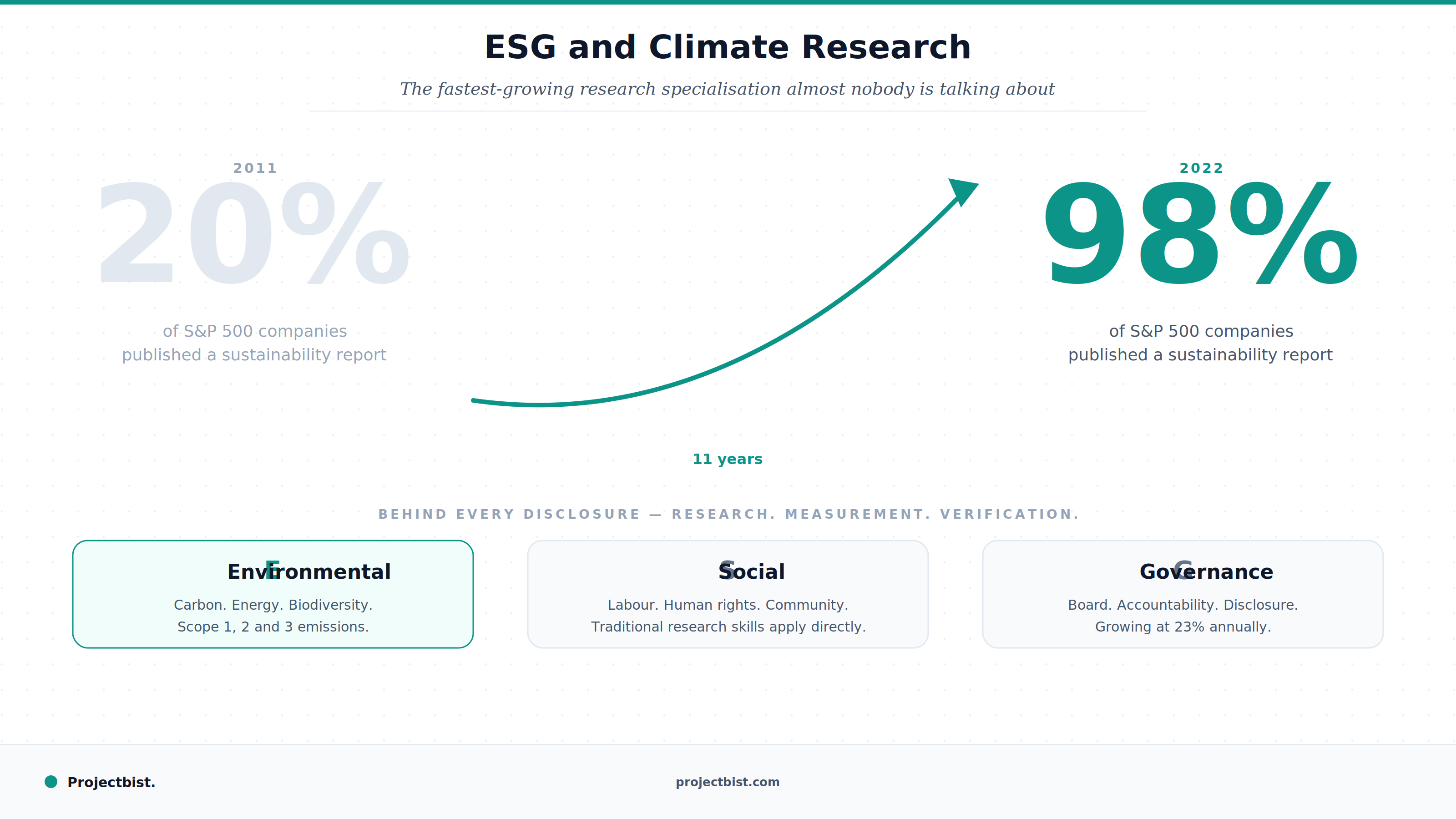
ESG stands for Environmental, Social, and Governance: the three domains through which companies' non-financial impacts and risks are measured. What this means in practice for researchers varies significantly by domain and by client type.
Measuring a company's carbon emissions (Scope 1 direct emissions, Scope 2 indirect from energy, and the increasingly important and difficult Scope 3 value chain emissions), energy and water consumption, waste generation, and biodiversity impacts. This requires combining company-reported data with independent verification, satellite imagery analysis, supply chain auditing, and sometimes community-level fieldwork to assess impact on local environments.
Measuring labor practices, community impact, human rights standards in supply chains, diversity and inclusion metrics, and health and safety outcomes. This is the domain where traditional social research methods, including surveys, focus groups, key informant interviews, and community assessments, are most directly applicable. Researchers with development sector backgrounds are particularly well-positioned here.
Evaluating board composition, executive pay structures, anti-corruption frameworks, and shareholder rights. This is primarily a desk-based research domain, drawing on corporate disclosures, regulatory filings, and structured comparison against governance standards.
The most urgent ESG research gap is not in measuring what companies report. It is in verifying whether what they report reflects reality. That requires fieldwork, local expertise, and the kind of independent verification that only trained researchers can provide.
The OECD's 2025 ESG metrics report noted that the ESG data and services market has been growing at 23 percent annually and has likely exceeded USD 1.5 billion. This growth is driven by three converging forces: regulatory requirements that mandate disclosure (with CSRD in Europe being the most significant example), investor demand for comparable and reliable data to inform portfolio decisions, and a growing recognition that greenwashing, where companies overstate their sustainability performance, has real financial and reputational consequences that markets are beginning to price.
One of the most important findings in the ESG research space is the extraordinary divergence between different rating agencies' assessments of the same company. A study in the Review of Finance (Berg et al.) found that ESG ratings for the same company from different providers often pointed in opposite directions. The methodological variance is that significant.
This divergence is not primarily a data problem. It is a measurement design problem. Different providers use different indicators, different weighting frameworks, and different sources of data. The OECD analysis found that among 186 indicators in one major ESG scoring system, only 18 to 37 percent were outcome-based measures. The rest were process and policy indicators, meaning companies could score well by having the right policies on paper regardless of actual outcomes.
This creates a significant opportunity for researchers who can design and execute outcome-focused measurement, going beyond company-reported data to independently verify actual environmental and social impacts.
For research professionals looking to develop this specialization, it is worth building a profile that explicitly names ESG measurement, sustainability research, or impact assessment as a methodology category. Clients in this space search for very specific expertise. ProjectBist's researcher profiles allow methodology specialization to be surfaced in searches precisely for this reason.
Newsletter
Personalize your updates! Subscribe to ProjectBist's Newsletter and choose from the following categories.
How to Price Your Research Consulting Services: The Honest Guide for Independent Researchers Globally
Inference vs Description: The Distinction That Quietly Determines Whether Your Research Findings Mean What You Think They Mean

Time Use Surveys: The Research Method That Makes Invisible Work Visible