P
Loading blog...
Loading blog...
The most heated debate in market research right now is not about AI tools. It is about whether AI-generated survey responses can replace real people. Here is our honest read of where the evidence points.
Kwame Mensah
May 16, 2026•5 min read
In October 2023, marketing strategist Mark Ritson wrote in Marketing Week that AI's ability to simulate consumer responses had 'gigantic implications' for market research. The research industry responded with approximately the grace he predicted it would.
That exchange launched what has become the most contested debate in market research: can artificially generated data replace real survey respondents? And if so, when, and for what?
Eighteen months on, the industry is not much closer to a clean consensus. But the evidence has gotten clearer. Here is where things actually stand, without the evangelism or the defensiveness.
The confusion in this debate starts with the term itself. In June 2025, the ICC/ESOMAR Code introduced the first official definition: data artificially generated to replace what would normally be collected directly from people. But even within that definition, there are at least five distinct things researchers are actually describing:
These are not the same thing. Calling all of them 'synthetic data' and evaluating them as one category is how the debate gets muddled.
The most rigorous academic research on AI-simulated survey data has produced results that should give serious practitioners pause. A study comparing AI-generated responses to actual human survey data, referenced in Quirks Magazine, found that 48 percent of statistical coefficients estimated from AI responses were significantly different from their human counterparts. Among those cases, the direction of the relationship was reversed 32 percent of the time. This is not a small margin of error. This is systematically wrong in a way that could lead to opposite conclusions.
The problem is particularly acute for non-Western populations. AI language models are trained predominantly on English-language data from North American and European sources. When researchers use these models to simulate consumer perspectives from Latin America, Sub-Saharan Africa, or Southeast Asia, they are not getting authentic regional insight. They are getting a Western approximation wearing an international demographic label.
The most dangerous thing about synthetic data that looks plausible is that you cannot easily tell when it is wrong. A survey with bot responses at least leaves detectable patterns. An AI that confidently reverses a real-world relationship leaves you with confident, well-formatted nonsense.
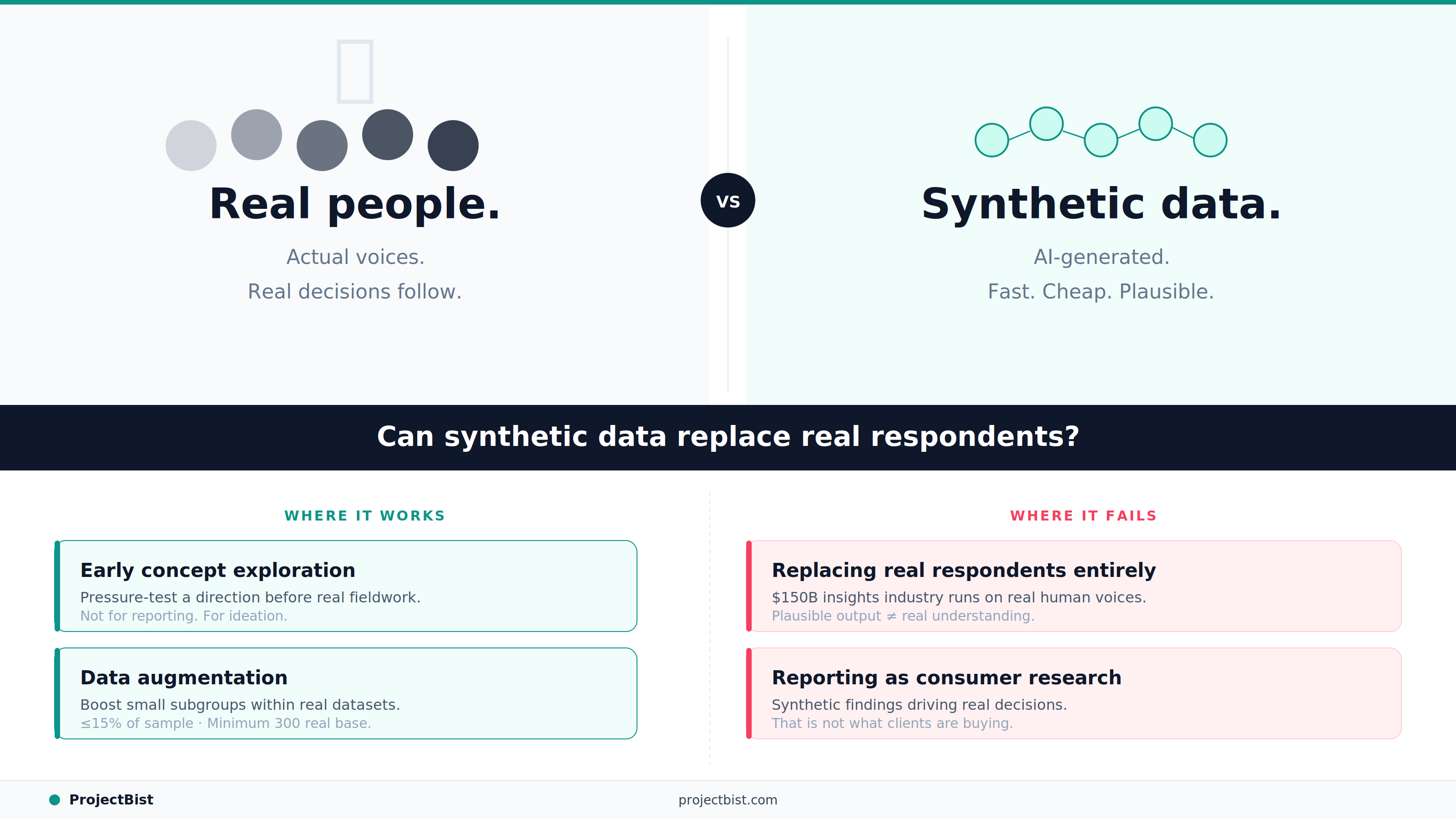
The case for synthetic data is strongest in three specific contexts:
A Harvard Business Review study found that AI can be useful for early-phase idea testing, where the goal is not to produce reportable findings but to quickly pressure-test a direction before investing in real fieldwork. Synthetic personas exploring whether a concept resonates enough to be worth investigating further is a reasonable use. Reporting those explorations as consumer research is not.
Where you have collected real data on 300 respondents from a target group that is genuinely hard to reach and need to make estimates for a specific subgroup of 40, carefully applied augmentation techniques can improve statistical reliability. The critical requirement, as noted by researchers at ESOMAR's 2025 Congress, is that augmentation models should only be applied to segments comprising 15 percent or less of the total sample, and only with at least 300 real respondents as the base.
Running synthetic responses through a survey before fielding it to real respondents can help identify confusing questions, skip logic errors, and implausible response patterns. This is analogous to using a test set before deployment.
We think the most honest framing is this: synthetic data is a real innovation with real, bounded applications. It is not a replacement for the voice of actual human beings on questions that matter enough to invest research budget in. The $150 billion insights economy runs on research clients who need to make real decisions based on real understanding of real people. That is a different thing from fast, cheap, plausible output that sounds like what a target audience might say.
The researchers and firms on ProjectBist work on real fieldwork, real analysis, and real findings. The demand for that will not shrink because AI can simulate a focus group. It will shift. The work that requires genuine human judgment, contextual intelligence, and cultural fluency will become more visibly valuable precisely because the synthetic alternative exists.
Is synthetic data approved by ESOMAR for market research?
In June 2025, the ICC/ESOMAR Code introduced an official definition of synthetic data and published guidance on responsible use. It does not prohibit synthetic data but requires transparency: buyers must be informed when synthetic data is used, and suppliers must disclose the methods and minimum viable data thresholds applied. It is not a blanket endorsement.
Can AI-generated synthetic data replace surveys?
The current academic evidence does not support this for quantitative research reporting. Studies have found that AI-simulated survey data reverses the direction of statistical relationships in a meaningful proportion of cases. For early-stage ideation and concept exploration, synthetic approaches have more defensible uses.
What is a digital twin in research?
A digital twin is an AI-generated replica of a specific, real individual, built from their behavioral data, purchase history, and survey responses. It is distinct from a synthetic persona, which represents a generalized demographic segment. Digital twins raise significant privacy and data security concerns, including the risk of inadvertent exposure of sensitive personal information.
Newsletter
Personalize your updates! Subscribe to ProjectBist's Newsletter and choose from the following categories.
How to Price Your Research Consulting Services: The Honest Guide for Independent Researchers Globally
Inference vs Description: The Distinction That Quietly Determines Whether Your Research Findings Mean What You Think They Mean

Time Use Surveys: The Research Method That Makes Invisible Work Visible