P
Loading blog...
Loading blog...
The debate between qualitative and quantitative research has largely resolved. The more sophisticated question is now how to integrate them well.
Amina Idris
May 09, 2026•4 min read
For most of the twentieth century, the research world was divided into camps. Quantitative researchers argued that knowledge worth having was knowledge that could be measured. Qualitative researchers argued that the most important human phenomena resisted quantification and that rich description produced insight that statistics could not.
Development research spent decades in this argument. Randomized controlled trials were celebrated as the gold standard. Qualitative studies were dismissed as anecdotal. Then evaluation teams started noticing that programs with rigorous impact evidence from RCTs were still failing at scale, because no one had adequately studied why the measured change was or was not happening.
Mixed methods emerged as the practical response to that limitation. It is now increasingly the norm for serious development research, not a methodological compromise.
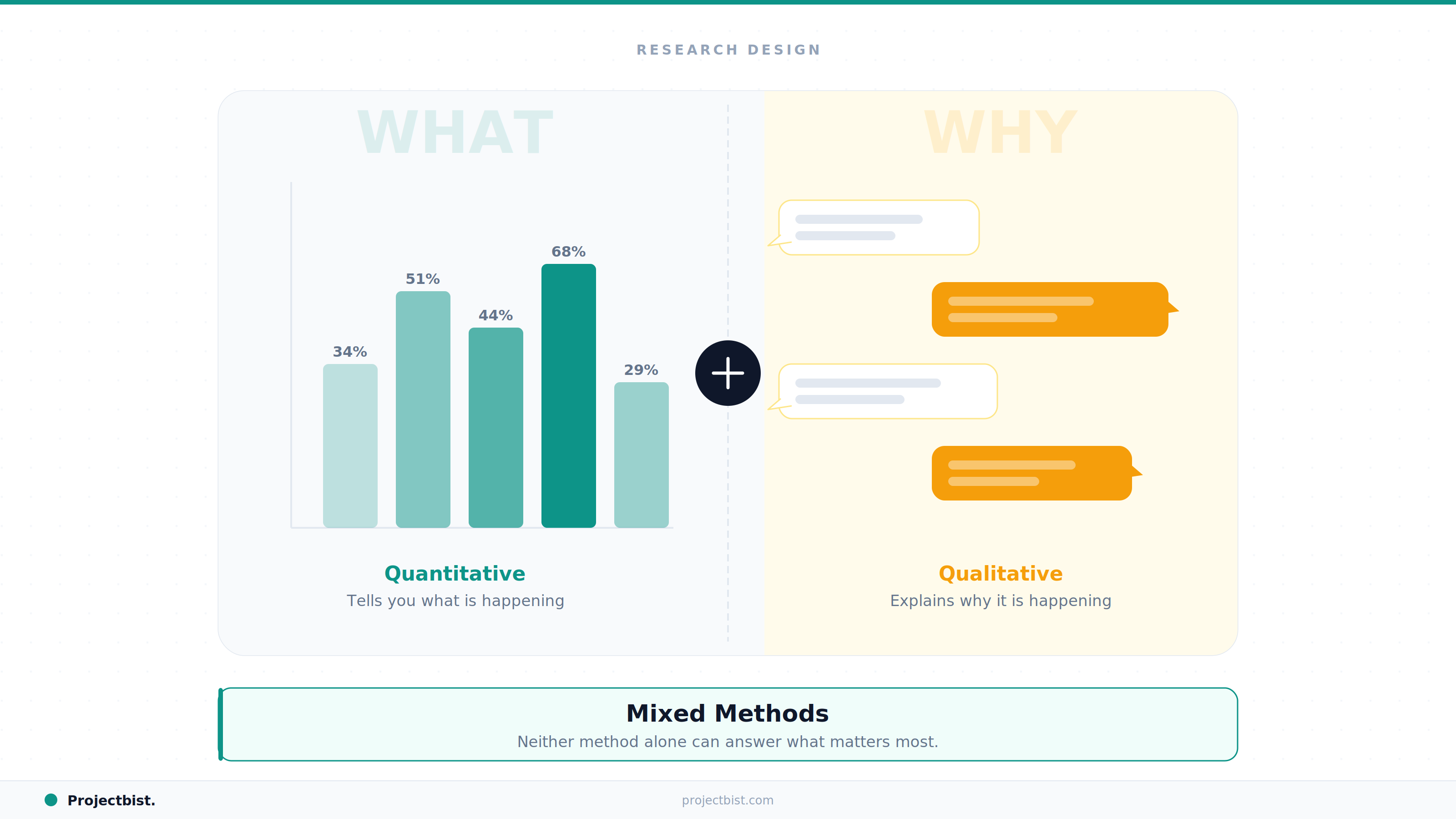
The most honest answer is that the research questions that matter most in development and social policy cannot be fully answered by either quantitative or qualitative methods alone.
A survey can tell you that 34 percent of program beneficiaries increased their agricultural income. It cannot tell you which of the program's many components drove that increase, why some beneficiaries benefited more than others, or why the program produced effects in some communities and not in neighboring ones. For those questions, you need qualitative investigation of the mechanisms and contexts underlying the quantitative pattern.
Conversely, qualitative research can identify a compelling story about why something is happening. But it cannot tell you how common that story is or whether it generalizes beyond the 20 households the researcher spent time with. For that, you need quantitative verification.
Quantitative data is collected and analyzed first. The findings drive the design of a subsequent qualitative phase that explains or explores the quantitative results. A survey finds that certain farmer groups adopted a new variety at much lower rates than others. The qualitative phase investigates why.
This is the most common mixed methods design in evaluation research because it allows quantitative findings to inform precisely targeted qualitative inquiry.
Qualitative research is conducted first to understand the phenomenon and develop appropriate concepts and measures. Those concepts then inform a subsequent quantitative study. Used when the researcher does not yet know what the right survey questions are, which often happens in new or poorly understood contexts.
Qualitative and quantitative data are collected simultaneously and compared during analysis. The goal is to see whether the two sources of evidence point in the same direction (increasing confidence in the finding) or contradict each other (revealing complexity that neither method alone would have surfaced).
The point of mixed methods is not to use more methods. It is to make the combination produce evidence that neither method could produce independently. If the integration is just reporting two parallel studies side by side, it is not genuinely mixed methods.
Mixed methods studies are only as strong as their integration. This is where most mixed methods research falls short. Researchers collect rich qualitative data and rigorous quantitative data and then present them in separate sections of the report with a brief conclusion that says both methods broadly aligned. That is not integration. It is parallel reporting.
Genuine integration means using each data source to actively interpret the other. Quantitative findings identify patterns that qualitative data explains. Qualitative findings identify mechanisms that quantitative data confirms are widespread. The integration happens at the analytical level, not in a paragraph at the end of the report.
Mixed methods studies require researchers who are genuinely competent in both methodological traditions. This is rarer than it sounds. Many researchers are strong qualitatively or quantitatively, and genuinely dual-competent researchers are more valuable precisely because they can design and execute studies where both components are rigorous and the integration is coherent.
For research firms building their capability portfolio, having staff whose profiles document both quantitative survey experience and qualitative fieldwork and analysis skills is increasingly a competitive differentiator. This is visible and verifiable on structured research profiles like those at ProjectBist.
Newsletter
Personalize your updates! Subscribe to ProjectBist's Newsletter and choose from the following categories.
How to Price Your Research Consulting Services: The Honest Guide for Independent Researchers Globally
Inference vs Description: The Distinction That Quietly Determines Whether Your Research Findings Mean What You Think They Mean

Time Use Surveys: The Research Method That Makes Invisible Work Visible