P
Loading blog...
Loading blog...
The research industry has never been more valuable. The question is who is capturing that value and whether the growth is reaching the professionals doing the work.
Amina Idris
May 19, 2026•4 min read
The number is easy to say: $150 billion. The global insights economy has crossed that threshold for the first time, according to ESOMAR's 2025 annual industry report. Research software alone surged 11.5 percent year over year, topping $62 billion. The demand for data-driven decision-making has never been higher.
But large industry numbers have a way of concealing more than they reveal. The research industry crossing $150 billion does not automatically translate into more work, better rates, or more visibility for the independent researcher in Nairobi, the small firm in Accra, or the specialist consultant in Jakarta. Understanding where the growth is actually happening and why is what makes the headline useful.
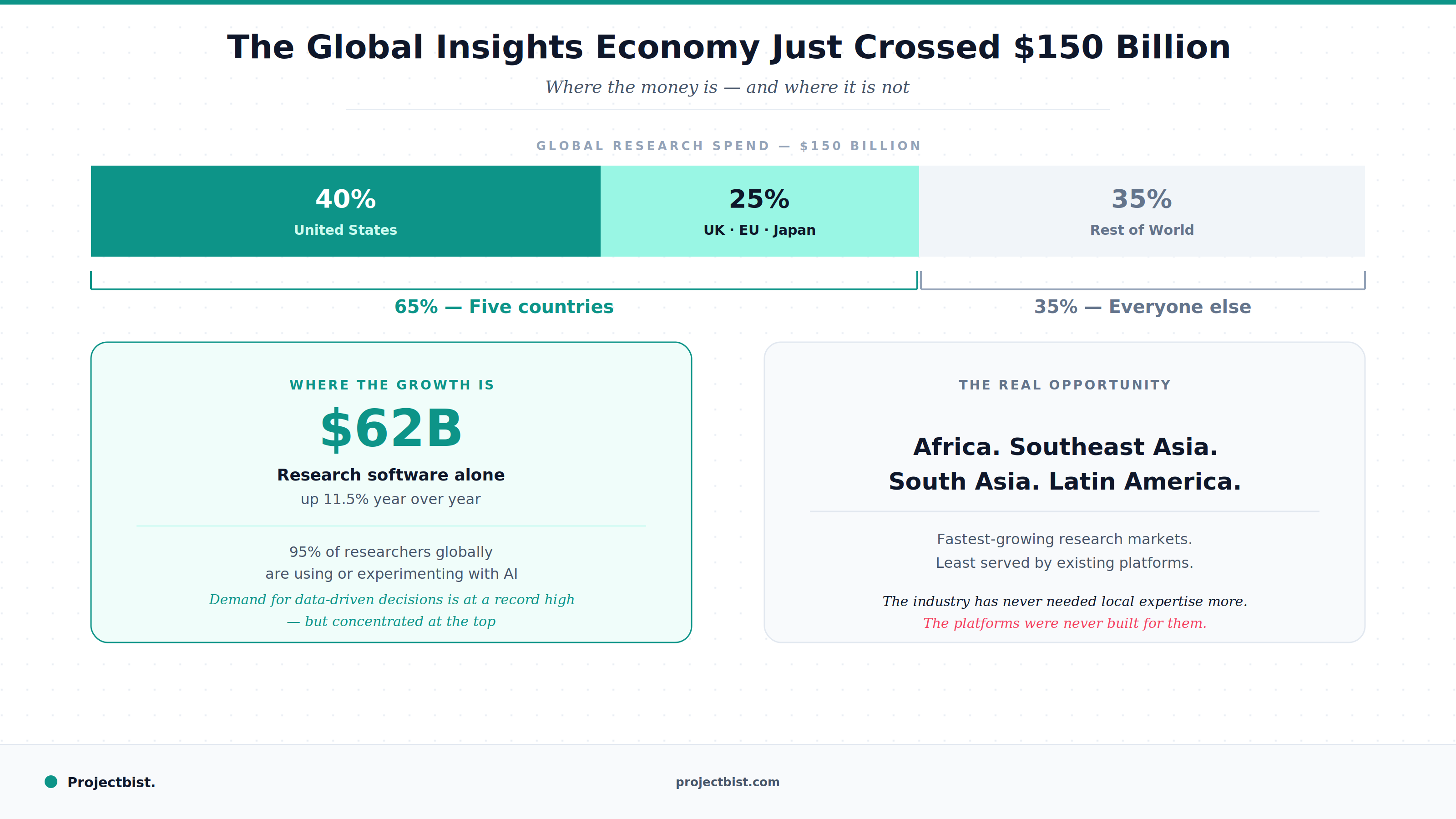
The bulk of the $150 billion is concentrated in North America and Europe, as it has been for decades. The United States alone accounts for roughly 40 percent of global research spend. The United Kingdom, Germany, France, and Japan collectively represent another 25 percent. The rest of the world, including all of Africa, South and Southeast Asia, and Latin America, shares the remaining 35 percent of a market that these same regions are disproportionately being researched in rather than leading.
That geographic concentration matters for two reasons. First, the firms most likely to be purchased by the $150 billion are primarily headquartered in those high-spend markets. Second, the fastest-growing research markets are outside those centers, which means there is a structural opportunity for locally positioned researchers that the headline number does not reflect.
AI tools have made research faster and cheaper to execute at scale. According to Qualtrics' 2026 Market Research Trends Report, 95 percent of researchers globally are now using or experimenting with AI tools. This has reduced the cost of certain types of research, which means more clients can afford to commission studies they previously could not, expanding the overall market.
Regulatory requirements around non-financial reporting are expanding rapidly. The EU's Corporate Sustainability Reporting Directive (CSRD), which came into effect in 2025, requires a significantly broader set of companies to disclose ESG metrics than previous directives. This is creating new demand for research expertise in measuring and reporting on environmental impact, social outcomes, and governance practices.
Financial services, healthcare, consumer goods, and government services are all expanding their digital footprint in Africa, Southeast Asia, and South Asia, requiring research on populations and contexts that Western research methods are poorly calibrated to handle. This is creating genuine demand for researchers with local knowledge, local language capability, and fieldwork experience in these markets.
The research industry has never needed local expertise more. The irony is that the platforms that researchers in emerging markets have used to find work have almost never been built for them.
The $150 billion number is relevant for independent researchers and small firms in a specific way: it tells you that the market you are working in is growing, that demand for your skills is structurally increasing, and that the infrastructure challenge is not demand but visibility and access.
The consistent finding from researchers in developing markets is that finding clients is harder than doing the work. Referral networks and LinkedIn connections can only carry someone so far. The gap between the size of the global market and the ability of individual researchers to access it is primarily an infrastructure problem, not a capability problem.
Platforms like ProjectBist are built specifically to address that infrastructure gap: a verified, searchable, globally accessible profile where clients from anywhere in the world can evaluate and engage researchers from anywhere in the world. In a $150 billion market, the question of visibility is not small. It is the difference between participating in that growth and watching it happen.
The most interesting structural shift in the insights economy over the next five years may not be size but redistribution. As AI compresses the cost of production-level research tasks, the premium on contextual expertise, local knowledge, and high-judgment analysis will increase. Researchers who have spent decades building deep sector or geographic expertise are positioned to capture more of that premium, not less, as generalist research production becomes cheaper.
The firms and researchers who will struggle are those whose value proposition has been primarily process execution. The ones who will thrive are those who can answer the questions that speed and scale cannot.
Newsletter
Personalize your updates! Subscribe to ProjectBist's Newsletter and choose from the following categories.
How to Price Your Research Consulting Services: The Honest Guide for Independent Researchers Globally
Inference vs Description: The Distinction That Quietly Determines Whether Your Research Findings Mean What You Think They Mean

Time Use Surveys: The Research Method That Makes Invisible Work Visible