P
Loading blog...
Loading blog...
The problem is not that respondents deceive researchers. It is that human cognition is structurally unreliable in ways that standard survey design does not account for.
Jordan Blake
Jun 03, 2026•5 min read
A food consumption survey asks respondents how many times they ate vegetables in the past week. The average reported is 4.2 times. A dietary observation study tracking the same population finds the real figure is closer to 2.7.
Nobody lied. The gap is not a measurement of dishonesty. It is a measurement of how human memory and self-presentation actually work.
This is what behavioral economics has been documenting with extraordinary precision since Daniel Kahneman and Amos Tversky began publishing their work on cognitive heuristics and biases in the 1970s, and what Richard Thaler and Cass Sunstein formalized in the concept of nudge theory in 2008. The research world has largely absorbed these findings in the realm of public policy and commercial product design. It has been slower to absorb their implications for research design itself. That is a gap worth closing.
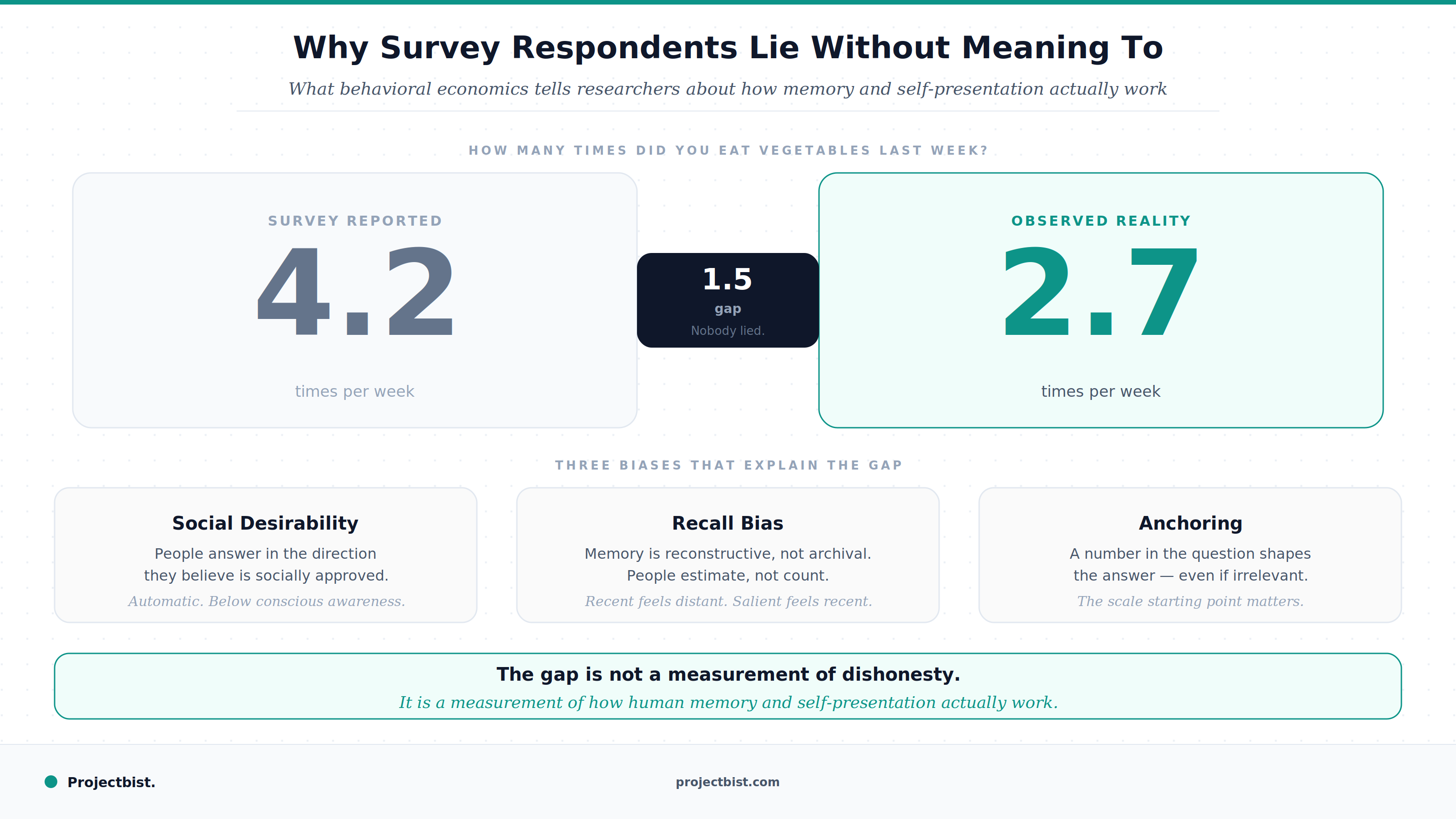
Respondents tend to answer questions in the direction they believe is socially acceptable or that presents them favorably. This is not deliberate deception. It is an automatic social adjustment that happens below conscious awareness.
Surveys on voting behavior, charitable giving, exercise frequency, reading habits, alcohol consumption, and dietary choices consistently produce estimates that diverge from verified behavioral data in the direction of what is socially approved. The more salient the social norm, the larger the gap.
Human memory is reconstructive, not archival. When asked to recall past events or behaviors, people draw on general impressions, narrative coherence, and emotional salience rather than accurate temporal records. Two systematic errors emerge from this:
When a question includes a numerical reference point, respondents use that number as an anchor for their own estimates even when it is irrelevant. A survey asking 'In the last year, did you spend more or less than $500 on clothing?' followed by 'How much did you spend?' will produce systematically higher estimates than one that does not provide a reference number.
Anchoring also operates in rating scales. The starting point of a Likert scale, whether it runs from 'strongly disagree' at the left or at the right, affects average response patterns in predictable ways.
Richard Thaler's research on default options showed that people have a strong tendency to stay with whatever option is presented as the default, even when changing it would better serve their interests. In surveys, this manifests as acquiescence bias: respondents tend to agree with statements more often than they disagree, regardless of content. A survey that presents statements rather than questions systematically captures more affirmation than a survey that balances positive and negative framings.
Behavioral economics does not suggest that surveys are fundamentally broken. It suggests that surveys built on the assumption of rational, accurate, context-independent responding will systematically produce distorted data. That is a design problem, not an unavoidable fact.
The shorter the recall period, the more accurate the memory. 'In the last seven days' produces better behavioral data than 'in the last month,' which produces better data than 'in the last year.' When longer recall periods are unavoidable, consider using event anchors: 'Since the last school holiday...' or 'Since the lockdown ended...' to help respondents locate memories more accurately in time.
Asking 'Did you vote in the last election?' produces more reliable data than 'Do you usually vote?' because it anchors the question to a specific event rather than inviting a general self-characterization. Behavioral questions with specific time periods and concrete objects are harder to misremember than abstract attitude questions.
For topics where social desirability is strong, several techniques reduce the bias. Self-administered questionnaires consistently produce more honest responses than interviewer-administered ones on sensitive topics. Randomized response techniques allow respondents to answer sensitive questions while maintaining plausible deniability. Audio computer-assisted self-interview (ACASI) removes the interviewer influence from the most sensitive items.
For any attitude or perception scale, rotate the direction of statements so that agreeing is sometimes the positive response and sometimes the negative one. This counteracts acquiescence bias and forces respondents to engage with the actual content rather than settling into an agree/somewhat agree pattern.
Understanding behavioral economics does not require redesigning every instrument from scratch. It requires a specific quality check: for each sensitive behavioral question, ask whether the social desirability gradient favors over- or under-reporting. For each recall question, ask whether the time window is realistic given typical human memory for that type of event. For each rating scale, ask whether the framing and anchor points are creating systematic pull in one direction.
These are not exotic statistical adjustments. They are design decisions that happen before a single response is collected. Getting them right in the design phase is far cheaper and more effective than trying to correct for cognitive bias in the analysis phase.
Newsletter
Personalize your updates! Subscribe to ProjectBist's Newsletter and choose from the following categories.
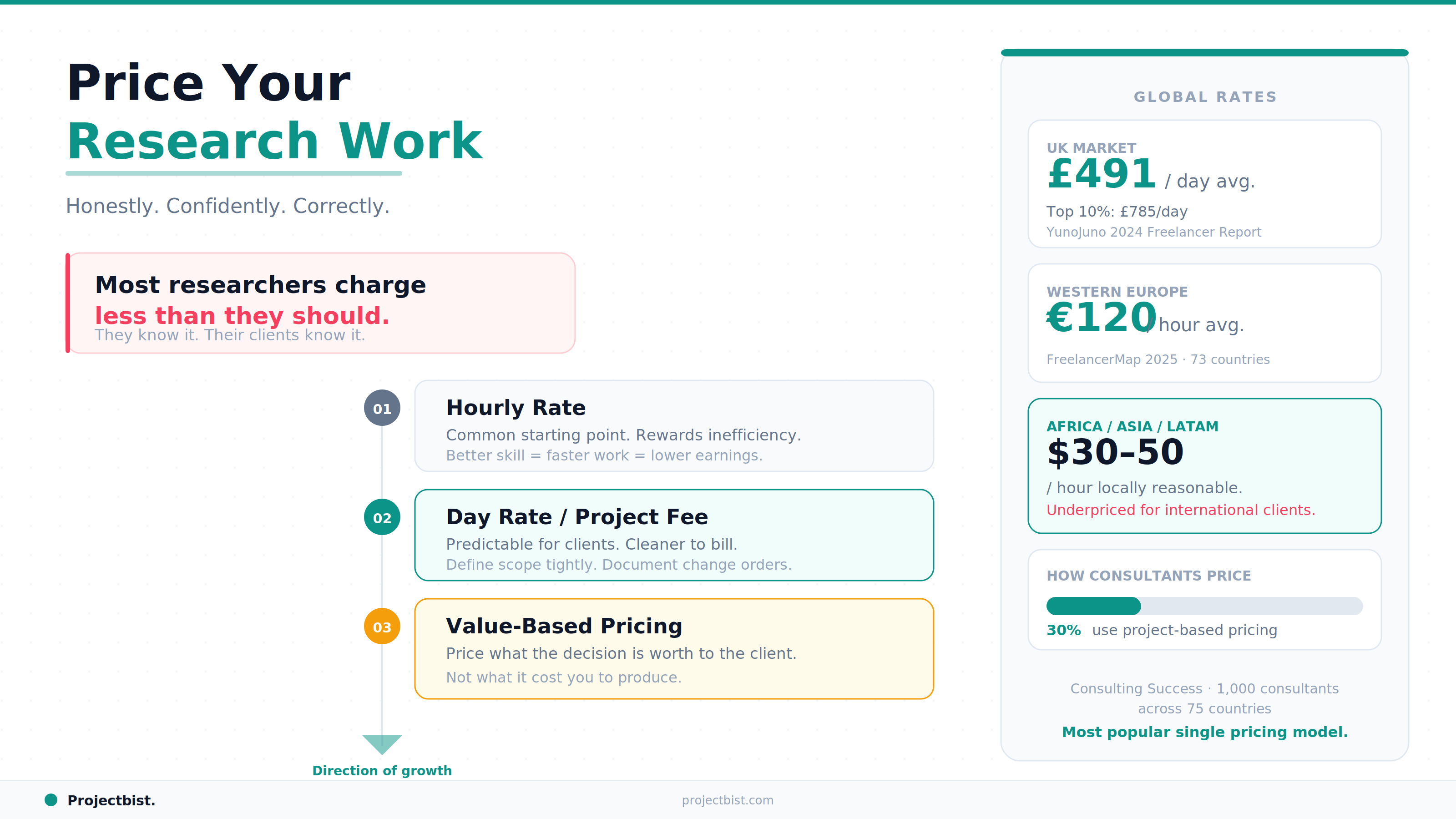
How to Price Your Research Consulting Services: The Honest Guide for Independent Researchers Globally
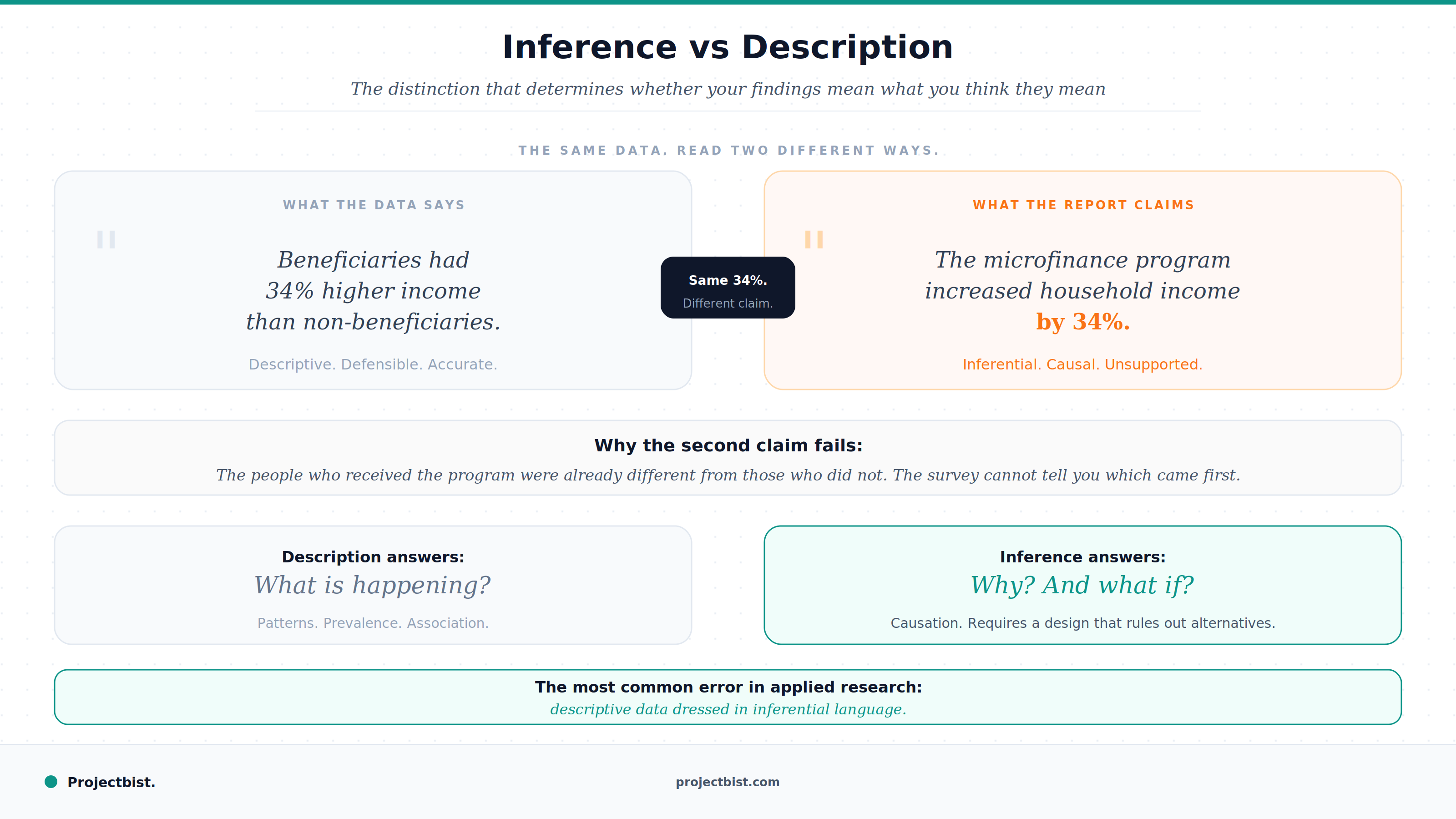
Inference vs Description: The Distinction That Quietly Determines Whether Your Research Findings Mean What You Think They Mean

Time Use Surveys: The Research Method That Makes Invisible Work Visible