P
Loading blog...
Loading blog...
Research budgets are always at risk. The researchers and firms who consistently protect and grow their budgets are the ones who can articulate what the research was actually worth.
Chloe Dubois
Apr 24, 2026•4 min read
At some point in a budget meeting, someone will say: we spent $80,000 on research last year. What did we actually get for that?
If the answer is 'a report,' the research budget will shrink. If the answer is 'we found that our product's price point was 18 percent above what our target segment would accept at current quality levels, which led us to reposition before launch and avoid what our modelling suggests would have been a $2.4 million launch failure,' the research budget will grow.
According to the Greenbook GRIT 2025 Report, demonstrating research ROI has become one of the most critical skills for research teams. Tighter budgets, more scrutiny from the C-suite, and the availability of AI-powered alternatives mean that research which cannot articulate its business value is increasingly vulnerable. Here is how to change that.
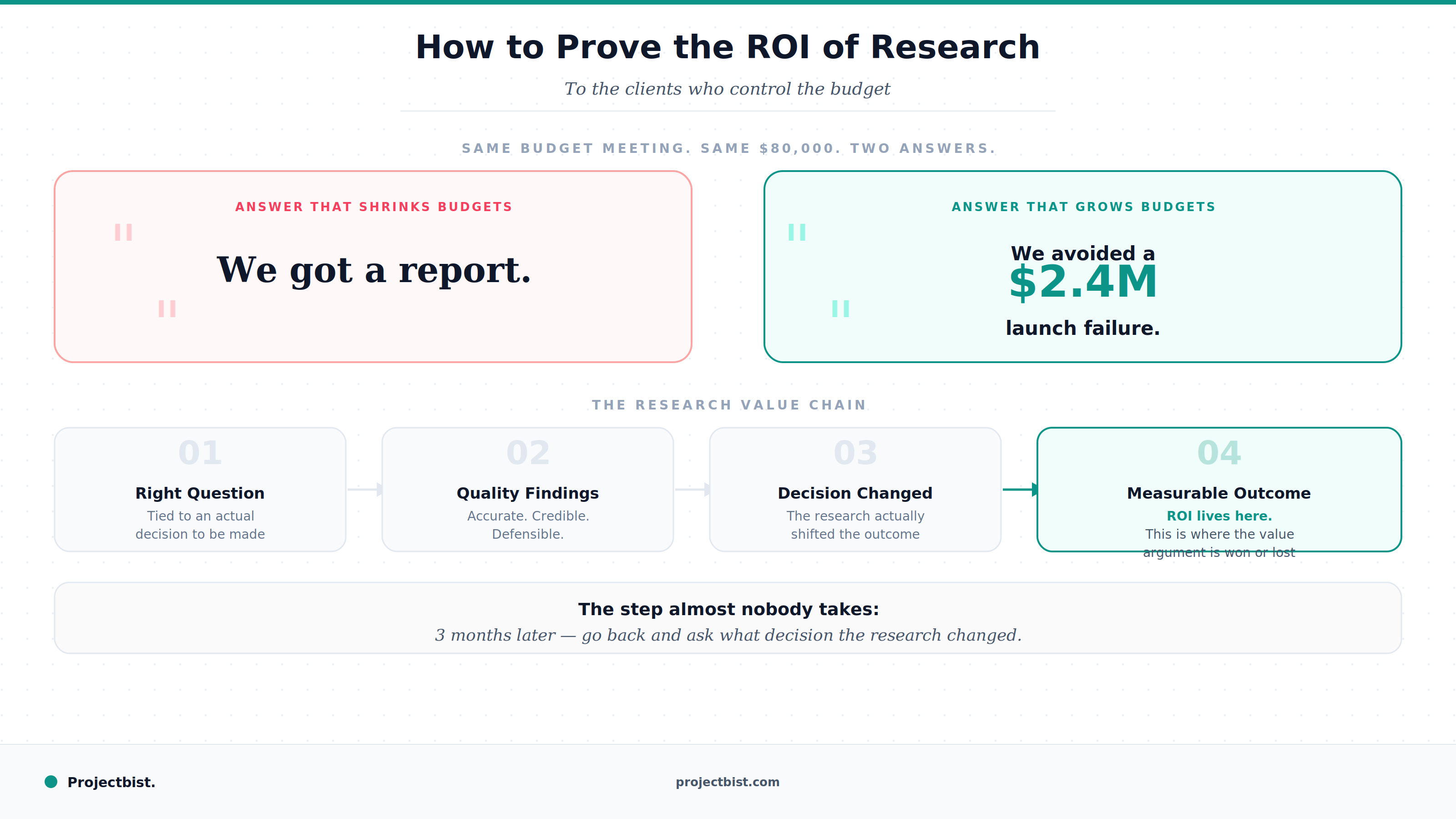
Research is a decision-support investment. Its value is not in the report. It is in whether the report changed a decision for the better, and whether that decision produced a measurable outcome.
The challenge is that research teams almost never close that loop. They deliver a report, move to the next project, and never track what happened to the decisions the research was supposed to inform. When budget review time comes, there is no trail connecting the research investment to any measurable business outcome.
That is not inevitable. It requires designing research engagements with measurement in mind from the start.
Research ROI lives in link 4. But it requires all four links to be intact. Research that was methodologically rigorous but answered the wrong question, or answered the right question but was ignored by decision-makers, or was acted on but never tracked: none of these produce measurable ROI.
The research industry has spent decades improving the quality of links one and two. The real opportunity is links three and four. That is where the value argument is won or lost.
The strongest position is to establish the ROI framework before the research begins, not after.
A simple structure: 'This research will answer [specific question] which will inform [specific decision]. If the research changes our decision from [option A] to [option B], we estimate the outcome difference to be [estimated value] based on [specific assumptions]. The cost of the research is [amount]. The expected return is [ratio].'
Not all research lends itself to this level of specificity. But for any research where a specific decision follows, the pre-research ROI case is not only possible: it is persuasive in a way that post-hoc justifications rarely are.
Three months after delivering a research report, go back to the client and ask two questions: What decision did the research inform? What was the outcome?
Most clients will not have tracked this formally. But the conversation prompts them to connect the research investment to business outcomes in a way they had not done explicitly. And the answers, when they are positive, become the most powerful evidence for renewing the research relationship.
When the answers are negative, that is even more valuable. It tells you what did not work: whether the research question was wrong, whether the findings were not actionable, or whether the decision-making process ignored the research entirely. Each of those diagnoses points to a specific improvement in the next engagement.
Research firms that embed ROI measurement into their standard client engagement process differentiate themselves from those that deliver and disappear. This means: agreeing on success metrics before fieldwork starts, building in a 90-day check-in as part of the project scope, and documenting the outcome when the decision is made.
Over time, this produces a portfolio of outcome evidence that is far more compelling to prospective clients than any capability statement or case study can be. It shows not just that you can produce good research, but that your research produces good decisions.
Newsletter
Personalize your updates! Subscribe to ProjectBist's Newsletter and choose from the following categories.
How to Price Your Research Consulting Services: The Honest Guide for Independent Researchers Globally
Inference vs Description: The Distinction That Quietly Determines Whether Your Research Findings Mean What You Think They Mean

Time Use Surveys: The Research Method That Makes Invisible Work Visible