P
Loading blog...
Loading blog...
How you define poverty shapes what you see. The measurement framework is not a neutral choice: it determines which populations are counted, which interventions appear to work, and which policy responses seem justified.
Maya Chen
Jun 06, 2026•3 min read
Two studies examine poverty in the same district. The first, using a consumption expenditure survey, finds that 38 percent of households fall below the national poverty line. The second, using a multidimensional poverty index that includes education access, health outcomes, and housing quality alongside consumption, finds that 61 percent of households are deprived in at least two dimensions.
Neither is wrong. They are measuring different things. And the policy responses they suggest, the programs that would show impact under each measure, and the communities that show up as most in need are all different.
The choice of welfare measure in development research is not a technical footnote. It is a political and conceptual decision that shapes everything downstream.
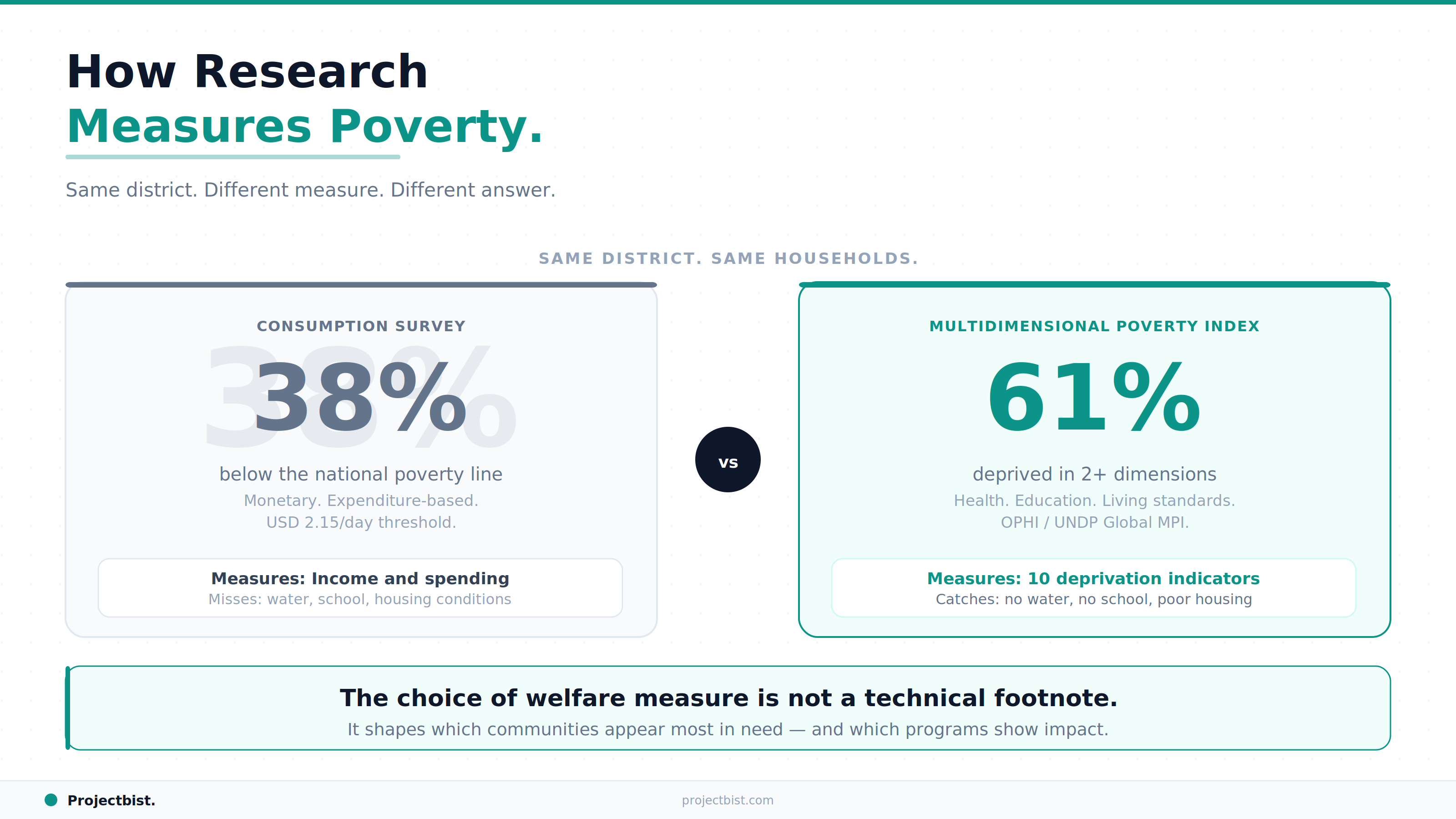
The most common international standard for monetary poverty measurement. Household surveys record all consumption, both purchased and subsistence, over a recall period (typically one week for food, one month for non-food regular items, one year for durables). Total per capita consumption is compared to a poverty line, defined at an expenditure level below which basic needs cannot be met.
The World Bank's international poverty line of USD 2.15 per person per day in 2017 purchasing power parity terms is based on this approach. The World Bank PovcalNet/Poverty and Inequality Platform provides global poverty data derived from harmonized consumption surveys.
Consumption data is expensive and complex to collect well, requires long recall periods that introduce memory error, and may not fully capture non-market welfare in subsistence-oriented economies where food grown and consumed at home is central to nutrition but difficult to value.
Developed by OPHI (Oxford Poverty and Human Development Initiative) and UNDP, the Global MPI measures poverty across three dimensions: health, education, and living standards, using ten indicators including child mortality, years of schooling, cooking fuel, water, sanitation, electricity, housing quality, and assets. A household is considered multidimensionally poor if it is deprived in at least one third of the weighted indicators.
The MPI captures deprivations that income measures miss: a household may have consumption above the monetary poverty line while having no access to clean water, no electricity, and no schooling beyond primary for its children. These deprivations matter for welfare independently of income.
Asset indices score households based on ownership of durable goods (refrigerators, televisions, motorcycles), housing quality (wall, roof, and floor materials), and access to services (water source, toilet type). They are substantially cheaper to collect than consumption data and less susceptible to recall error.
The limitation is that assets are a proxy for long-run wealth rather than a measure of current consumption or deprivation. A household that recently lost its income may retain assets while experiencing acute food insecurity. Asset indices are better for stratification and program targeting than for measuring recent changes in welfare.
Self-rated welfare, questions like 'How do you rate your overall wellbeing?' on a ladder scale, or the Cantril Self-Anchoring Striving Scale, capture what respondents themselves think of their situation. These measures consistently diverge from objective welfare indicators in interesting ways: populations with objectively low material welfare sometimes report higher wellbeing than wealthier populations if they have stronger social ties, community cohesion, and sense of agency.
The welfare measure you choose is a statement about what poverty means. Consumption poverty says poverty is about not having enough money to buy things. Multidimensional poverty says it is about being deprived of the building blocks of a decent life. Both are right about something. Neither is complete.
Newsletter
Personalize your updates! Subscribe to ProjectBist's Newsletter and choose from the following categories.
Ethnographic Research: How to Study Culture and Community by Being Present in Ways Other Methods Cannot
Survey Translation and Back-Translation: How to Ensure Your Instrument Means the Same Thing in Every Language
How to Build a Research Firm From Scratch: What the First Three Years Actually Require