P
Loading blog...
Loading blog...
Surveys capture responses. Ethnography captures reality. For understanding how people actually live, the presence of a researcher in a community over time is still the most powerful data collection instrument available.
Sofia Alvarez
Jun 14, 2026•3 min read
In 1973, agricultural economist Robert Chambers noticed something that changed development research. When he visited project sites with government officials and international consultants, everyone ended up in the same places: the villages near paved roads, the households whose heads were willing to receive visitors, the fields that were doing well. The genuinely poor, the isolated, the ones whose situations were most difficult to access, were systematically invisible to official assessments.
He called this 'rural development tourism.' The antidote was deeper, longer, less structured presence in communities. That insight eventually became a set of participatory and ethnographic methods that remain foundational to qualitative development research.
Ethnography is the method built for exactly this purpose: understanding what is actually happening in a social setting, rather than what is visible from the outside in a brief, structured visit.
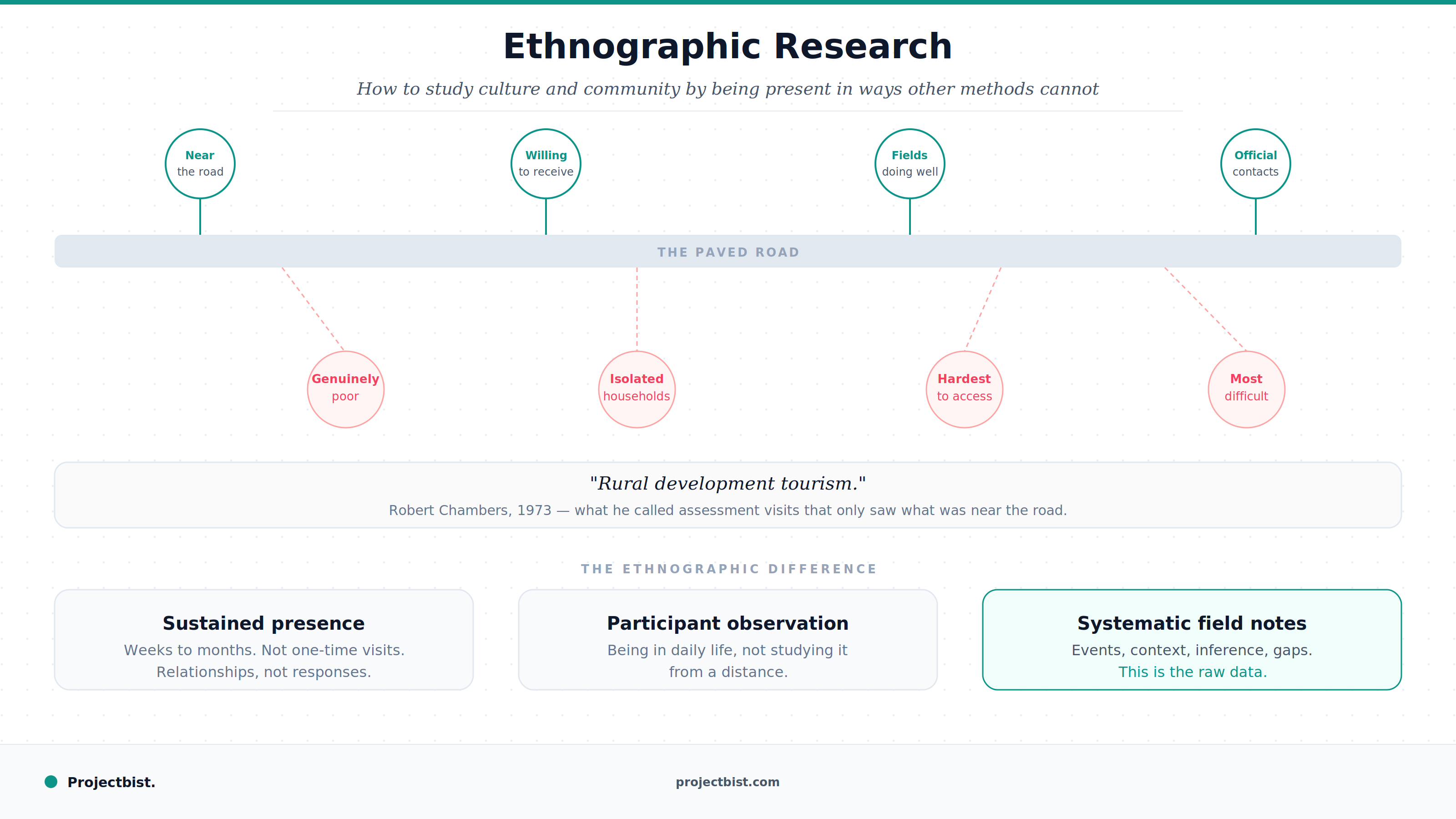
Ethnographic research requires a researcher to spend extended time in a social setting, participating in daily life to varying degrees, observing interactions and events, conducting informal and formal interviews, and producing systematic field notes that are analyzed to develop an interpretive account of the community's social life.
The defining characteristic is sustained presence. A researcher who spends two weeks in a community conducts some interviews and leaves is not doing ethnography. Ethnography typically requires months of presence, and sometimes years in academic contexts. Applied ethnography in commercial or development research is necessarily compressed, but even applied versions require several weeks of sustained fieldwork rather than one-time visits.
The researcher participates in the daily activities of the community, not as an outside observer but as a presence whose involvement is known and whose relationships with community members develop over time. Participation takes many forms: attending community meetings, sharing meals, accompanying people on their daily routines, being present during ceremonies and informal social gatherings.
The notes taken after each day of observation are the raw data of ethnography. They should capture not just events but context: who was present, what was said and not said, what the researcher inferred and on what basis, and what remains unexplained or puzzling.
Alongside observation, ethnographic researchers conduct conversations ranging from brief informal exchanges to extended life history interviews with key informants. These conversations fill gaps in what observation alone can reveal: people's own interpretations of their behavior, historical context that precedes the researcher's presence, and perspectives on aspects of community life that are not observable.
Physical documents, records, photographs, objects, and spatial arrangements in a community setting all carry social meaning. Birth and death records, land maps, agricultural calendars, household inventories, religious materials, and community meeting minutes are all sources of ethnographic data that observations and interviews alone cannot produce.
Ethnographic analysis is interpretive and iterative. It involves developing analytical categories from field notes and interview data, moving between those categories and the data to refine them, and eventually producing a written account that makes the insider logic of the community comprehensible to outside readers.
The final ethnographic account is not a summary of everything that happened in the field. It is an argument: a claim about how this community works, supported by evidence from the fieldwork, that is sufficiently specific and detailed to be challenged, extended, or refined by other researchers.
Newsletter
Personalize your updates! Subscribe to ProjectBist's Newsletter and choose from the following categories.
Survey Translation and Back-Translation: How to Ensure Your Instrument Means the Same Thing in Every Language
How to Build a Research Firm From Scratch: What the First Three Years Actually Require
Grounded Theory: Building Theory From Data Rather Than Testing It