P
Loading blog...
Loading blog...
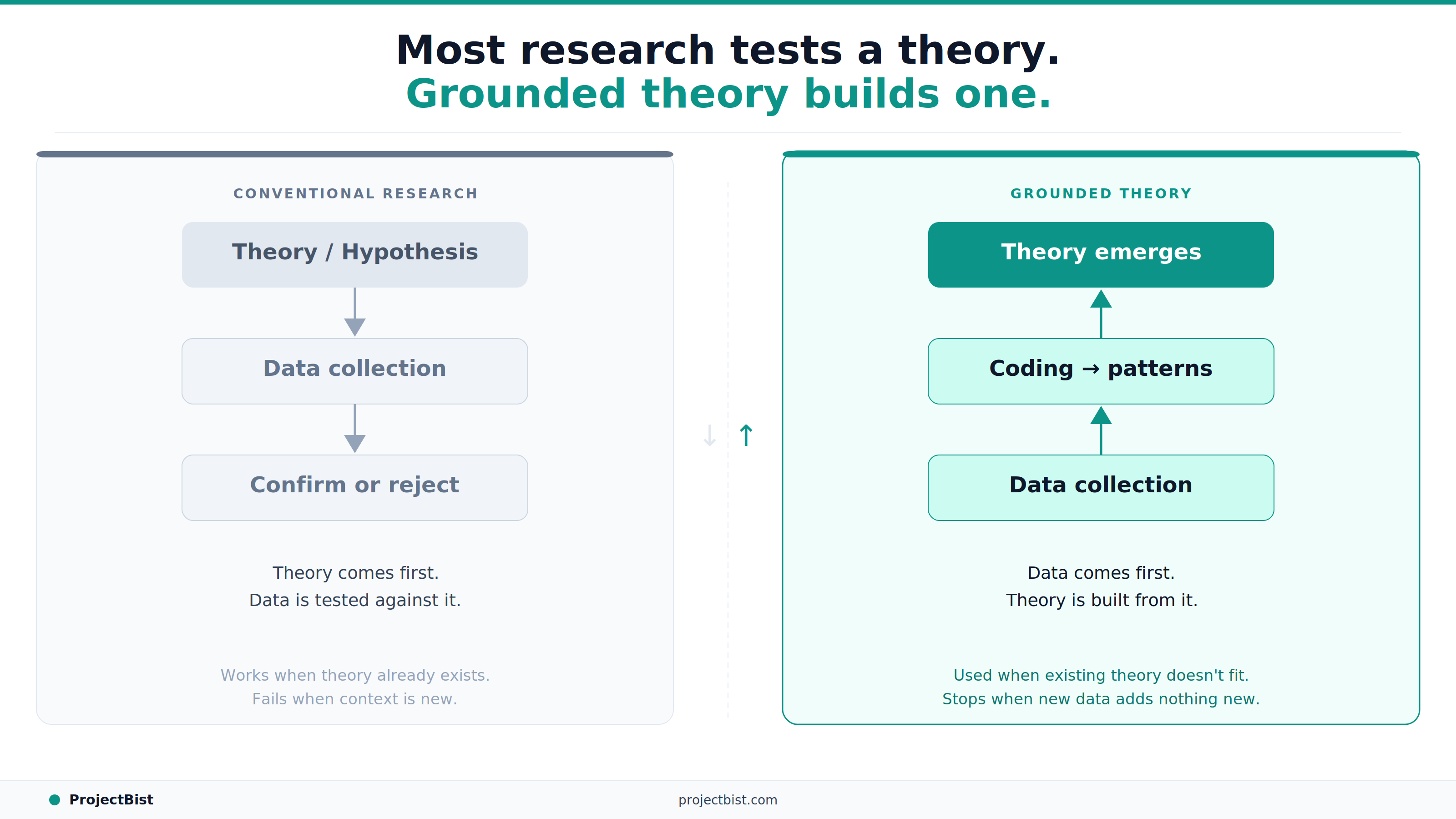
Most research starts with a hypothesis and tests it. Grounded theory starts with data and builds the explanation from what it finds. The difference is more fundamental than it sounds.
Sofia Alvarez
Jun 08, 2026•4 min read
Most researchers approach their field with a theory already in hand. Literature review, conceptual framework, hypotheses derived from existing models, data collection to test those hypotheses. This is the standard scientific method applied to social phenomena, and for questions where existing theory is well-developed, it works well.
But some of the most important research questions are the ones where existing theory is inadequate, incomplete, or simply does not apply to the context at hand. How do informal savings groups in rural West Africa actually make lending decisions? How do frontline health workers navigate conflicting institutional mandates in a specific country context? What does 'economic recovery' actually mean to households that experienced a specific shock?
For questions like these, testing an imported theory often produces findings that technically confirm it while missing what is actually happening. Grounded theory is the methodology built for exactly this situation.
Grounded theory was developed by sociologists Barney Glaser and Anselm Strauss, first described in their 1967 work The Discovery of Grounded Theory. The core principle is simple but methodologically demanding: theory should emerge from systematic engagement with data, not be imposed on it from prior literature.
The researcher enters the field without a predetermined analytical framework. Data is collected and analyzed simultaneously, with each round of analysis shaping the next round of data collection. The process continues until theoretical saturation: the point at which new data no longer produces new analytical categories.
Unlike probability sampling or purposive sampling, theoretical sampling in grounded theory means selecting next cases based on what the developing theory needs to understand. If an early category is emerging around how women navigate childcare constraints in accessing financial services, theoretical sampling means deliberately seeking out women in different childcare situations to test whether the category holds, breaks down, or needs refinement.
Every incident, quote, or observation in the data is compared to every other incident, quote, or observation to identify similarities and differences that help define the category boundaries. This is the analytical engine of grounded theory. It is time-intensive and cannot be shortcut without degrading the analytical quality of the theory produced.
Open coding breaks data apart, assigning labels to every incident or piece of data without yet looking for patterns. Axial coding begins reassembling the data by identifying relationships between categories, asking: what conditions give rise to this category, what actions or strategies does it involve, and what are its consequences? Selective coding identifies the core category, the central concept around which the developing theory is organized, and systematically relates all other categories to it.
Memos are the researcher's ongoing analytical conversation with their data: recording ideas about what categories mean, how they relate, where the theory is developing toward, and what questions remain open. In genuine grounded theory, the memos are as analytically important as the codes themselves. A grounded theory study without extensive memos is usually a study that has borrowed the name without applying the method.
The most common misuse of grounded theory is applying the term to thematic analysis that started with a conceptual framework. If you knew what you were looking for before you looked, you did not do grounded theory.
Grounded theory is appropriate when: you are studying a phenomenon that has not been adequately theorized for your specific context; you want to understand how people experience and navigate a particular social process rather than test a pre-existing model; or existing theory from other contexts seems unlikely to transfer without significant modification.
It is not appropriate when: you have a specific hypothesis to test; when time constraints do not allow for the iterative, saturation-seeking data collection the method requires; or when your research question is primarily descriptive rather than theory-building.
Newsletter
Personalize your updates! Subscribe to ProjectBist's Newsletter and choose from the following categories.
Ethnographic Research: How to Study Culture and Community by Being Present in Ways Other Methods Cannot
Survey Translation and Back-Translation: How to Ensure Your Instrument Means the Same Thing in Every Language

How to Build a Research Firm From Scratch: What the First Three Years Actually Require