P
Loading blog...
Loading blog...
A survey that asks different questions in different languages is not a multi-language survey. It is multiple different surveys that will produce data that cannot be compared.
Ravi Menon
Jun 12, 2026•4 min read
A study across six West African countries translates its food security survey from English into the national languages of each country. The data is collected, merged, and analyzed. The findings from two countries diverge significantly from the others in ways that do not match the economic and humanitarian reality of those countries.
Later review reveals that in one country, the phrase 'food-insecure' was translated using a term that local respondents understood to mean 'uncertain about food preferences.' In another, a question about 'household income' was translated with a word that implies formal employment income, so respondents with subsistence farming income reported zero.
The data was collected in six languages. The six versions were not measuring the same constructs.
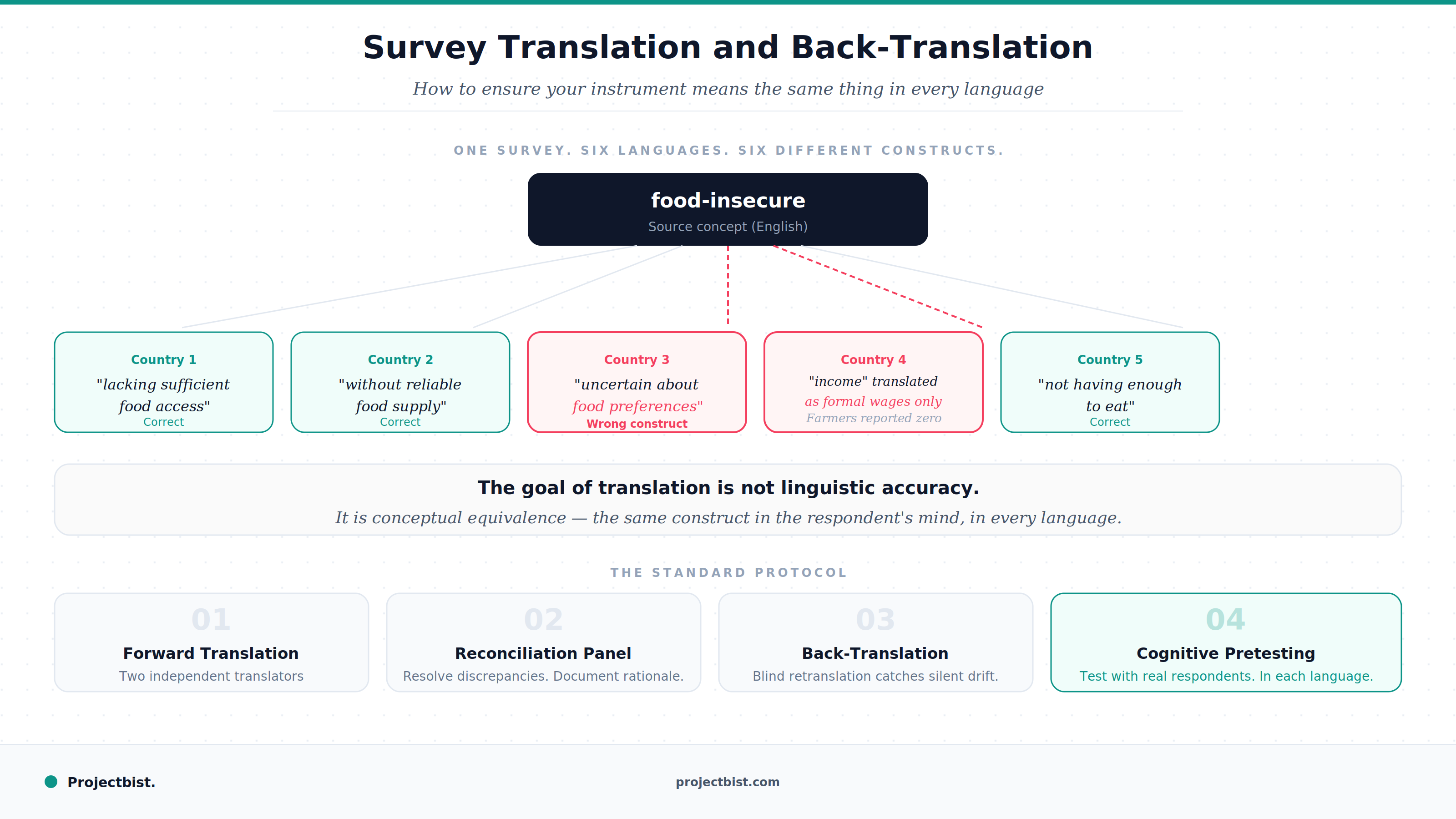
The goal of survey translation is not linguistic accuracy. It is conceptual equivalence: ensuring that the intended construct is evoked in the respondent's mind in the target language with the same meaning and the same degree of specificity as it is in the source language.
Words that translate linguistically correctly may not translate conceptually. 'Self-efficacy,' 'household,' 'income,' 'mental health,' 'privacy,' and 'community' are all examples of concepts that have clear English meanings and complex, culturally variable meanings when translated into many other languages. A translator who converts the words without engaging with the construct creates a measurement problem that is invisible until the data is analyzed.
Two translators with native fluency in the target language and research context expertise independently translate the instrument. Having two independent translations reveals ambiguities in the source instrument that a single translator might resolve in one direction without flagging it.
The two translations are reviewed by a bilingual reconciliation panel that identifies discrepancies and reaches a consensus version. Each discrepancy is documented with the rationale for the chosen resolution. This documentation becomes part of the methodological audit trail.
A third translator, who has not seen the original source instrument, translates the reconciled version back into the source language. The back-translation is compared to the original. Significant divergence between the back-translation and the original flags either a translation problem or an ambiguity in the original source instrument that needs to be resolved.
The translated instrument is administered to five to ten respondents from the target population in each language, using cognitive interviewing techniques: asking respondents to read each question aloud and explain in their own words what they understand it to be asking. This step catches translation problems that the bilingual review process misses because it involves native speakers in the actual respondent population rather than professional translators.
Back-translation tells you whether the translation is linguistically recoverable. Cognitive pretesting tells you whether it is communicatively functional for actual respondents. You need both.
Many African and Asian languages that have significant research populations do not have standardized written forms, do not have established technical vocabularies for research constructs, or are spoken by populations with limited formal literacy. These realities require adaptations to the standard translation protocol:
Newsletter
Personalize your updates! Subscribe to ProjectBist's Newsletter and choose from the following categories.
Ethnographic Research: How to Study Culture and Community by Being Present in Ways Other Methods Cannot
How to Build a Research Firm From Scratch: What the First Three Years Actually Require
Grounded Theory: Building Theory From Data Rather Than Testing It