P
Loading blog...
Loading blog...
The oil and gas sector uses research differently from most industries. Understanding those differences is what separates a capable sector researcher from a generic one.
Kwame Mensah
Apr 07, 2026•4 min read
Research in the oil and gas sector is not just about market sizing and consumer behavior. It covers environmental impact, community relations, workforce dynamics, regulatory compliance, and strategic market intelligence — often simultaneously. A researcher from a consumer goods background stepping into an oil and gas project will encounter methodological demands and stakeholder dynamics that do not appear in any other sector quite the same way.
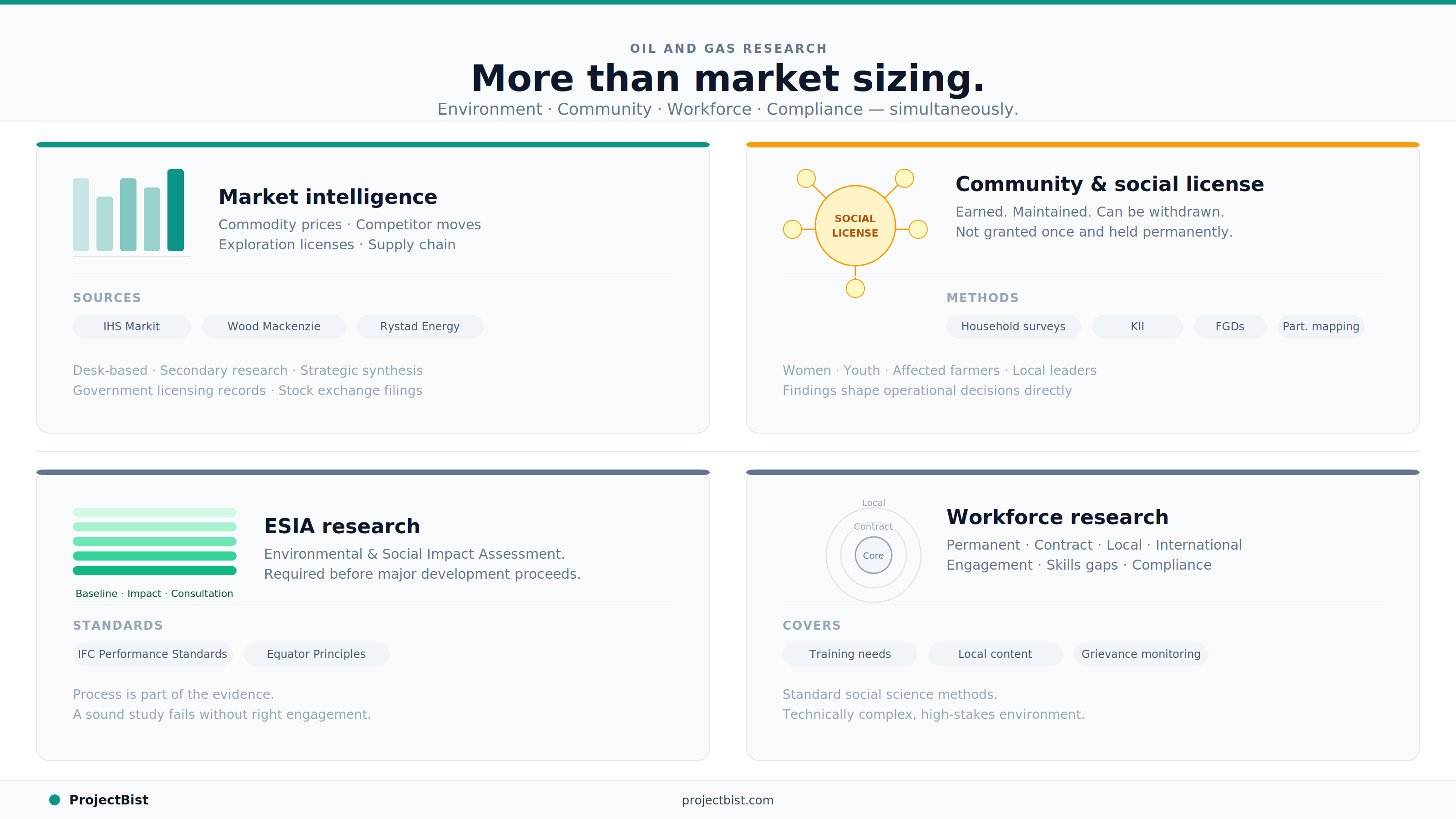
Companies operating in oil and gas need continuous intelligence on commodity price forecasts, competitor activity, new exploration licenses, refinery capacity changes, and supply chain developments. This research is primarily desk-based, drawing on industry databases such as IHS Markit, Wood Mackenzie, and Rystad Energy, as well as government licensing records and stock exchange filings.
Field researchers contributing to market intelligence studies need strong secondary research skills and the ability to synthesize complex, multi-source information into actionable strategic recommendations.
One of the most important and frequently underestimated research needs in oil and gas is understanding community perceptions of operations. Social license to operate — the ongoing acceptance of a company's activities by local communities — is not granted once and held permanently. It must be earned and maintained through meaningful engagement, and it can be withdrawn when communities feel their concerns are not being heard.
Research methods in this domain include household surveys in communities near operations, key informant interviews with local leaders, focus group discussions with specific community segments (women, youth, farmers whose land is affected), and participatory mapping of community concerns. The findings directly influence operational decisions and are often required as part of environmental and social impact reporting.
Most major oil and gas projects require a formal ESIA before development proceeds. The research component of an ESIA includes baseline studies of ecological and social conditions in the affected area, projected impact modelling, and stakeholder consultation to ensure affected communities have been properly engaged.
ESIA research is governed by international standards including the IFC Performance Standards and the Equator Principles, which set requirements for the scope and methodology of impact studies. Researchers working in this area need familiarity with these frameworks, not just with research methods.
In oil and gas research, the most technically sound study can still fail if it was not conducted with the right community engagement process. The process is part of the evidence.
Large-scale oil and gas operations have complex workforce structures: permanent employees, contract workers, local content workers, and international specialists. Research in this area covers employee engagement, skills gaps, training needs assessment, local content compliance, and grievance monitoring.
For researchers from social science backgrounds, workforce studies in oil and gas provide a structured application of standard survey and qualitative methods in a technically complex and commercially high-stakes environment.
Researchers with documented experience in oil and gas sector studies, particularly in community perception or ESIA work, are in high demand and can command premium rates. ProjectBist's sector filters allow clients to search specifically for researchers who have listed oil and gas sector experience in their profiles.
Newsletter
Personalize your updates! Subscribe to ProjectBist's Newsletter and choose from the following categories.
How to Price Your Research Consulting Services: The Honest Guide for Independent Researchers Globally
Inference vs Description: The Distinction That Quietly Determines Whether Your Research Findings Mean What You Think They Mean

Time Use Surveys: The Research Method That Makes Invisible Work Visible