P
Loading blog...
Loading blog...
Speed and quality are not always opposites. But fast research requires deliberate design choices that most researchers do not make when they are in a hurry.
Ravi Menon
Jun 02, 2026•4 min read
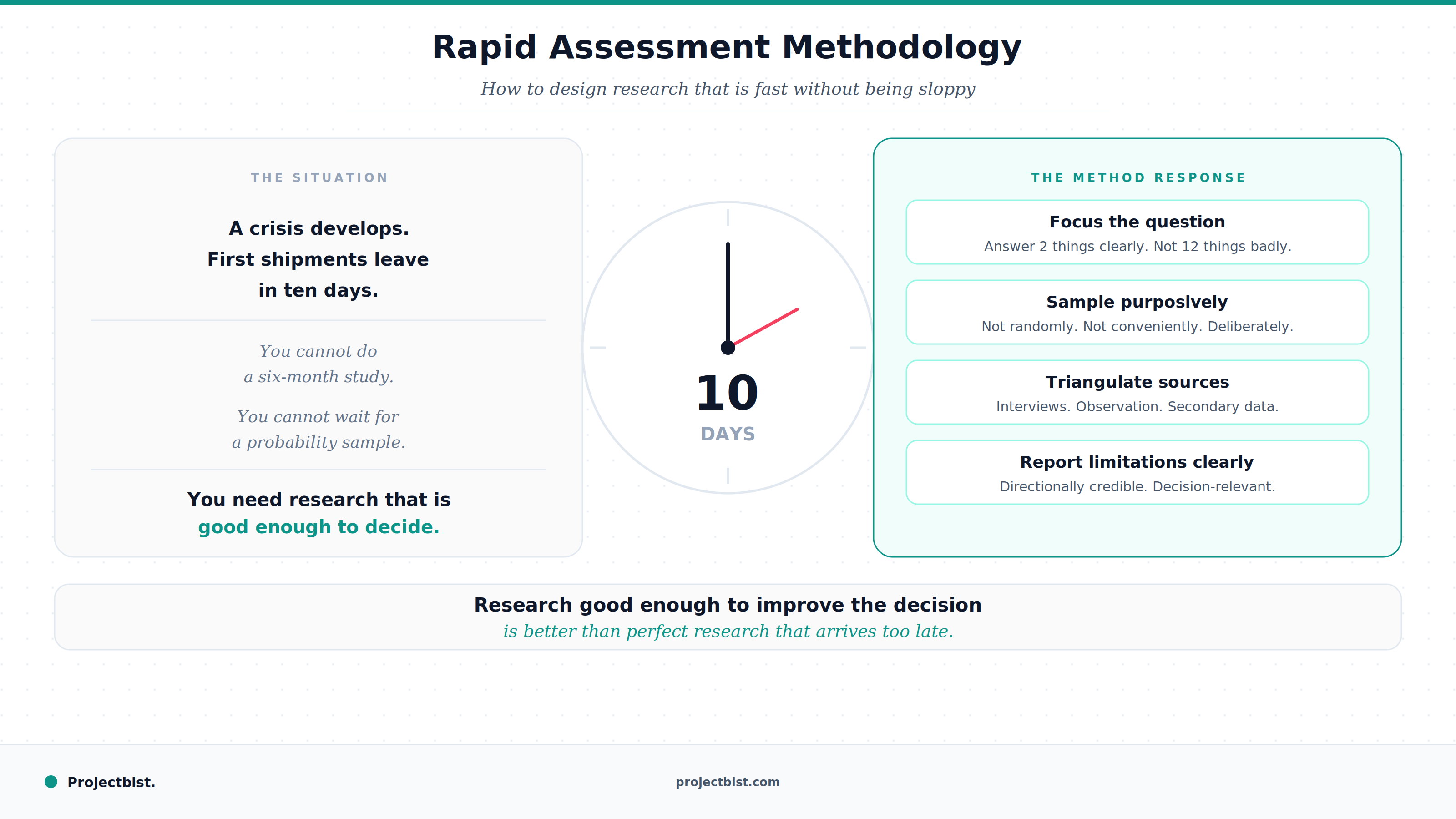
A humanitarian crisis develops in a region your organization is preparing to respond to. You have ten days before the first shipments need to leave. You need to understand the most critical needs among the affected population, the local market structures that would enable or constrain distribution, and the community dynamics that would affect acceptance of the response.
You cannot do a six-month ethnographic study. You cannot wait for a nationally representative probability sample. You need research that is good enough to improve the decision significantly over no research at all, produced within the time and resource constraints of the actual situation.
That is what rapid assessment methodology is for. And understanding how to design it well is different from just doing research faster.
Rapid assessment encompasses a family of research designs intended to produce actionable findings within days to weeks, using methods that are feasible under resource and time constraints while maintaining sufficient validity to support decision-making. The most established frameworks include:
Rapid assessments that try to answer too many questions answer none of them well. The primary constraint is time. Every additional research question extends the data collection period, complicates the analysis, and diffuses the findings. A rapid assessment that answers two questions clearly is more valuable than one that explores twelve questions superficially.
Probability sampling is usually not feasible in rapid assessments. The alternative is not convenience sampling but purposive sampling: deliberately selecting informants or sites that represent key types of variation in your research question. Document the sampling rationale explicitly. Readers need to understand who was and was not included and why.
A rapid assessment typically combines three or four data sources: key informant interviews, focus group discussions or community consultations, direct observation, and secondary data review. Triangulation does not make up for the limitations of any single source. It identifies where sources agree (building confidence in the finding) and where they disagree (requiring explanation rather than averaging away).
The professional obligation in rapid research is not to pretend the limitations do not exist but to report them clearly alongside the findings. A rapid assessment of 40 key informant interviews and four focus groups conducted over 10 days cannot produce findings with the same confidence as a probability sample of 800. It can produce findings that are directionally credible and decision-relevant, and the difference matters.
The goal of rapid research is not certainty. It is reducing uncertainty enough to make a better decision than no research would have enabled. That is a more modest but entirely legitimate goal.
Rapid assessments are not appropriate for research questions that require statistical inference about a defined population, causal impact evaluation, or findings that will be used to set policy across a large geographic area or substantial number of people. They are designed for early-stage intelligence gathering, emergency response contexts, and situations where any research is better than none.
Using rapid methods in contexts that require rigorous methods is a methodological error, not a pragmatic compromise. The output looks like research findings. The confidence that should attach to it is much lower than the format suggests.
Newsletter
Personalize your updates! Subscribe to ProjectBist's Newsletter and choose from the following categories.
Ethnographic Research: How to Study Culture and Community by Being Present in Ways Other Methods Cannot
Survey Translation and Back-Translation: How to Ensure Your Instrument Means the Same Thing in Every Language
How to Build a Research Firm From Scratch: What the First Three Years Actually Require