P
Loading blog...
Loading blog...
A cross-sectional survey tells you what is happening. A longitudinal study tells you whether it is changing and why. The gap between those two questions is enormous
Priya Nair
Apr 12, 2026•4 min read
A development program runs for three years. At the end of it, 72 percent of participants report improved livelihoods. Is the program responsible for that improvement?
Without a baseline, you cannot know. The 72 percent might have arrived at the program already doing well. Without a comparison group or a pre-post design, there is no way to isolate the program's contribution. And without following the same individuals over time, what looks like an improvement might be a different group of people at the endpoint.
This is the problem longitudinal research design exists to solve. It is also the reason so many evaluations that could have been longitudinal end up as cross-sectional studies that cannot answer the questions they were commissioned to answer.
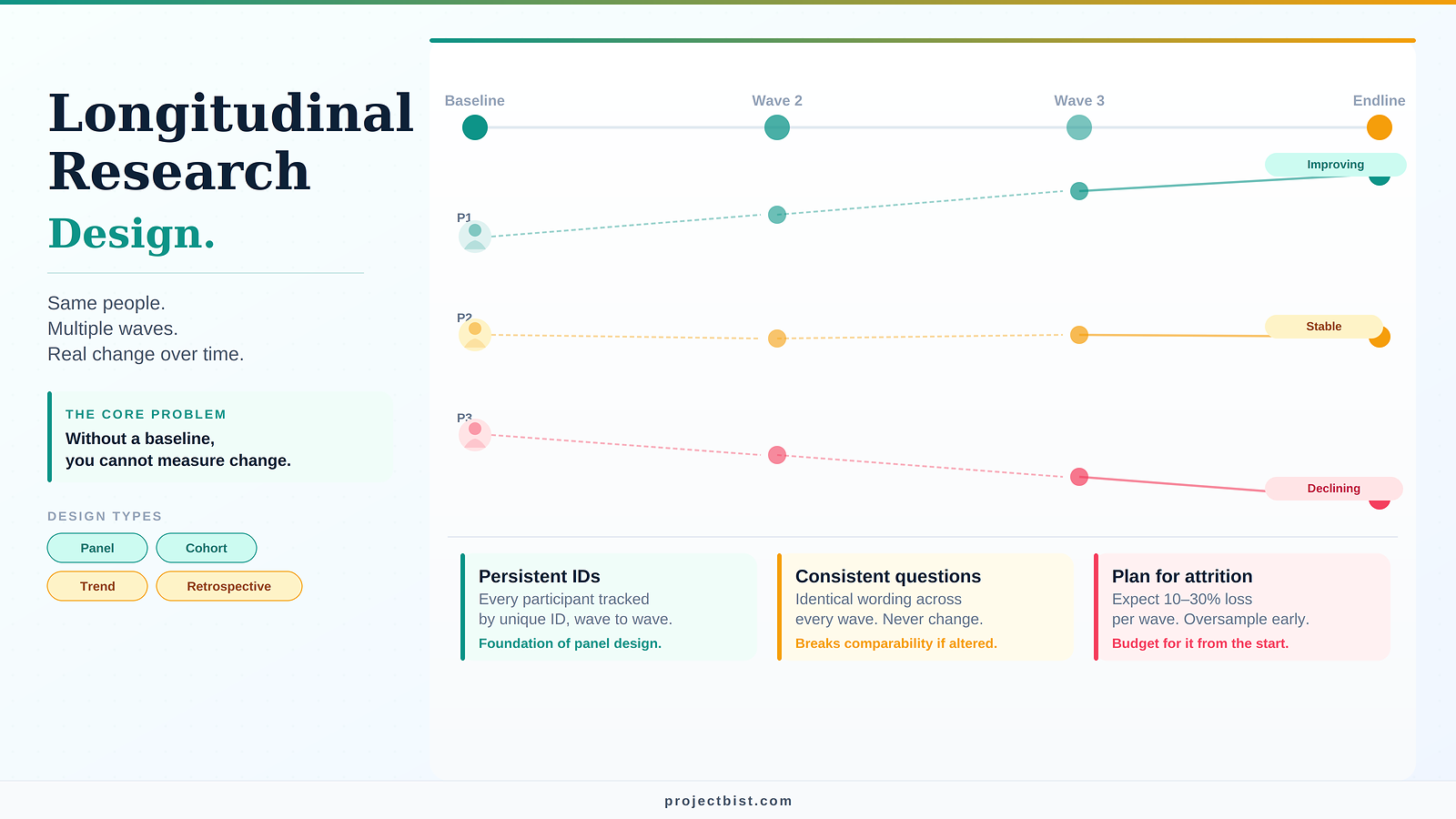
The same individuals are tracked across all measurement waves. This is the most powerful longitudinal design for measuring individual-level change, establishing causal relationships, and controlling for time-invariant differences between participants. It is also the most demanding: participants must be re-contacted and re-engaged at each wave, which requires persistent identification systems and dedicated follow-up protocols.
Panel design is the standard for household surveys tracking welfare outcomes, baseline-endline studies in development research, and longitudinal customer research tracking behavior over product or service lifecycles.
A group defined by a shared characteristic is tracked over time, but not necessarily the same individuals. A cohort study might follow all participants who completed a training program in a given year, surveying different members of that cohort at each wave. Cohort design is more resilient to attrition than panel design but cannot support individual trajectory analysis.
Different samples drawn from the same population are surveyed at each time point. This is what national opinion polls and annual consumer attitude surveys typically use. You are not tracking individuals. You are tracking population-level trends. The advantage is that attrition is not a problem because each wave draws a fresh sample. The limitation is that you cannot observe individual change, only population shifts.
Historical data collected over time is analyzed longitudinally after the fact. This is the fastest and cheapest approach, but it is limited to the questions that the original data collection instruments were designed to answer. If you need a baseline from three years ago but no baseline was collected, retrospective longitudinal analysis cannot create it.
The single most common reason a longitudinal study produces disappointing evidence is not poor execution. It is poor design at the start, usually choosing the wrong design type for the actual research question.
This is the foundation of panel and cohort design. Every participant receives a unique identifier at baseline that follows them through every subsequent wave. Without this, matching participants across waves becomes a manual reconciliation exercise that introduces errors and erodes the study's analytical integrity.
Questions that appear in multiple waves must be identical in wording, response options, and presentation. Changing a question between wave one and wave two, even to improve it, breaks the comparability of responses and introduces measurement error into the change estimate.
Panel studies lose participants over time. Some move. Some die. Some refuse further participation. Some simply cannot be recontacted. Attrition rates of 10 to 20 percent per wave are common, and if attrition is non-random (the people most affected by the program drop out at different rates than those least affected), the remaining sample becomes systematically biased.
Calculate your required wave-one sample size by working backwards from the minimum required sample at the final wave, adding a buffer for expected attrition at each wave.
Attrition cannot be eliminated. It can be managed. The strategies that make the most difference:
What is the difference between a longitudinal study and a panel study?
A panel study is a specific type of longitudinal study in which the exact same individuals are tracked across all waves. Longitudinal research is a broader category that includes panel studies, cohort studies, and trend studies. All panel studies are longitudinal, but not all longitudinal studies are panel studies.
What is attrition in longitudinal research?
Attrition is the loss of participants between waves in a longitudinal study. It becomes a problem when the people who drop out differ systematically from those who remain, biasing the analytical sample. Attrition is inevitable in long studies but can be minimized through active tracking, multiple contact points, and appropriate incentives.
How many waves does a longitudinal study need?
The minimum is two: a baseline and at least one follow-up. Most impact evaluations use two or three waves. Academic panel studies often span many more waves over years or decades. The appropriate number depends on the research question: how long does change take to manifest, and at what intervals is it meaningful to measure it?
Newsletter
Personalize your updates! Subscribe to ProjectBist's Newsletter and choose from the following categories.
Ethnographic Research: How to Study Culture and Community by Being Present in Ways Other Methods Cannot
Survey Translation and Back-Translation: How to Ensure Your Instrument Means the Same Thing in Every Language
How to Build a Research Firm From Scratch: What the First Three Years Actually Require