P
Loading blog...
Loading blog...
Computer-Assisted Personal Interviewing has become the standard for face-to-face fieldwork in professional research. Here is everything you need to know to do it properly.
Maya Chen
Apr 09, 2026•4 min read
Before digital tools changed how field surveys worked, an enumerator would arrive at a household with a paper questionnaire, a pen, and a clipboard. They would fill in the answers by hand, carry the forms back to the office, and wait for a data entry team to type everything into a system. At every step: transcription errors, lost forms, misread handwriting, data entry mistakes.
CAPI, Computer-Assisted Personal Interviewing, replaced that process. The enumerator still goes to the household. The interview still happens face-to-face. But the questionnaire lives on a tablet or smartphone, and every answer goes directly into a digital form with built-in logic, constraints, and quality checks.
It is now the standard for professional face-to-face survey research globally. Here is how it works and what you need to run it well.
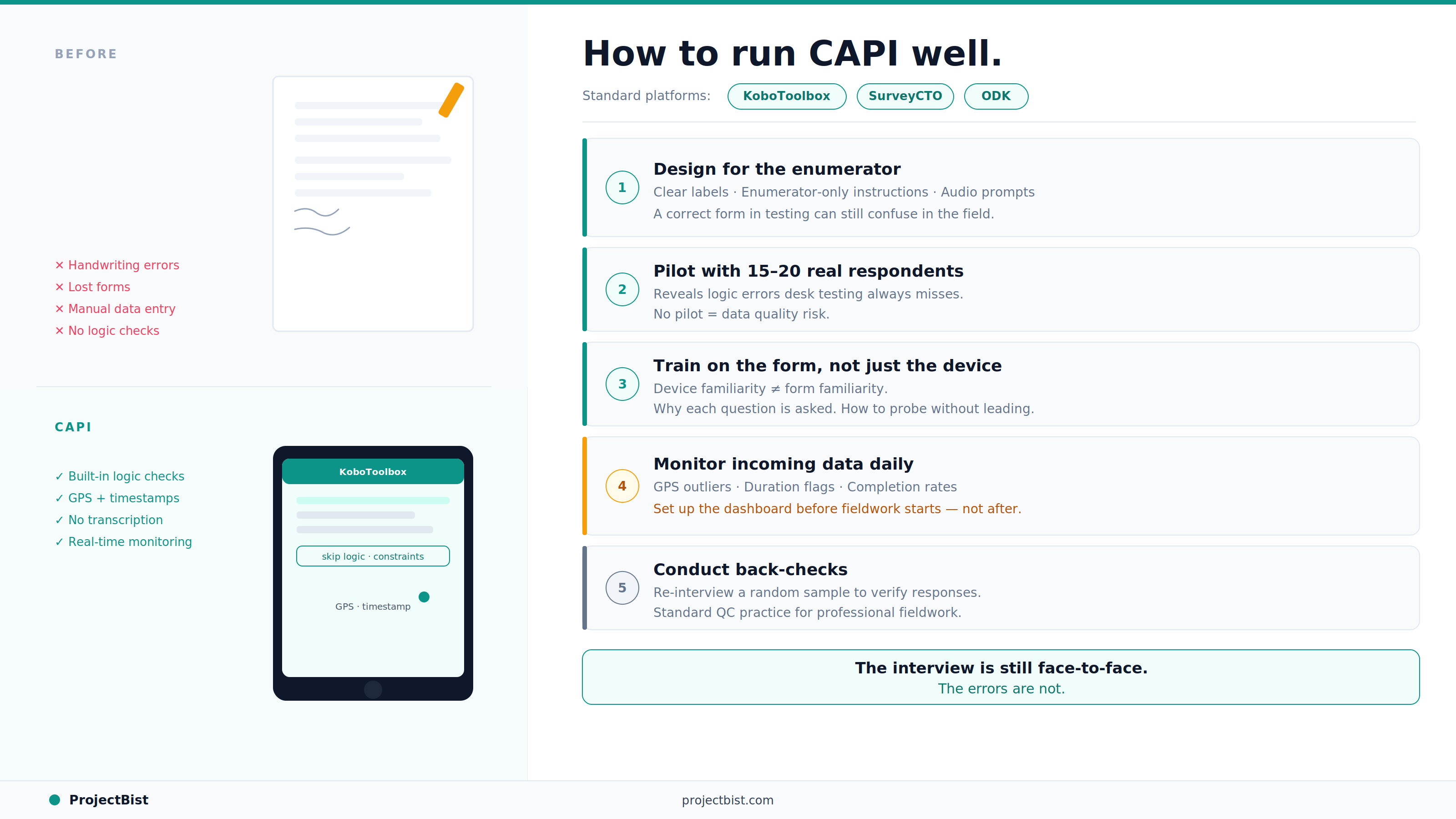
The three most widely used platforms in international development and applied research are:
A form that works correctly in testing can still confuse enumerators in the field. Use clear, short question labels. Add enumerator instructions (visible only to the interviewer, not the respondent) for questions that require explanation or that have unusual skip logic. Build audio prompts for enumerators who are working in language-diverse areas where reading fatigue is a concern.
A pilot with 15 to 20 real respondents in a representative setting will reveal almost every logic error, translation problem, and flow issue that desk testing misses. Any survey form that has not been piloted before full deployment is a data quality risk.
Device familiarity is not the same as form familiarity. Enumerators need to understand why each question is asked, how to probe appropriately without leading, and how to handle the specific respondent situations that create difficulty for that form. Training that only covers how to use the app is insufficient.
Set up a monitoring system before fieldwork begins, not after. Key things to check daily: GPS locations for interviews submitted outside the target area, interview duration per enumerator (flag those consistently faster than the expected minimum), completion rates against targets, and any constraint violations that were overridden.
A back-check involves contacting a random subset of respondents (typically 10 percent) after the interview to verify that it took place and that key responses were recorded correctly. Back-checks are the most reliable way to detect enumerator fabrication and are standard practice in professional CAPI research.
What is the difference between CAPI and CATI?
CAPI (Computer-Assisted Personal Interviewing) is conducted face-to-face: the enumerator is physically present with the respondent. CATI (Computer-Assisted Telephone Interviewing) is conducted over the phone. Both use digital forms to guide the interview, but the data collection context is different. CAPI allows for observation of respondent behavior and is better suited for complex or sensitive topics. CATI is faster and cheaper for large-scale surveys.
Can CAPI surveys be conducted offline?
Yes. Most professional CAPI platforms including KoboToolbox, SurveyCTO, and ODK support offline data collection. Forms are downloaded to the device before fieldwork. Completed interviews are stored locally and sync to the server when the device connects to the internet.
How do I prevent enumerator fabrication in CAPI?
GPS logging, interview duration monitoring, audio audits on random responses, and back-checks are the standard combination. No single method eliminates fabrication risk entirely, but used together they make systematic fabrication very difficult to conceal.
Newsletter
Personalize your updates! Subscribe to ProjectBist's Newsletter and choose from the following categories.
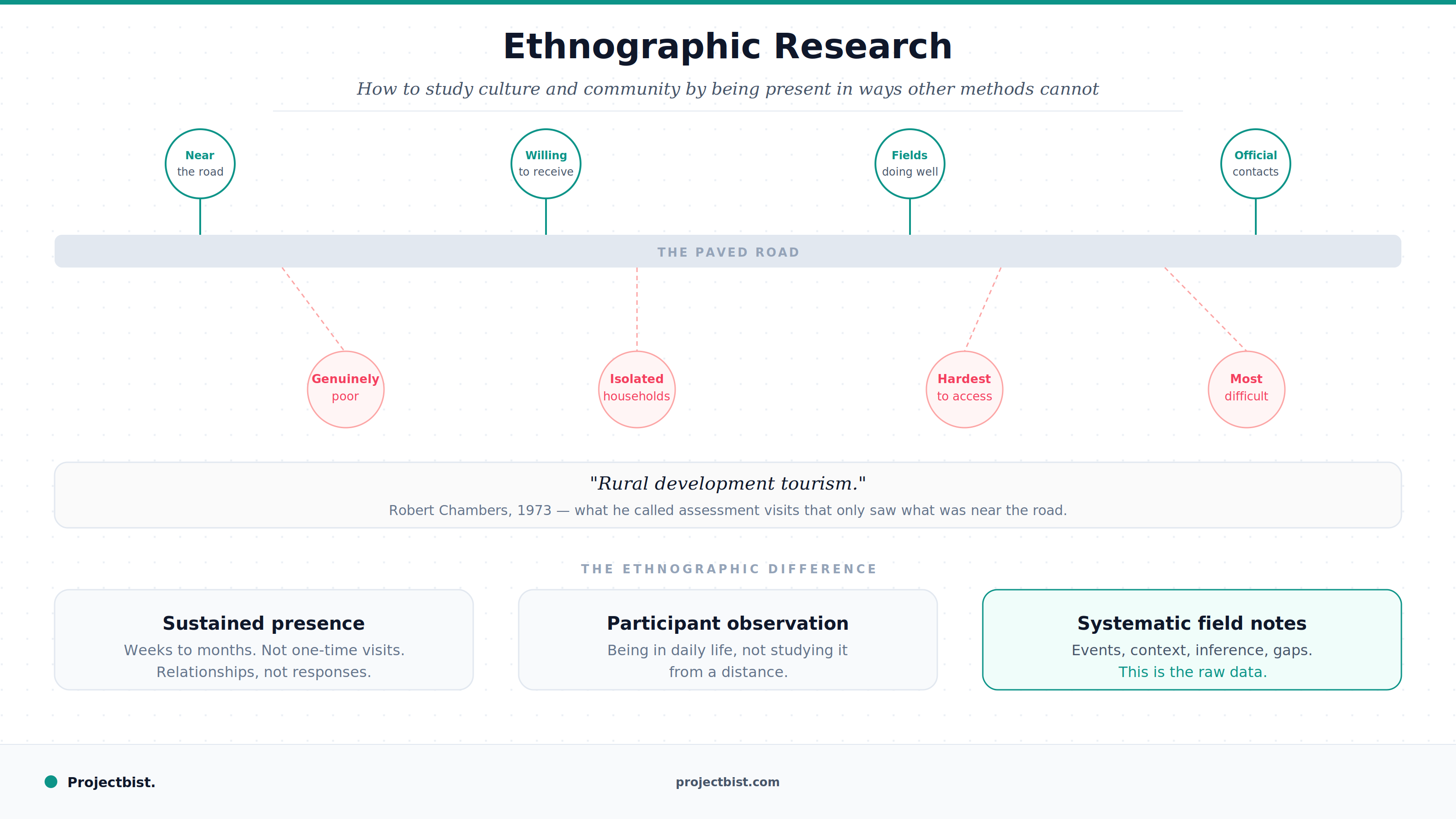
Ethnographic Research: How to Study Culture and Community by Being Present in Ways Other Methods Cannot
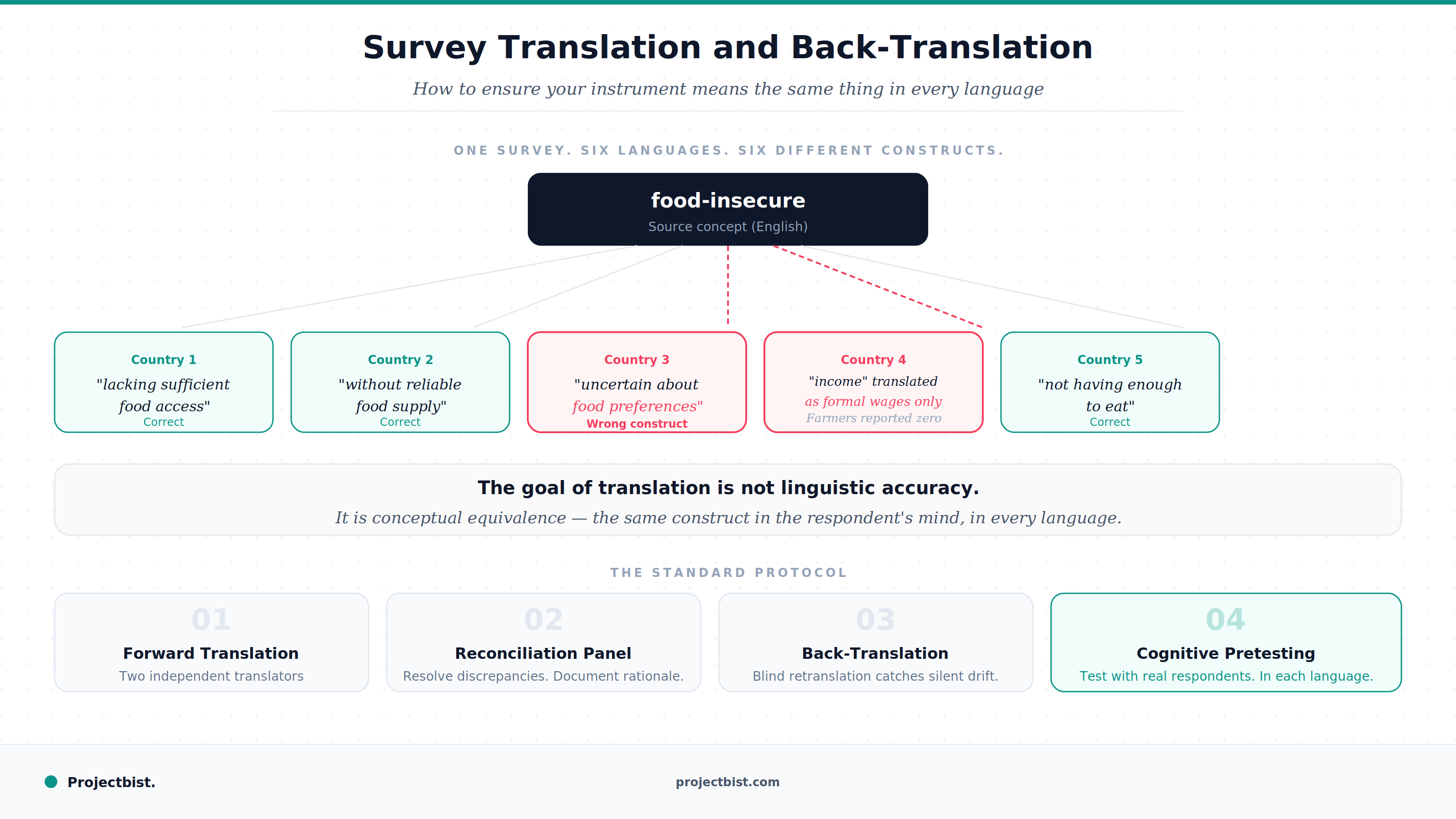
Survey Translation and Back-Translation: How to Ensure Your Instrument Means the Same Thing in Every Language
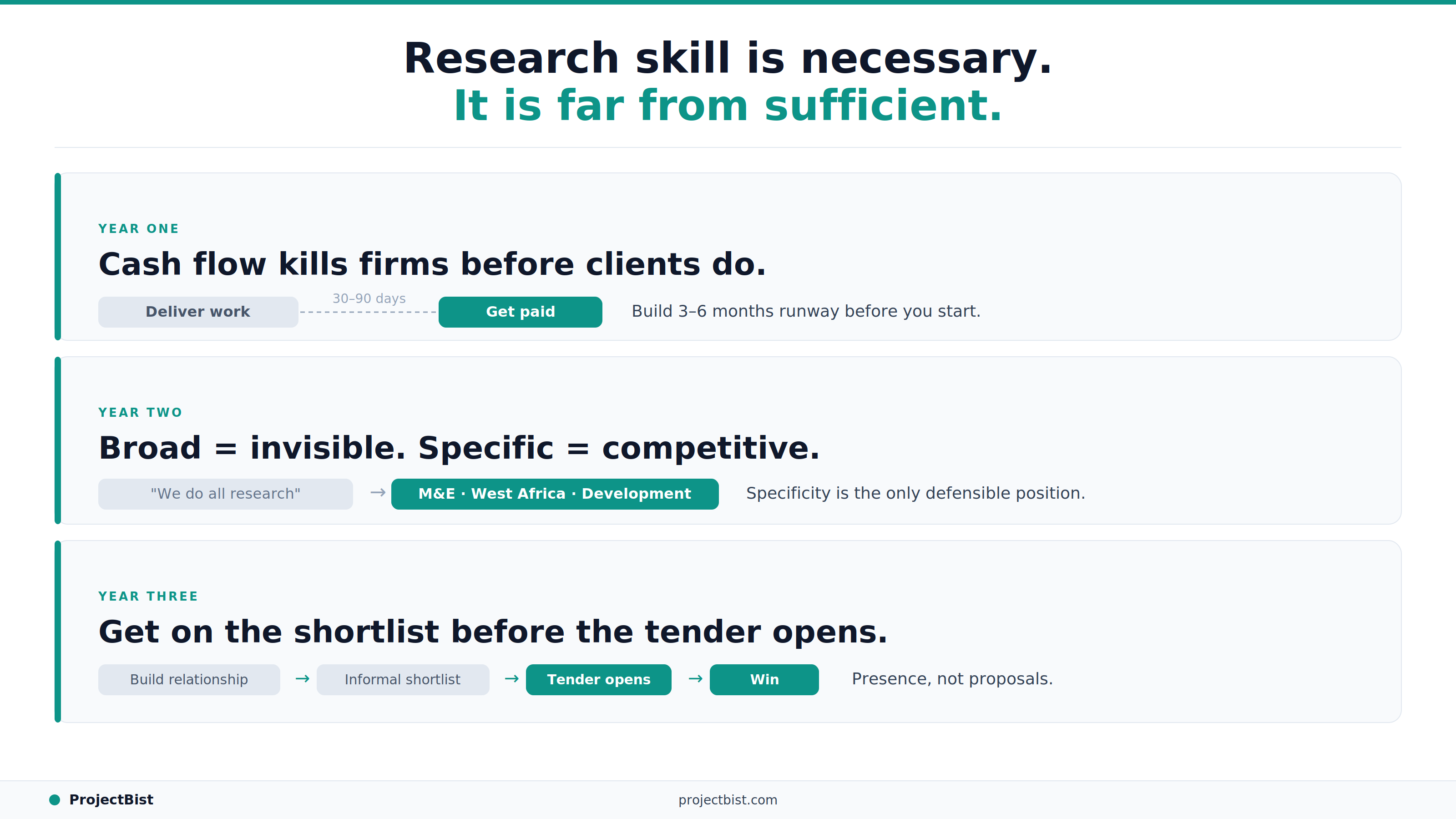
How to Build a Research Firm From Scratch: What the First Three Years Actually Require