P
Loading blog...
Loading blog...
One of the most rigorous within-household selection methods ever developed. Here is a practical guide to how it actually works.
Priya Nair
Mar 30, 2026•4 min read
Picture this. You arrive at a household for a survey. There are four adults at home. Your survey targets one respondent per household. You need to pick one. Randomly.
How do you do that without introducing bias?
The Kish Grid was developed to answer exactly this question, and it remains one of the most widely used and methodologically rigorous approaches to within-household respondent selection in field research globally.
Without a systematic selection method, interviewers tend to interview whoever is most available or most cooperative. That person is often a woman, often older, and often not representative of the full household membership. This introduces selection bias directly into your sample, even if your household selection was perfectly random.
The Kish Grid, first developed by survey methodologist Leslie Kish in 1949, solves this by giving every eligible person within the household a known probability of being selected, regardless of who answers the door.
The grid itself is a pre-printed table that interviewers carry into the field. Each household visit is assigned a sequential number (household 1, household 2, household 3, and so on).
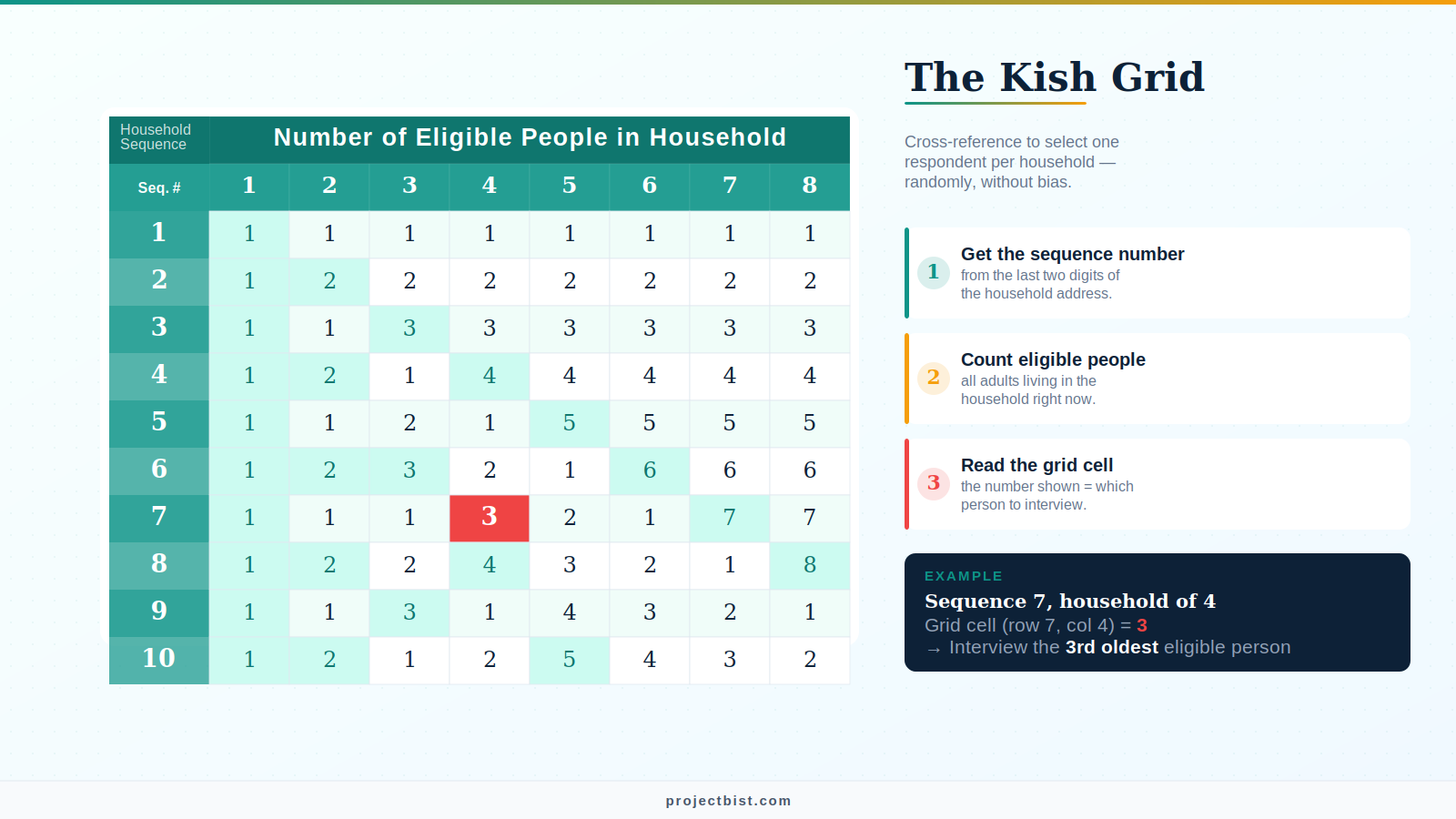
The grid itself is pre-configured so that across many households, the selection probabilities distribute evenly. No individual household needs to know about the grid. The randomness is built into the table design.
The Kish Grid does not ask you to trust the interviewer's judgment. It removes judgment from the equation entirely.
Research comparing the Kish Grid to alternative methods, including studies published in the Italian Sociological Review, has shown that the method can produce underrepresentation of men and overrepresentation of older respondents in contexts where household structures differ significantly from the American households of the 1950s when the grid was developed. This is particularly relevant in countries with large household sizes or where young men are frequently absent during typical interview hours.
Use the Kish Grid when:
Consider simpler alternatives (last-birthday, next-birthday, or youngest adult methods) when:
The Kish Grid is a rigorous, well-validated tool. Like all tools, its value depends on how well it matches the demands of the project. Understanding when to use it, and when a simpler method is equally valid, is part of what distinguishes a thoughtful researcher from one who applies methods mechanically.
ProjectBist profiles show methodology specialization and past project credentials.
Browse Field Researchersarrow_forwardSources: Leslie Kish (1949) — Journal of the American Statistical Association; SAGE Encyclopedia of Social Science Research Methods; Italian Sociological Review 2021; Statistics How To; ResearchGate
Newsletter
Personalize your updates! Subscribe to ProjectBist's Newsletter and choose from the following categories.
Ethnographic Research: How to Study Culture and Community by Being Present in Ways Other Methods Cannot
Survey Translation and Back-Translation: How to Ensure Your Instrument Means the Same Thing in Every Language
How to Build a Research Firm From Scratch: What the First Three Years Actually Require