P
Loading blog...
Loading blog...
Research budgets get cut when they are not clearly justified. Here is how to build one that explains its own logic and does not sacrifice quality under pressure.
Chloe Dubois
May 25, 2026•4 min read
Every research proposal has a moment: the client looks at the budget total and goes quiet for a second. Then they say: can we bring this down a bit?
If you do not have a clear, itemized, justified budget with specific trade-off logic, you will agree to cuts you should not have agreed to. You will reduce sample size to something that makes the analysis meaningless. You will cut the pilot test that would have caught the instrument error. You will agree to a timeline that makes proper analysis impossible.
And then you will deliver findings that are technically your findings but that carry more uncertainty than anyone realizes.
A properly built research budget prevents all of this, because it makes the trade-offs explicit rather than invisible.
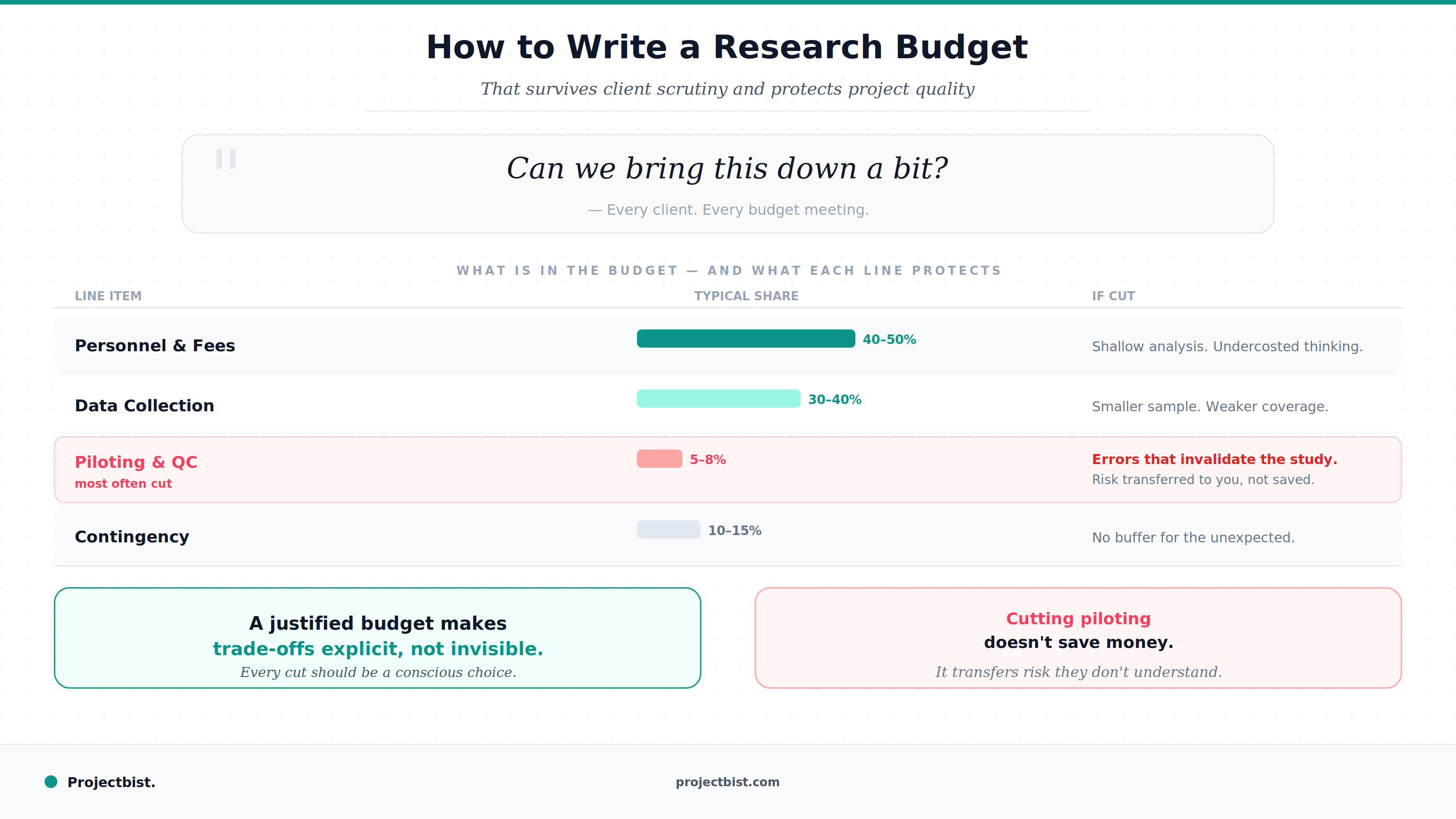
The largest cost in most research projects is researcher time. Be specific: principal researcher time for design, data collection oversight, analysis, and reporting; field supervisor time; enumerator time calculated by interview duration and travel; analyst time for quantitative or qualitative coding; and report writer time if separate from the analyst.
A common mistake is underestimating analysis time. Data collection is visible and easy to cost. Analysis is invisible and routinely undercosted. A 1,000-respondent quantitative survey with five variables of interest takes far less analysis time than a 1,000-respondent survey with complex cross-tabulations, regression analysis, and subgroup breakdowns. The brief should drive the analysis budget, not the sample size alone.
For field surveys: transport (often the most significant line item in rural research), respondent incentives, printing (for paper forms), device costs or rental, and supervisory logistics. For online surveys: platform fees, panel costs, and screening incentives. For qualitative studies: recruitment fees, venue hire for focus groups, recording and transcription.
This is the line item that gets cut most often and should not be. A pilot test that costs 5 to 8 percent of the data collection budget prevents errors that can invalidate the full study. Back-checking and data monitoring that costs 2 to 3 percent of the project budget is the difference between data you can stand behind and data that might embarrass you when scrutinized.
If a client proposes cutting piloting or quality control, be clear and direct about what that does to the findings. Not as a negotiating tactic. As genuine disclosure.
When a client cuts the pilot test, they are not saving money. They are taking on risk they do not understand, and transferring it to you.
Field research in particular encounters the unexpected: respondents who are harder to reach than expected, rainy season that delays access, community leaders who require formal engagement before surveys can proceed, or government requirements that were not anticipated during project design. A 10 to 15 percent contingency is standard for field studies in complex environments.
The single most effective approach to defending a research budget is to annotate it: for each significant line item, include a sentence explaining why this cost is present, what it produces, and what would be lost without it.
Most clients who push back on research budgets are not trying to undermine quality. They are working within their own organizational constraints and trying to understand what they are actually buying. A budget that explains itself gives them the information they need to advocate for the full budget internally, or to make an informed trade-off if they must.
If a client genuinely cannot fund the full study design, there are legitimate ways to reduce cost without destroying quality. Smaller samples with wider confidence intervals, fewer subgroup analyses, a desk-based rather than field-based component, or a narrower scope that answers fewer questions: all of these are honest trade-offs.
Keeping the sample size on paper while cutting the quality checks, shortening the analysis time without acknowledging that fewer variables will be reported, or committing to deliverables that cannot actually be produced within the timeline: these are not acceptable trade-offs. They are quiet deceptions that tend to produce unsatisfying work and relationships that do not renew.
Newsletter
Personalize your updates! Subscribe to ProjectBist's Newsletter and choose from the following categories.
Ethnographic Research: How to Study Culture and Community by Being Present in Ways Other Methods Cannot
Survey Translation and Back-Translation: How to Ensure Your Instrument Means the Same Thing in Every Language
How to Build a Research Firm From Scratch: What the First Three Years Actually Require