P
Loading blog...
Loading blog...
A weak brief produces weak proposals. Here is how to write one that works.
Sofia Alvarez
Mar 29, 2026•4 min read
The quality of the proposals you receive is almost entirely determined by the quality of your brief. That sounds obvious, but most clients underestimate how much work a brief actually needs to do.
A weak brief produces vague proposals, mismatched methodologies, and quotes that are either too high or suspiciously low because researchers are guessing at what the project actually involves. A strong brief attracts precise, competitive proposals from researchers who understood exactly what you need.
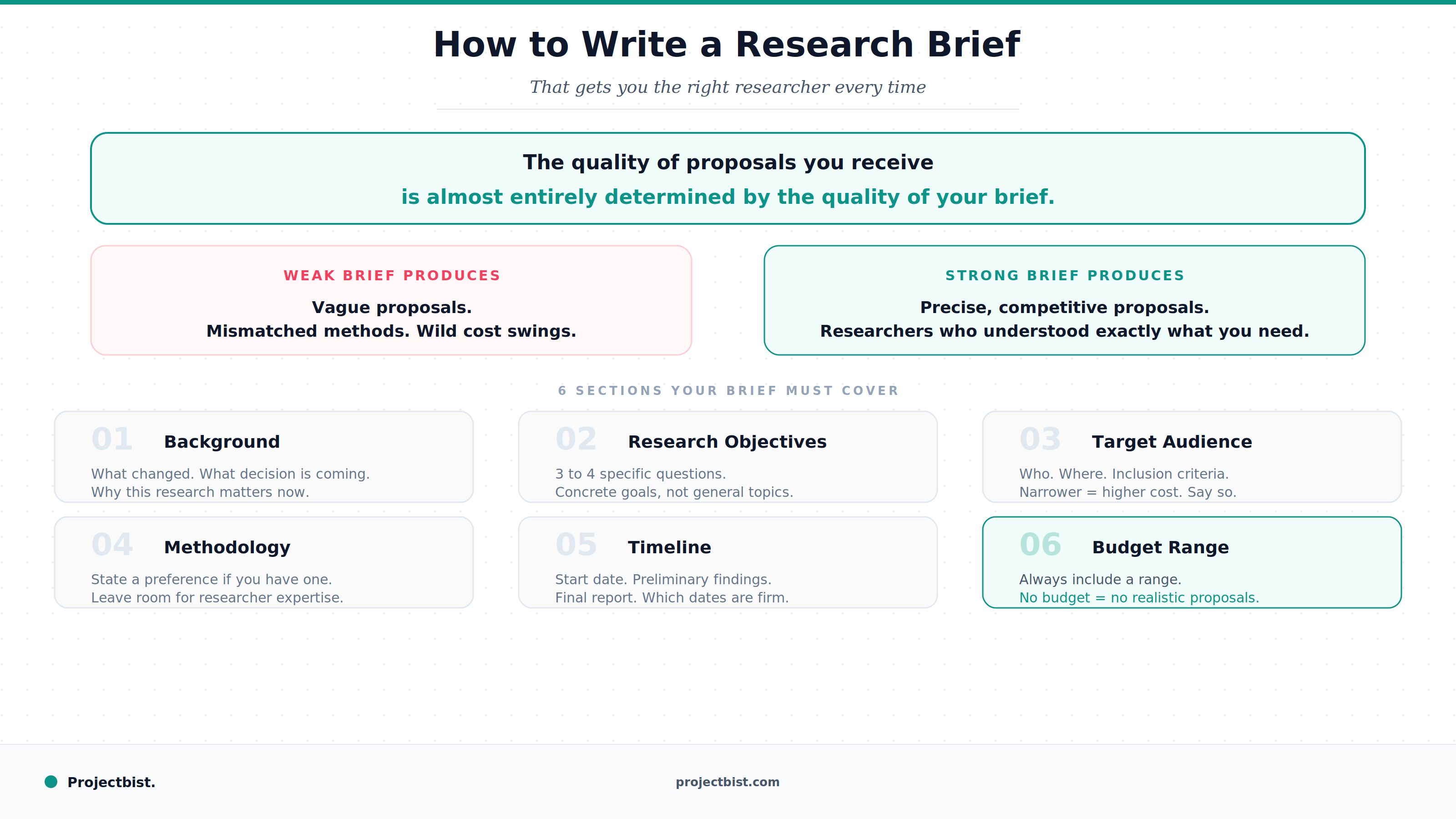
A research brief is not a research report, a full project specification, or a methodology guide. It is a client document that gives researchers enough context to understand the problem, propose an appropriate approach, and quote accurately. According to IFF Research, the best briefs are comprehensive enough to enable a detailed proposal but focused enough that the key information does not get buried in detail.
Start by telling researchers about your organisation and the situation that led to this research. What does your organisation do? What has changed or what decision is coming up that requires evidence? Keep this focused. Two or three paragraphs is enough. The goal is to give researchers the context to understand why this research matters.
List 3 to 4 specific things the research needs to find out. Frame these as concrete questions or measurable goals. Instead of 'understand consumer behaviour', write 'identify the three main reasons customers in Southwest Nigeria are switching away from our product.' Specific objectives produce specific proposals.
Who should this research focus on? Define the demographic, geographic scope, and any specific inclusion or exclusion criteria. If you need respondents from households earning below a specific income threshold, or businesses in a specific sector, say so here. Be honest about how restrictive the criteria are: narrower populations usually mean higher costs and longer timelines.
If you have a view on the research approach, include it. If not, you can leave this open and let researchers propose. As Conjointly notes, being too prescriptive on methodology can limit the quality of proposals. The best briefs indicate a preference where it exists but leave room for researchers to bring their own expertise.
Include the project start date, when you need preliminary findings, and when you need the final report. If there is a fixed decision date driving the timeline, say so. That context helps researchers understand which deadlines are truly firm.
Include at least a budget range, even if you are not certain. A researcher who does not know your budget cannot tell you whether their proposed approach fits within it. You do not need a precise figure, but 'up to $15,000' or '$10,000 to $25,000' gives researchers the information they need to propose something realistic.
What do you want at the end? A written report? A presentation? A dataset? Both? Be explicit. Researchers need to know what the final product looks like to scope and price the work correctly.
Most briefs describe the research need but not the decision it will inform. Adding one sentence that says 'this research will inform our 2026 market entry strategy' or 'findings will be presented to the board in October' gives researchers crucial context for how to frame their approach and how to calibrate the depth and rigor of the work.
Tell the researcher what you will do with the findings. It changes how they design the study.
A research brief is the first step in a working relationship. The effort you put into it signals to researchers how seriously you approach this project. A clear, well-structured brief tends to attract clear, well-structured proposals. And it reduces the back-and-forth before a project starts, which saves everyone time.
ProjectBist makes it easy to find the right researcher for every project.
Post a Research Jobarrow_forwardSources: IFF Research; Conjointly; Zappi; FlexMR; Blainy
Newsletter
Personalize your updates! Subscribe to ProjectBist's Newsletter and choose from the following categories.
Ethnographic Research: How to Study Culture and Community by Being Present in Ways Other Methods Cannot
Survey Translation and Back-Translation: How to Ensure Your Instrument Means the Same Thing in Every Language
How to Build a Research Firm From Scratch: What the First Three Years Actually Require