P
Loading blog...
Loading blog...
An IDI is not just a long survey. It is a craft that requires preparation, skill, and the discipline to get out of the respondent's way.
Sofia Alvarez
May 02, 2026•5 min read
There is a moment in a well-run in-depth interview where the respondent stops giving you the polite, considered answer they prepared and starts telling you what they actually think. It usually happens around the 20-minute mark, after the formal warm-up has passed and the respondent has decided you are genuinely listening.
That moment is what in-depth interviews are for. And it only happens when the researcher has done the preparatory work correctly and knows how to create the conditions for it.
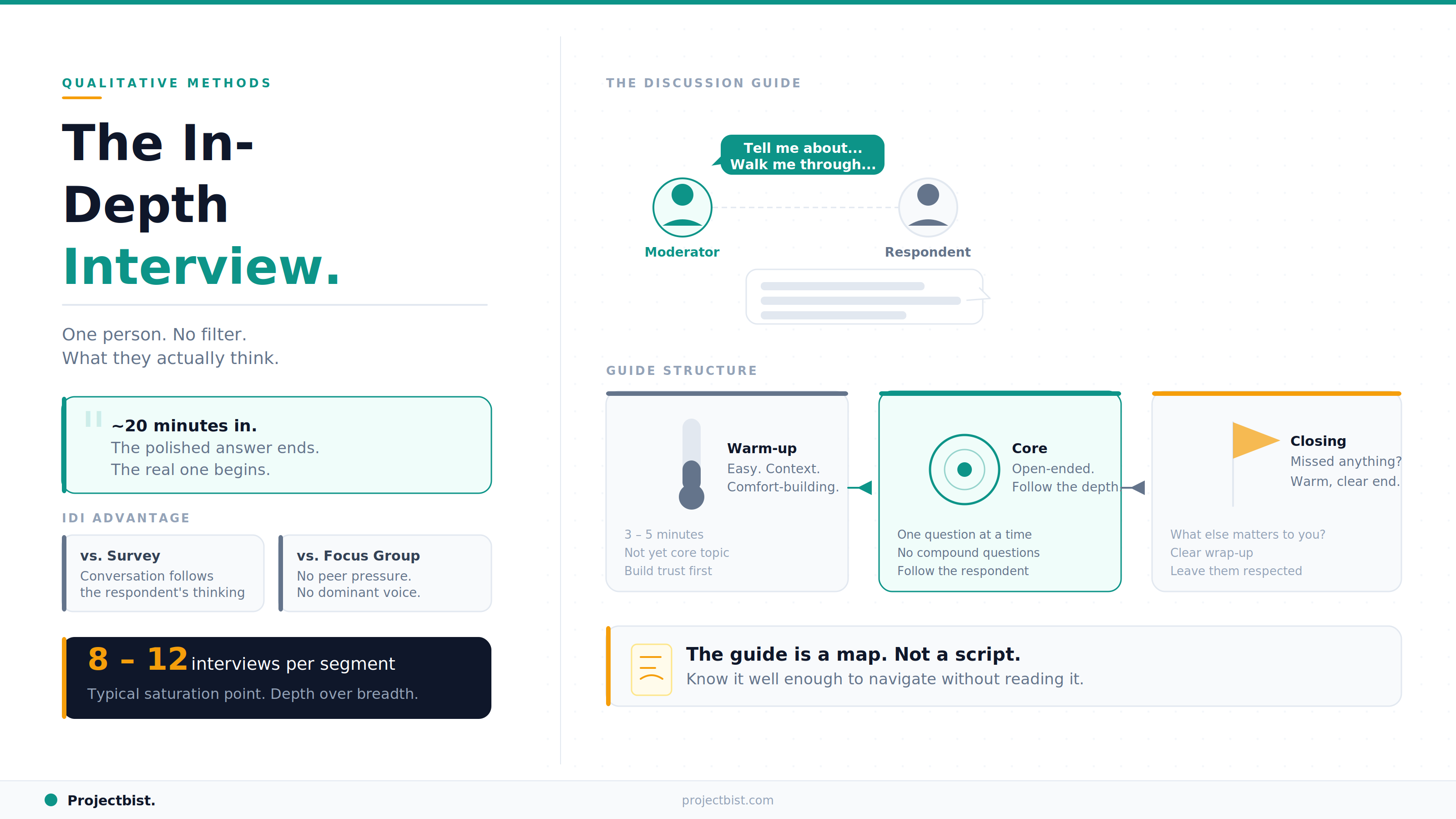
An in-depth interview is a one-on-one qualitative research conversation, conducted by a trained moderator, that explores a participant's views, experiences, motivations, or behaviors in depth. Unlike a survey, the conversation can follow the respondent's thinking wherever it leads most productively. Unlike a focus group, there is no group dynamic to manage, no peer pressure to conform, and no dominant participant pulling the conversation.
IDIs are the right choice when: the topic is sensitive enough that group dynamics would suppress honest answers; respondents are difficult to recruit together (senior executives, specialists, people in geographically dispersed locations); you need individual-level depth rather than group-level consensus; or your research question is genuinely about the individual's experience rather than a social phenomenon.
This is one of the most frequently asked questions about IDI research, and the answer is not a number. It is a principle: you collect interviews until you reach thematic saturation, the point at which new interviews stop producing new themes. In practice, for consumer IDI studies, 8 to 12 respondents per distinct segment typically reaches saturation. For studies with a single homogeneous population and a focused research question, saturation can occur as early as 6 to 8 interviews.
This is why IDI samples are smaller than survey samples: each interview generates far more analytical material per respondent than a survey response does. The trade-off is depth for breadth.
A discussion guide is not a questionnaire. It is a map, not a script. You should know it well enough to navigate the conversation without reading from it, adapting to where the respondent's most interesting answers are leading you.
Questions that begin with tell me about, walk me through, or describe for me tend to open conversations. Questions that begin with do you or is it tend to close them. Every question in the guide should be open-ended unless there is a specific reason to use a closed question.
Spend the first three to five minutes before you open the guide talking to the respondent personally. Ask about their day, their role, or their environment, depending on the research context. This is not wasted time. It signals that you are genuinely interested in them as a person, which changes the quality of everything that follows.
The single best discipline for an IDI moderator is to count how many words they are using compared to the respondent. If the ratio is not heavily skewed toward the respondent, something has gone wrong. Silence is a valid and powerful technique: after a respondent finishes an answer, waiting three seconds before speaking will often produce a more thoughtful follow-up from them than any question you could ask.
The most common mistake in an IDI is filling silence with questions. Silence is not a gap to fill. It is space for the respondent to think.
Probing is following up on something the respondent said to go deeper. Effective probes include: can you tell me more about that, what did you mean when you said, how did that make you feel at the time, has that always been the case?
Ineffective probes include those that telegraph the answer you are hoping for or that push the respondent toward a conclusion rather than genuinely exploring their view.
Write a debrief note within 30 minutes of every interview. Not a transcript. A note covering: the two or three most important things this respondent said, anything unexpected that emerged, how this interview compares to previous ones, and any analytical questions it raised.
These notes, written while memory is fresh, are often more analytically valuable than the transcripts themselves. They capture the tone, the hesitations, the things the respondent almost said. Transcripts capture words. Debrief notes capture meaning.
How long should an in-depth interview last?
Most IDIs for market and social research run 45 to 75 minutes. Shorter than 45 minutes rarely reaches the depth that makes IDIs worth the cost. Longer than 90 minutes produces diminishing returns as respondent fatigue sets in. For B2B executive interviews where time is scarce, 30 to 45 minutes is often the practical ceiling.
Should I record the interview?
Yes, always, with the respondent's explicit consent. Taking notes while interviewing splits your attention and damages rapport. Recording allows you to be fully present during the conversation. Transcription happens afterward. If a respondent refuses recording, note-taking during the interview is acceptable but document the limitation.
What is the difference between an IDI and a key informant interview?
A key informant interview (KII) targets someone because of their institutional role or specialist knowledge, like a government official, a community leader, or a sector expert. An IDI targets someone because of their lived experience as a member of a study population. The methodology is similar but the sampling logic and the type of knowledge being sought are different.
Newsletter
Personalize your updates! Subscribe to ProjectBist's Newsletter and choose from the following categories.
Ethnographic Research: How to Study Culture and Community by Being Present in Ways Other Methods Cannot
Survey Translation and Back-Translation: How to Ensure Your Instrument Means the Same Thing in Every Language
How to Build a Research Firm From Scratch: What the First Three Years Actually Require