P
Loading blog...
Loading blog...
Going independent in research is a real option. Building income that holds is a different skill from delivering research.
Amina Idris
Apr 04, 2026•4 min read
The first year of independent research consulting usually goes one of two ways. Either a researcher has two or three anchor clients from their previous institutional life and things feel stable. Or they are scrambling from project to project, wondering whether this was the right decision.
The difference between those two outcomes is rarely talent. It is structure.
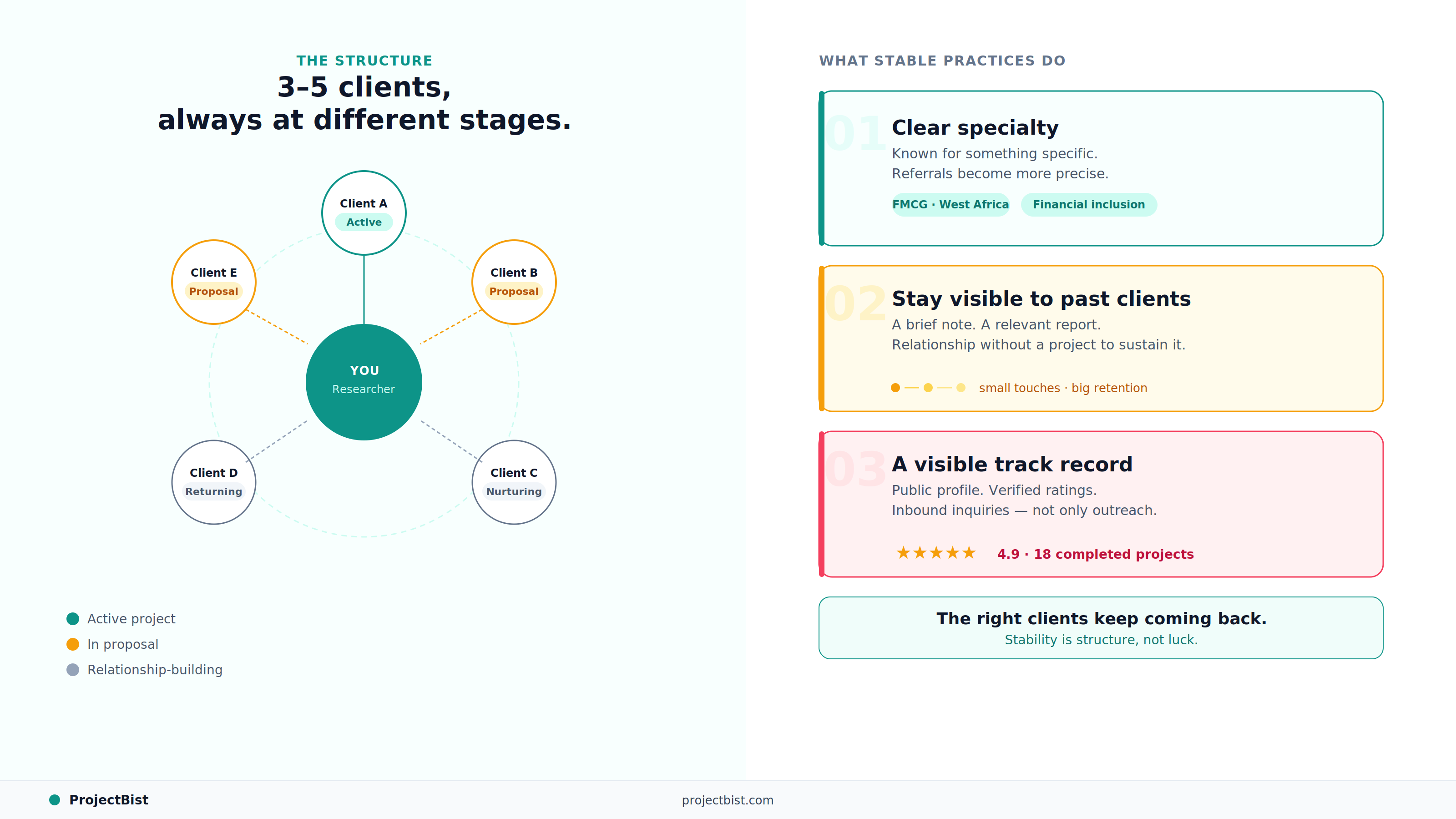
Research projects are inherently episodic. A client commissions a study, you deliver it, and then there is a gap before the next engagement. If your income depends entirely on project fees, it will follow that episodic pattern exactly: feast when projects are active, lean when they are not.
Researchers who build stable independent practices interrupt that pattern deliberately. They do not wait for the project cycle to determine their income. They design around it.
Relying on a single major client is the most common risk in independent research. When that client's budget is cut, or when their internal champion moves to a different role, the income disappears almost entirely.
The researchers who weather these shifts maintain a spread of three to five clients at different stages: one active project, one in proposal, one in relationship-building. They are always filling the next slot while delivering on the current one.
Generalist research consulting is a difficult market position. The researchers who consistently win work are known for something specific: FMCG consumer research in West Africa. Financial inclusion research in East Africa. Government program evaluation. Agricultural baseline studies.
Specialization makes referrals more specific and proposals more credible. A client with an FMCG study does not need to evaluate your full breadth of experience. They just need to see that you have done this type of work before.
Most research clients work with the same researcher again if the first project went well and the researcher stays in their awareness. The problem is that researchers often deliver a project and then disappear until they need work again.
Researchers who retain clients tend to stay in contact. Not aggressively. A brief update email when they see something relevant to the client's sector. A note when a report is published that touches on their work. These small touches maintain the relationship without requiring a project to sustain it.
This one is structural rather than behavioral. Researchers who have a public profile, with documented past projects, methodology specialization, and client ratings, get found without actively hunting for every opportunity. ProjectBist is built specifically for this: researchers who complete their profiles and collect ratings from completed engagements start receiving inbound inquiries rather than only winning work through active outreach.
The most stable independent research practices are not the ones with the most clients. They are the ones where the right clients keep coming back.
One of the most common mistakes independent researchers make is underpricing to win the first engagement with a new client. The logic is that a lower rate gets you in the door, and you can raise it later.
In practice, the rate you charge in the first engagement sets an anchor for every subsequent one. It is very difficult to raise rates significantly with an existing client. Price to what the work is actually worth from the beginning, or negotiate an explicitly time-limited introductory rate that both parties understand will change.
How many active clients should an independent researcher aim for at any one time?
Three to five is the range most sustainable independent practices target. Fewer than three creates significant income risk if one client pauses or exits. More than five tends to compromise quality and makes it harder to stay responsive to each client relationship. The number also depends on project size: if you primarily work on large multi-month studies, two active clients plus one in proposal may be the right balance.
When is the right time to raise rates with an existing client?
The most natural points are at the start of a new contract cycle, when taking on a project that is meaningfully more complex than previous work, or annually where you have a standing relationship. Framing matters. Rather than presenting it as a rate increase, frame it in terms of the scope or value of the engagement: this project involves additional complexity that the previous rate did not account for. Avoid applying a new rate mid-project without prior agreement.
What is the most effective way to stay in contact with past clients without being intrusive?
Low-effort, genuinely relevant touchpoints work best. Sending a brief note when a policy, report, or sector development is relevant to the client's work costs you almost nothing and keeps you in their awareness without requiring an active project to sustain the relationship. A check-in every two to three months is generally well-received. The key is that the contact has to offer something: a relevant observation, a useful link, a brief update. An email whose only purpose is to ask for work is transparent and usually counterproductive.
Is it better to specialize early or build a generalist track record first?
Building some breadth early is reasonable because it helps you identify where your strongest work and most natural client relationships lie. But deliberate specialization should come early rather than late. A generalist positioning becomes harder to change the longer it persists. Most independent researchers who build strong practices settle into a primary specialty within two to three years and use it as the center of gravity for their client development and profile building.
ProjectBist gives independent researchers a verified professional presence that works even when you are not actively pitching.
Create Your Free Profilearrow_forwardNewsletter
Personalize your updates! Subscribe to ProjectBist's Newsletter and choose from the following categories.
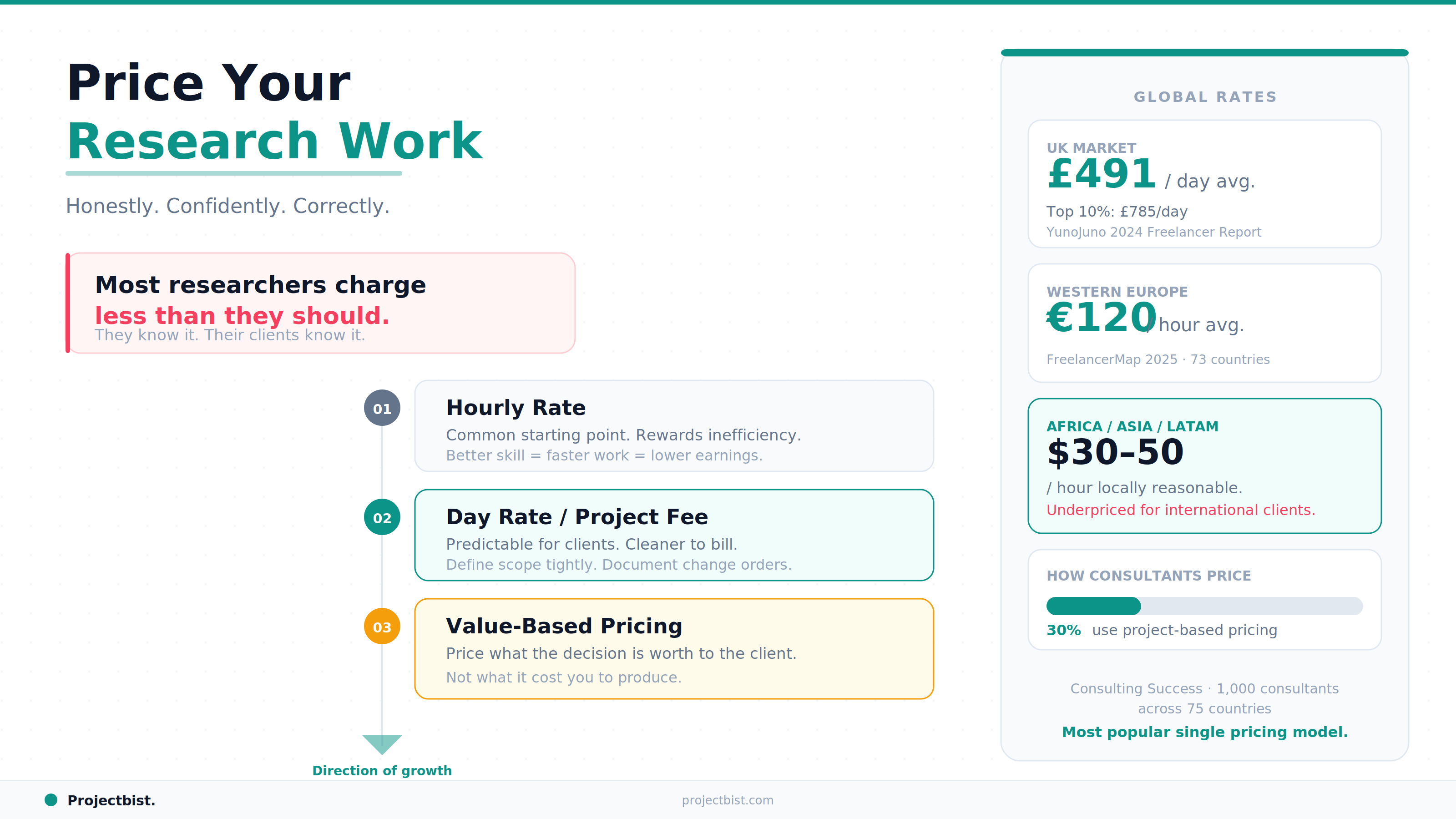
How to Price Your Research Consulting Services: The Honest Guide for Independent Researchers Globally
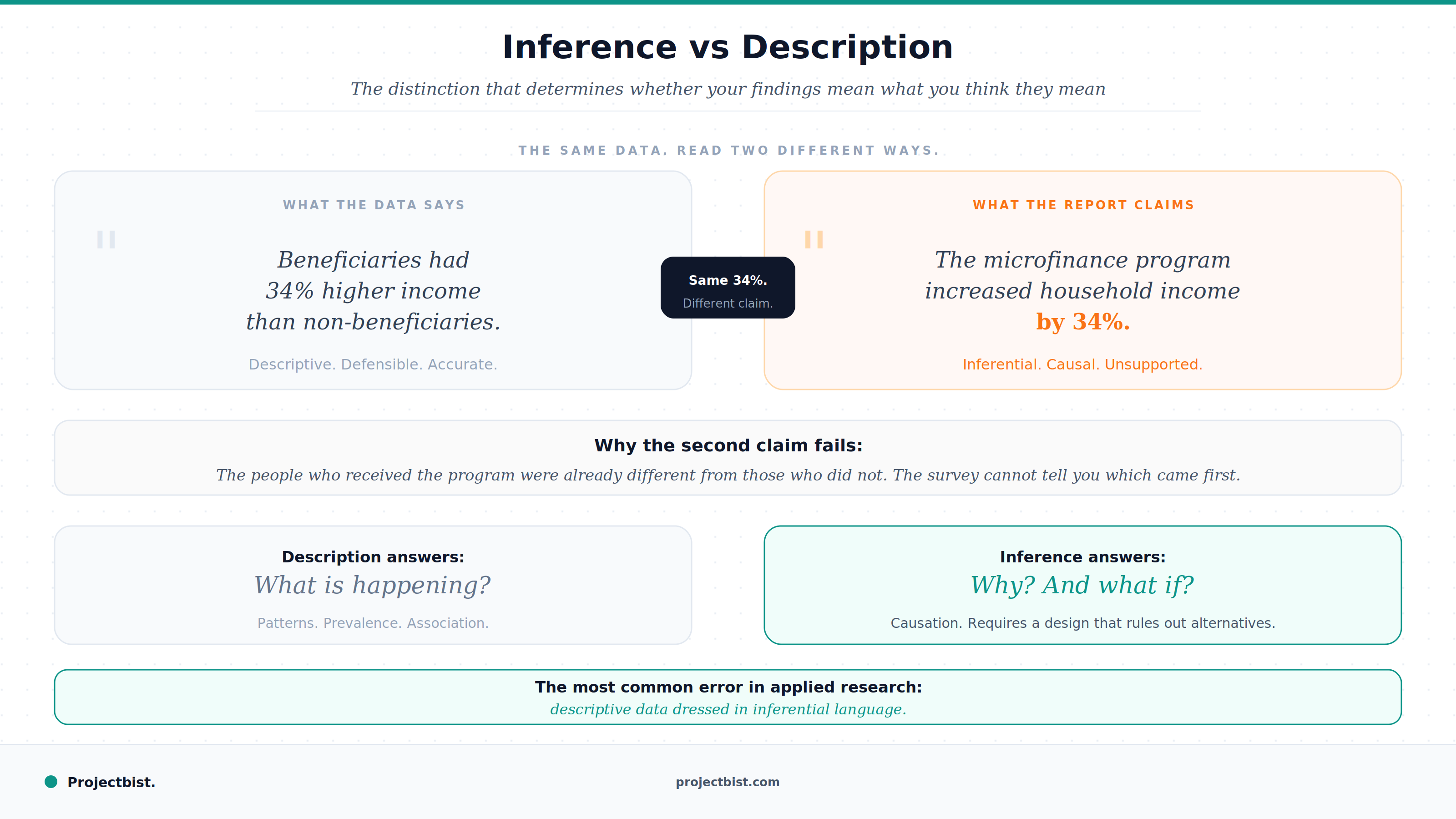
Inference vs Description: The Distinction That Quietly Determines Whether Your Research Findings Mean What You Think They Mean

Time Use Surveys: The Research Method That Makes Invisible Work Visible