P
Loading blog...
Loading blog...
It is not just the budget that suffers when the wrong person is on a project.
Samir Haddad
Mar 30, 2026•4 min read
The project ended. The report came in. And three weeks later, the team realized they still could not answer the question that started the whole thing.
That is not a rare story. It happens more often than clients talk about, and the cost of it runs deeper than most people stop to calculate.
A bad research engagement has three layers of cost, and most clients only see the first one.
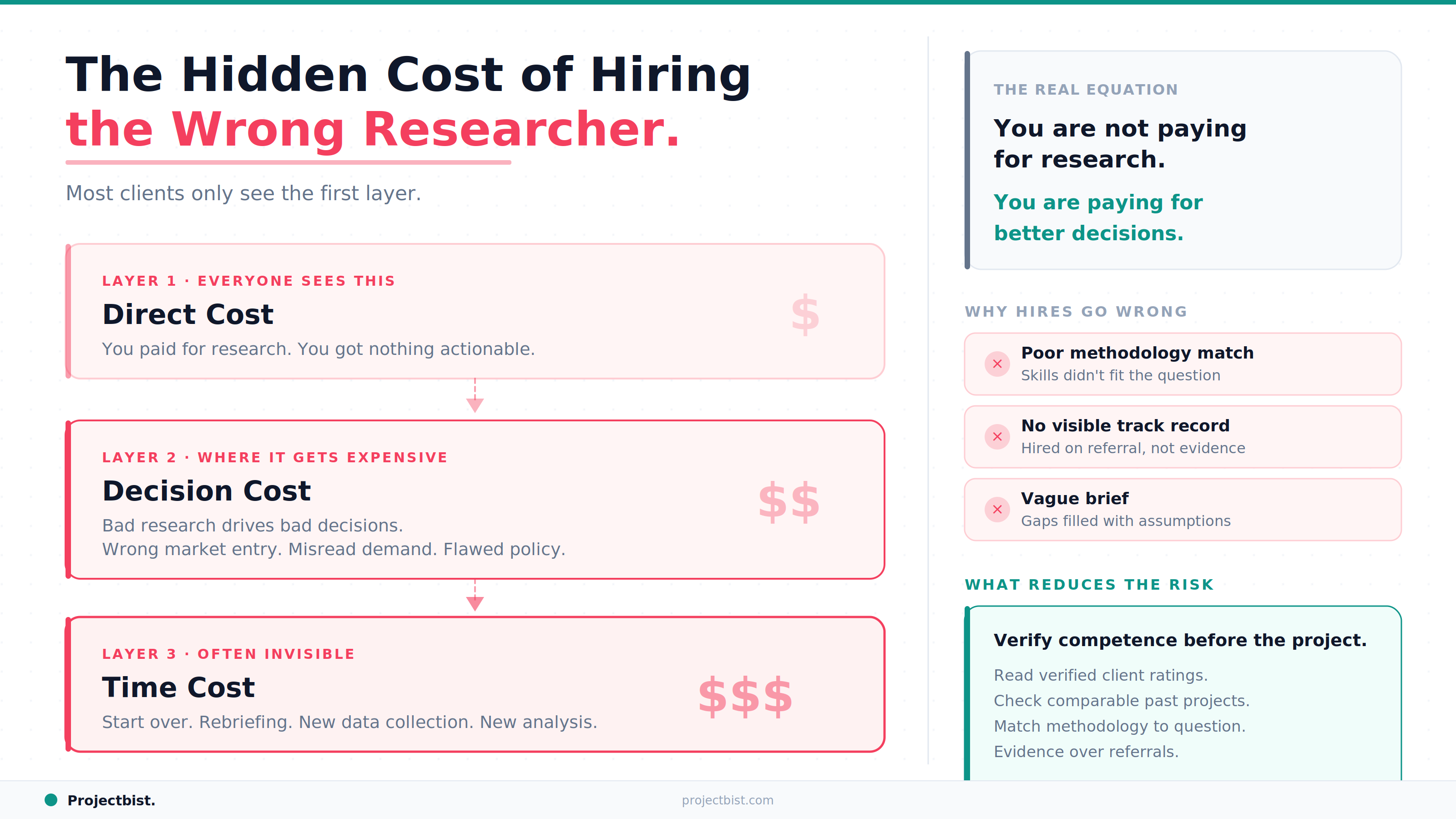
This is the one everyone sees. You paid for the research. The data is not reliable, the methodology was not fit for the question, or the sample was too small to tell you anything meaningful. The money is gone, and you have nothing actionable to show for it.
Depending on the size of the project, this can range from a few thousand dollars to significantly more. But this is also the smallest part of the damage.
This is where it gets expensive. Research is not a product. It is an input into a decision. When the research is bad, the decision that relies on it is also compromised.
A market entry decision based on flawed consumer data. A product launch timed incorrectly because the demand signal was misread. A policy recommendation built on a sample that did not reflect the target population. These decisions each carry consequences that can be many times larger than the cost of the original research.
McKinsey research consistently shows that organizations making decisions with poor underlying data underperform those with high-quality data inputs by a significant margin, not because of bad strategy but because of bad information.
You are not paying for research. You are paying for better decisions. When the research fails, it is the decisions that absorb the real cost.
Bad research has to be redone. And redoing it means starting the clock again: briefing a new researcher, waiting for new data collection, waiting for analysis. In fast-moving industries or time-sensitive projects, this delay is not a minor inconvenience. It is a strategic setback.
In some cases, by the time valid findings are available, the window for acting on them has already closed.
Most bad research hires are not the result of dishonest researchers. They happen when the match between the researcher and the project is poor, and neither side caught it early enough.
The best protection against a bad research hire is the ability to verify competence before the project starts. That means looking at past work, not just qualifications. It means reading client reviews from comparable projects. It means understanding the researcher's specific methodological experience, not just their general field.
This is the gap that platforms like ProjectBist exist to close: a verified profile with documented credentials, a rating trail from completed projects, and a clear picture of methodology specialization. It does not eliminate risk entirely, but it removes the biggest cause of bad hires, which is simply not having enough information to make a good decision.
The cheapest research is not the lowest quote. It is the research that produces findings you can actually use. Everything else is a cost disguised as a saving.
ProjectBist gives you the information you need before you commit
Browse Verified Researchersarrow_forwardNewsletter
Personalize your updates! Subscribe to ProjectBist's Newsletter and choose from the following categories.
How to Price Your Research Consulting Services: The Honest Guide for Independent Researchers Globally
Inference vs Description: The Distinction That Quietly Determines Whether Your Research Findings Mean What You Think They Mean

Time Use Surveys: The Research Method That Makes Invisible Work Visible