P
Loading blog...
Loading blog...
Public sector research operates under accountability, ethics, and reporting standards that most commercial research does not. That changes everything about how it is designed.
Jordan Blake
Apr 08, 2026•3 min read
Government agencies do not commission research the same way a private company does. The process is more formal, the reporting requirements are more detailed, the ethics standards are more stringent, and the audience for the findings extends well beyond the commissioning organization.
Researchers who approach a government tender with the same proposal they would use for a corporate client typically do not win it. And if they do, they often discover that the deliverable requirements are far more demanding than they expected.
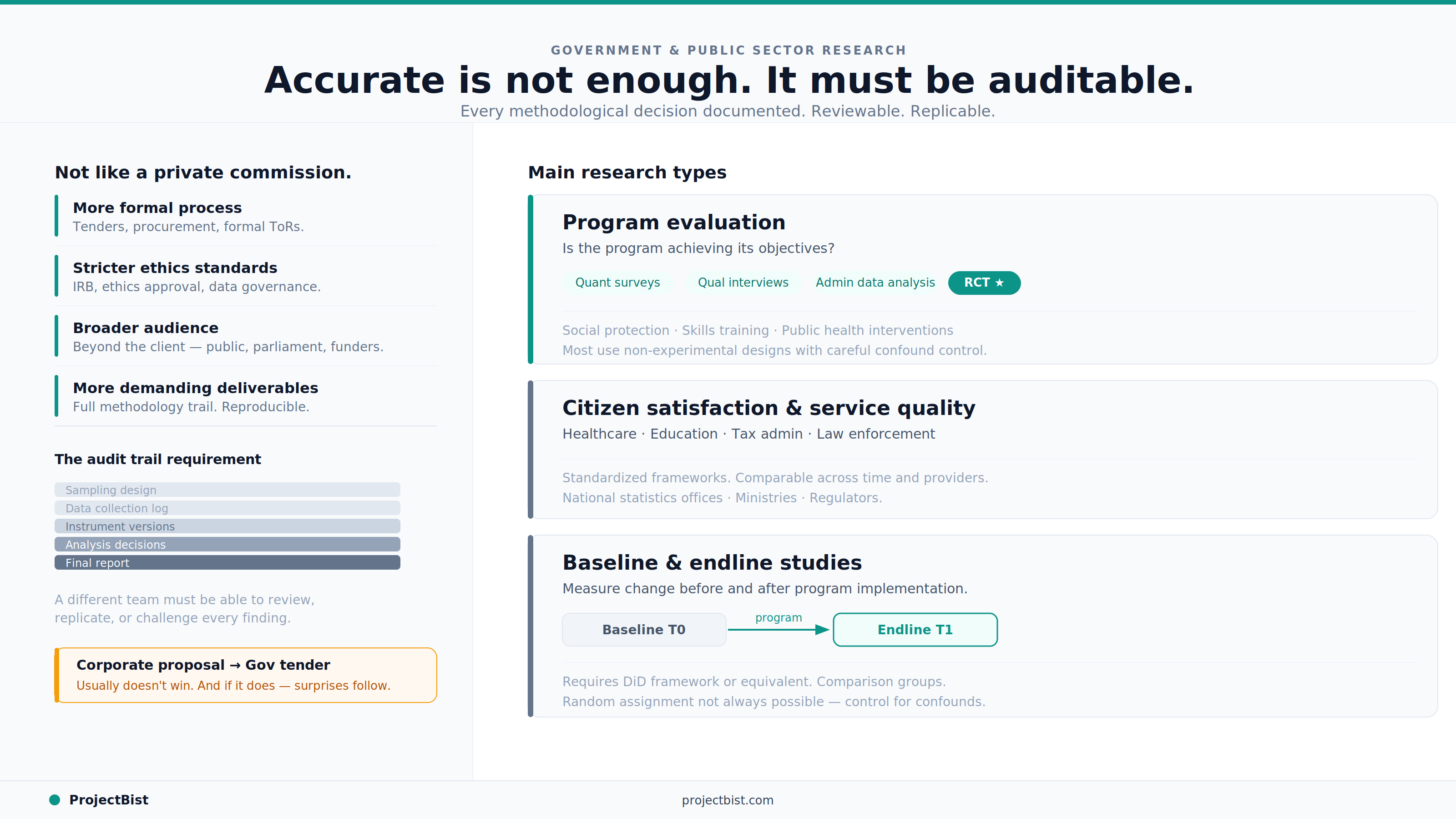
This is the most common type of government-commissioned research. An agency has been running a program — a social protection scheme, a skills training initiative, a public health intervention — and needs evidence on whether it is achieving its objectives.
Program evaluation typically involves a combination of quantitative surveys measuring outcomes, qualitative interviews with beneficiaries and implementers, administrative data analysis, and sometimes experimental or quasi-experimental designs to establish causality. The gold standard is a randomized controlled trial (RCT), but most government evaluations use non-experimental designs with careful control for confounding factors.
National statistics offices, ministries, and regulatory agencies regularly commission surveys measuring public satisfaction with government services: healthcare, education, tax administration, law enforcement. These studies use standardized measurement frameworks to allow comparisons across time and across service providers.
Development programs typically require a baseline study before implementation and an endline study after it to measure change. Researchers working on these studies need strong experience with the Difference-in-Differences (DiD) framework, or equivalent approaches, and a clear understanding of how comparison groups are selected when random assignment is not possible.
Government research does not just need to be accurate. It needs to be auditable. Every methodological decision needs to be documented well enough that a different team could review, replicate, or challenge the findings.
Researchers who have worked in government-commissioned research bring a combination of methodological skill and institutional knowledge that is genuinely difficult to replace. They know how to navigate ethics approval processes, how to write proposals that address public procurement criteria, how to work with government data systems, and how to present findings to policymakers who need actionable recommendations rather than academic discussions.
For researchers looking to enter this space, building documented experience through smaller government or development organization projects and collecting client ratings through platforms like ProjectBist is one of the most effective ways to signal the combination of skills and reliability that government clients are looking for.
Do I need special qualifications to do government research?
There are no universal qualification requirements, but many government tenders specify minimum requirements such as a master's degree in a relevant field, a minimum number of years of experience, or evidence of prior government-commissioned research. Review the specific tender requirements for each opportunity.
How long do government research projects typically take to complete?
Government research projects typically take longer than private sector equivalents at every stage: procurement can take months, ethics approval adds several weeks, and reporting requirements are more extensive. Build longer timelines into your proposals than you would for corporate clients.
Can an independent researcher bid for government contracts?
Yes, many government agencies actively seek individual consultants for specific research tasks. Competitive tendering processes typically have minimum experience and qualification thresholds, but independent researchers who meet those thresholds can bid directly or as part of a consortium with other researchers or firms.
Newsletter
Personalize your updates! Subscribe to ProjectBist's Newsletter and choose from the following categories.
How to Price Your Research Consulting Services: The Honest Guide for Independent Researchers Globally
Inference vs Description: The Distinction That Quietly Determines Whether Your Research Findings Mean What You Think They Mean

Time Use Surveys: The Research Method That Makes Invisible Work Visible