P
Loading blog...
Loading blog...
Research methods that analyze what people say are common. Discourse analysis goes further: it examines how and why they say it, and what power structures shape the saying.
Sofia Alvarez
May 27, 2026•4 min read
A government report describes beneficiaries of a social protection program as 'vulnerable populations requiring assistance.' An advocacy report about the same people describes them as 'rights-holders denied access to services they are entitled to.'
The people being described are identical. The words used to describe them are not. And the difference in language is not semantic coincidence: it reflects different assumptions about causality, different models of the state's role, and different theories of what kind of change is possible.
Discourse analysis is the research method that takes language like this seriously as data. Not just as a vehicle for information, but as evidence of how power operates, how social categories are constructed, and what kinds of things can and cannot be said in a given context.
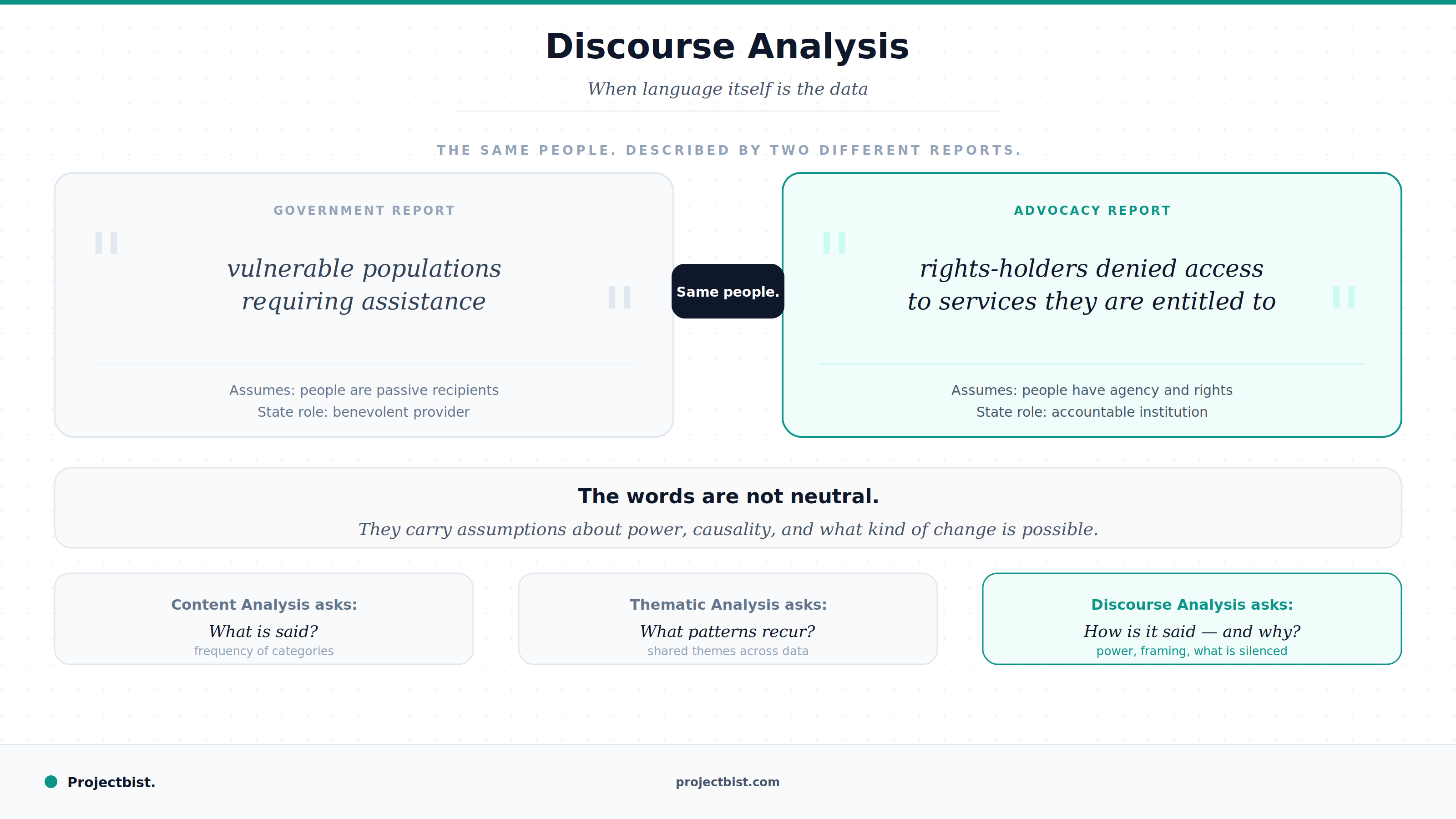
Discourse analysis studies language in its social context. It goes beyond content analysis (which counts what is present in a text) to examine how language works: how it creates meaning, who has the authority to speak, what assumptions are embedded in particular ways of describing the world, and how those assumptions shape what is thinkable and doable.
The field is not monolithic. There are at least three distinct approaches that researchers commonly use:
Examines how meaning is constructed in real-time conversation and interaction. Studies how people negotiate understanding in dialogue, how turns are taken and controlled, and how agreement and disagreement are managed. Commonly applied in healthcare communication research, workplace interaction studies, and interview methodology research.
Developed by Michael Halliday, SFL treats language as a system of meaning-making choices that simultaneously represent the world, enact social relationships, and organize text coherently. Applied in educational research, organizational communication, and media analysis.
The most politically oriented approach, associated with Norman Fairclough and Teun van Dijk. CDA examines how language reproduces and challenges relations of power and ideology. It is explicitly analytical and critical: it assumes that language choices are not neutral but reflect and reinforce power structures. Used extensively in policy research, media studies, and political analysis.
The question discourse analysis is always asking is: who gets to define the terms, and whose reality is made invisible by that definition?
Content analysis asks: what categories of content are present, and how frequently? It is primarily quantitative and concerned with what is said.
Thematic analysis asks: what patterns of meaning recur across a qualitative dataset? It is concerned with identifying shared themes in what people say.
Discourse analysis asks: how does language work to construct this particular version of reality? What is being assumed rather than stated? What is being silenced or made unspeakable? It is concerned with how something is said and what that reveals about context and power.
There is no single standard protocol for discourse analysis: it is interpretive and requires sustained engagement with the texts being analyzed. At minimum, a DA study should: clearly articulate the theoretical framework being used (which DA approach, and why), show the analytical process transparently (not just conclusions but the evidence trail from text to interpretation), address reflexivity (how does the researcher's position shape what they see in the data?), and engage with alternative interpretations (what else could this language be doing?).
Newsletter
Personalize your updates! Subscribe to ProjectBist's Newsletter and choose from the following categories.
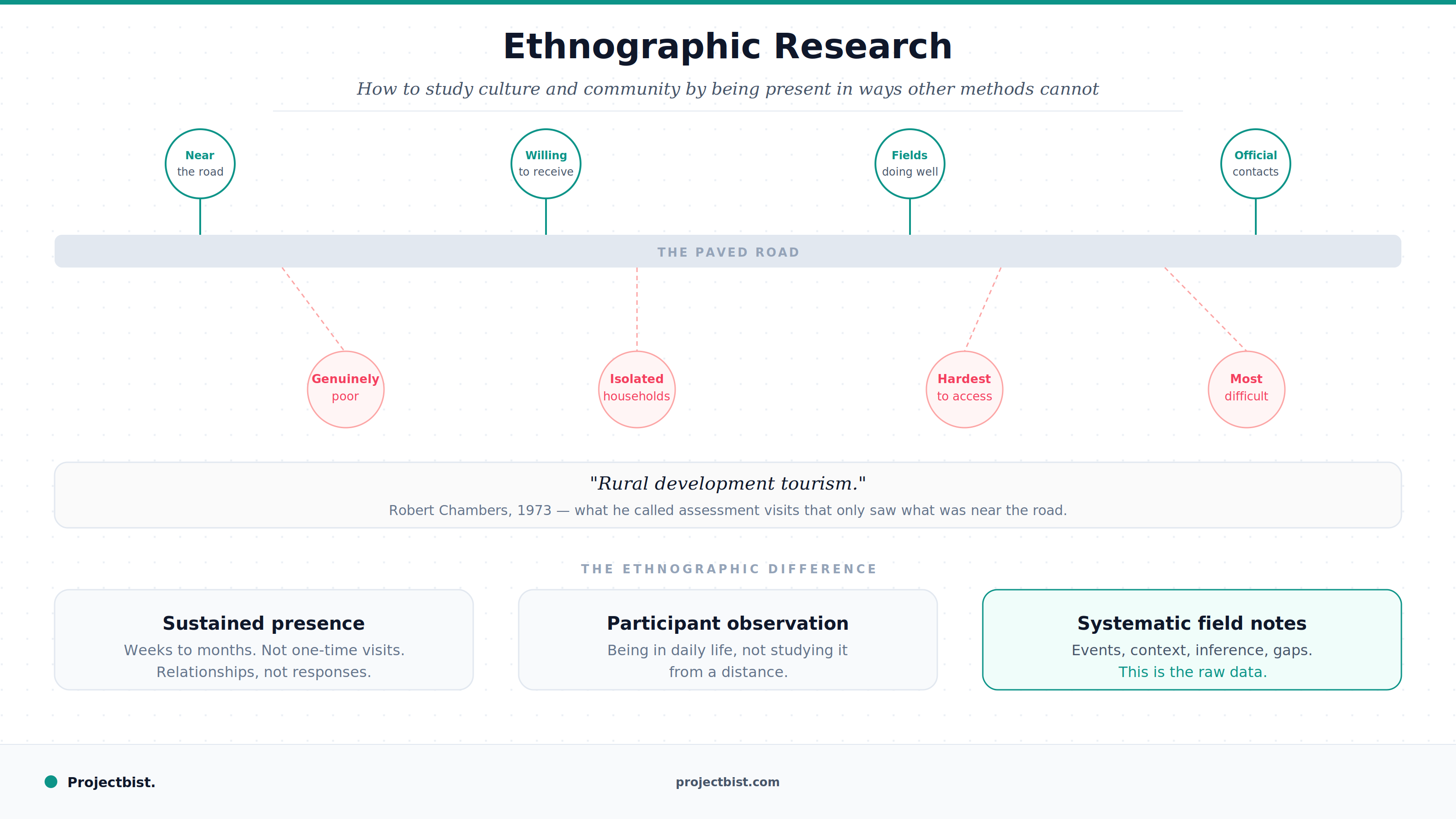
Ethnographic Research: How to Study Culture and Community by Being Present in Ways Other Methods Cannot
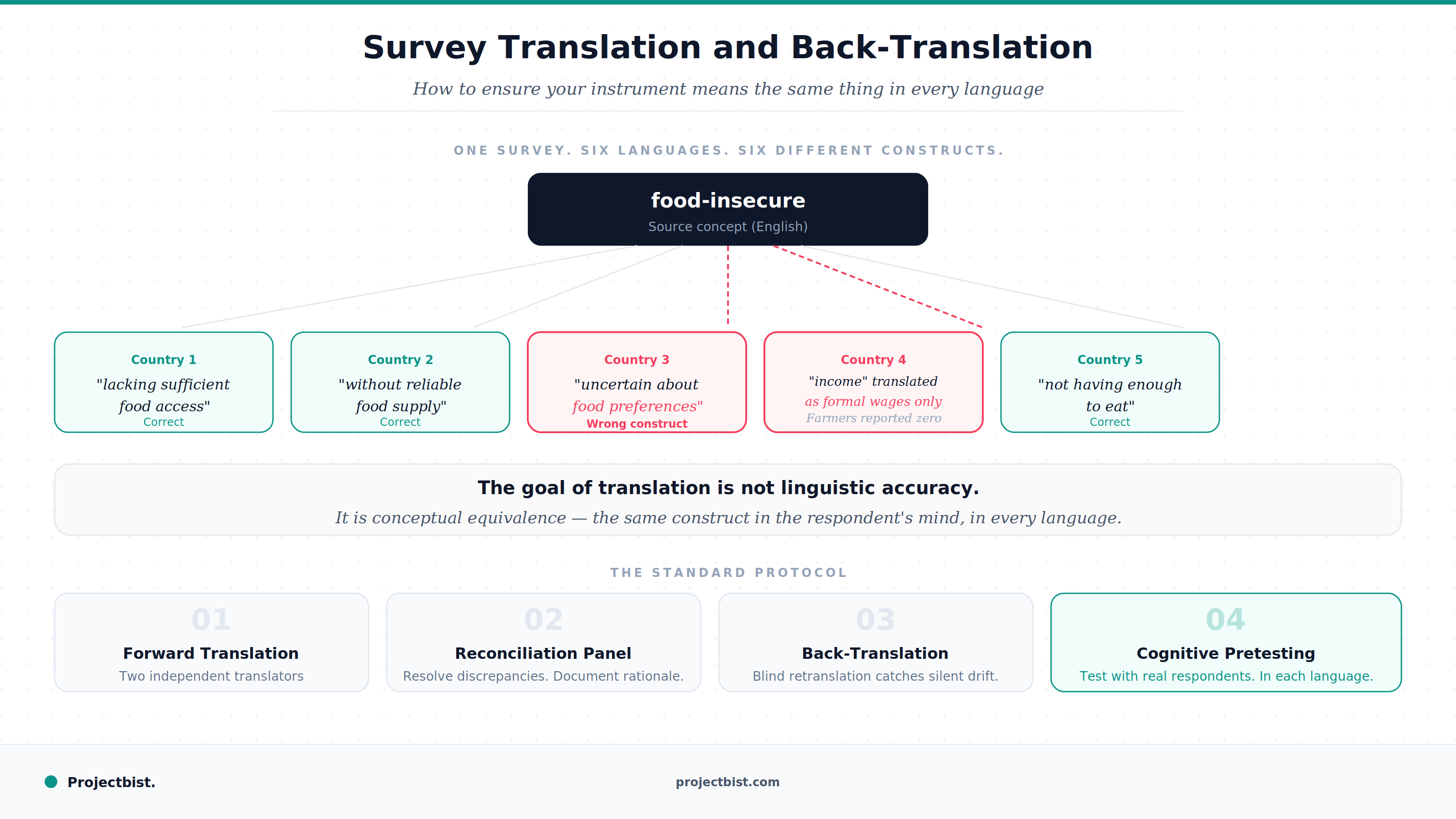
Survey Translation and Back-Translation: How to Ensure Your Instrument Means the Same Thing in Every Language
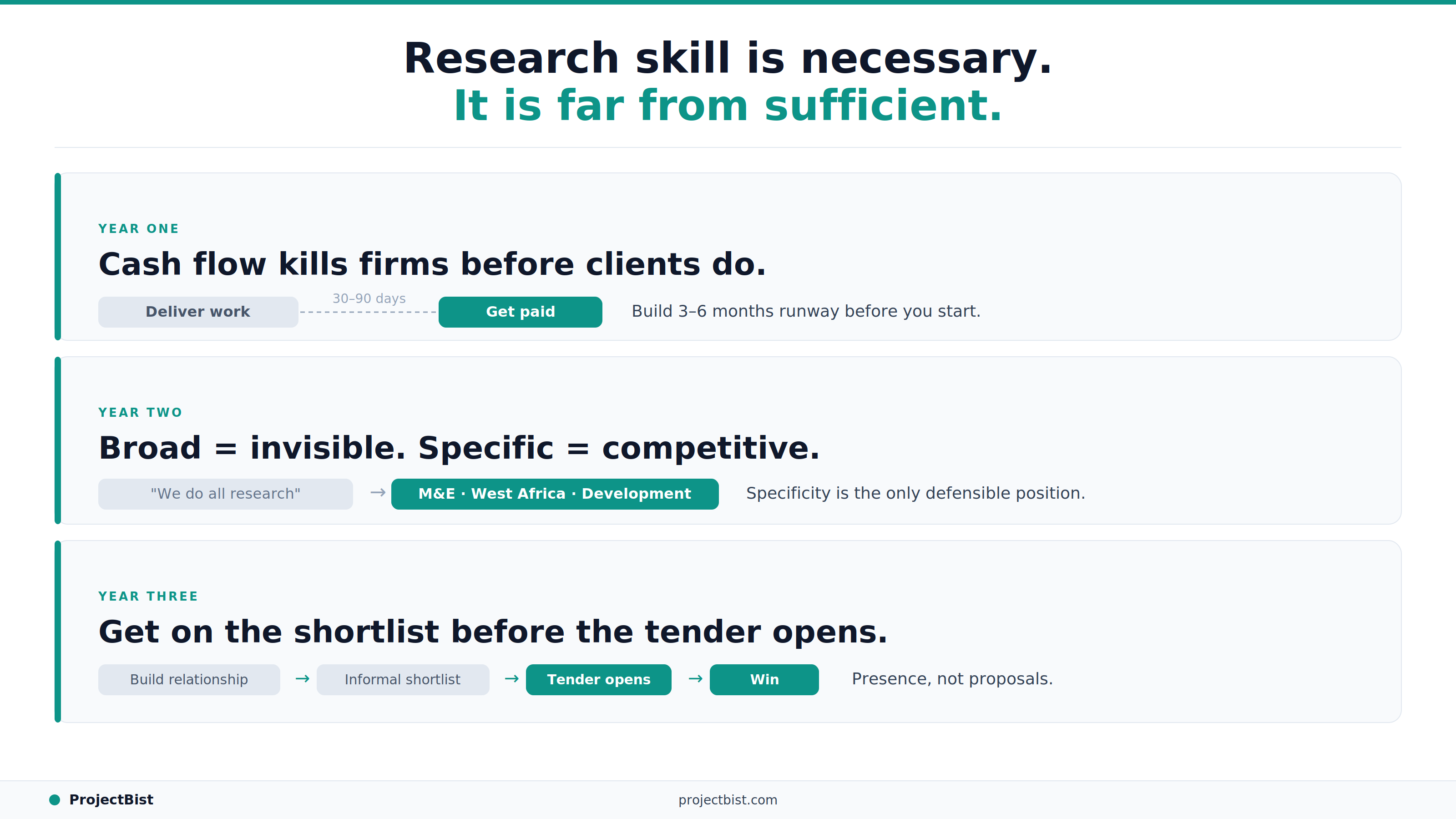
How to Build a Research Firm From Scratch: What the First Three Years Actually Require