P
Loading blog...
Loading blog...
Agriculture is one of the most important and most methodologically demanding sectors to research. Here is what working in this space actually requires.
Ravi Menon
Apr 15, 2026•4 min read
Agricultural research is one of the most consequential research domains in the world. Studies on smallholder farmer income, food security, technology adoption, and market access directly influence policy decisions, development funding allocations, and the commercial strategies of input companies, processors, and buyers operating across global food supply chains.
It is also one of the most methodologically demanding sectors to research correctly. The combination of seasonal timing constraints, rural accessibility challenges, subsistence mixed-income households, and the physical nature of agricultural production creates conditions that standard consumer or development research approaches do not fully address.
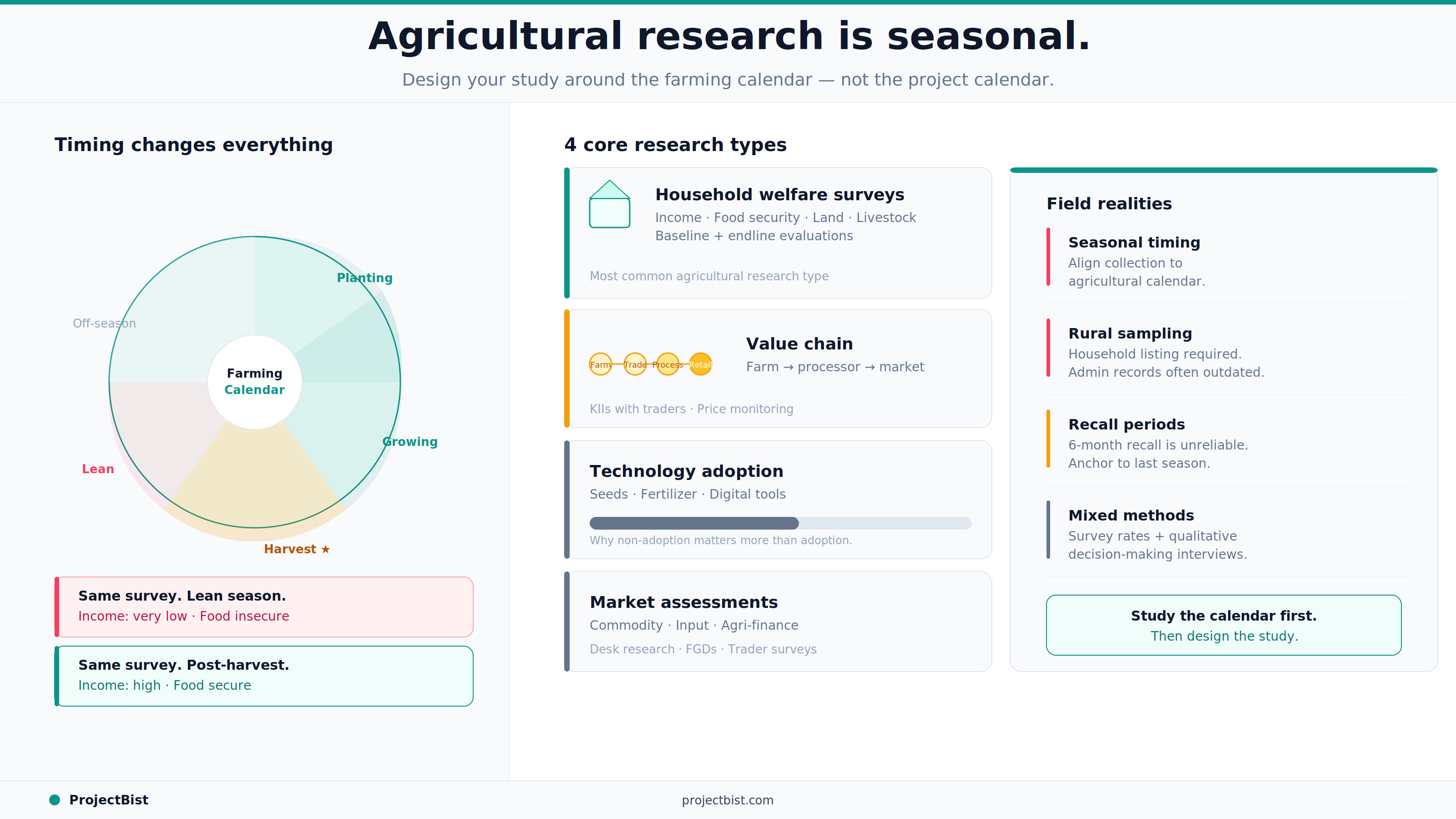
The most common agricultural research type. These surveys assess farm household income, food security status, land holdings, livestock assets, access to inputs, and welfare indicators. They are the backbone of development program baselines, endline evaluations, and national agricultural statistics.
Key methodological consideration: farming income is highly seasonal. A survey conducted in the lean season will produce very different income estimates than one conducted post-harvest. Researchers need to either control for timing or conduct multi-visit surveys that capture different seasons.
Value chain studies trace the path of an agricultural product from production through processing, distribution, and retail, mapping the actors at each stage, the value they add, the margins they capture, and the constraints that limit the chain's efficiency. Methods include key informant interviews with traders, processors, and input suppliers; trader surveys; price monitoring; and sometimes experimental designs testing information or market interventions.
Studies measuring whether and why farmers adopt new seeds, fertilizer types, irrigation practices, or digital tools. These studies are methodologically challenging because adoption is a process, not an event, and the reasons for non-adoption are often more informative than the reasons for adoption. Mixed methods approaches, combining survey data on adoption rates with qualitative interviews on decision-making, produce the most actionable findings.
Market intelligence studies for commodity markets, input supply chains, financial services targeting farmers, or agricultural technology products. These use a combination of secondary desk research, focus groups with farmer segments, trader interviews, and quantitative surveys.
This is the most frequently underestimated consideration in agricultural research. Income, food security status, time availability, and even psychological state vary dramatically by season for farming households. Recall periods in surveys must be defined carefully: asking a farmer to recall income from six months ago is less reliable than asking about the most recent planting season. Whenever possible, align data collection timing with the agricultural calendar of the study area, not the project management calendar.
Rural agricultural populations present sampling challenges that urban studies do not. Household listing exercises are often required before sample selection because administrative records in rural areas are frequently outdated or incomplete. Random route sampling and probability-proportional-to-size sampling are common approaches, but both require familiarity with local community structures and mapping.
Is the unit of analysis the household, the farm plot, the individual farmer, or the farming enterprise? These are not always the same thing, and the decision has significant implications for questionnaire design, sampling, and analysis. A household with two plots farmed by different family members under different tenure arrangements requires a different data structure than a single-farmer single-plot study.
Agricultural research done by someone unfamiliar with the sector typically produces technically clean data that answers the wrong questions. Sector knowledge is not optional in this field.
ProjectBist profiles show sector specialization. Search specifically for agricultural research professionals.
Search Agricultural Researchersarrow_forwardNewsletter
Personalize your updates! Subscribe to ProjectBist's Newsletter and choose from the following categories.
Ethnographic Research: How to Study Culture and Community by Being Present in Ways Other Methods Cannot
Survey Translation and Back-Translation: How to Ensure Your Instrument Means the Same Thing in Every Language
How to Build a Research Firm From Scratch: What the First Three Years Actually Require